
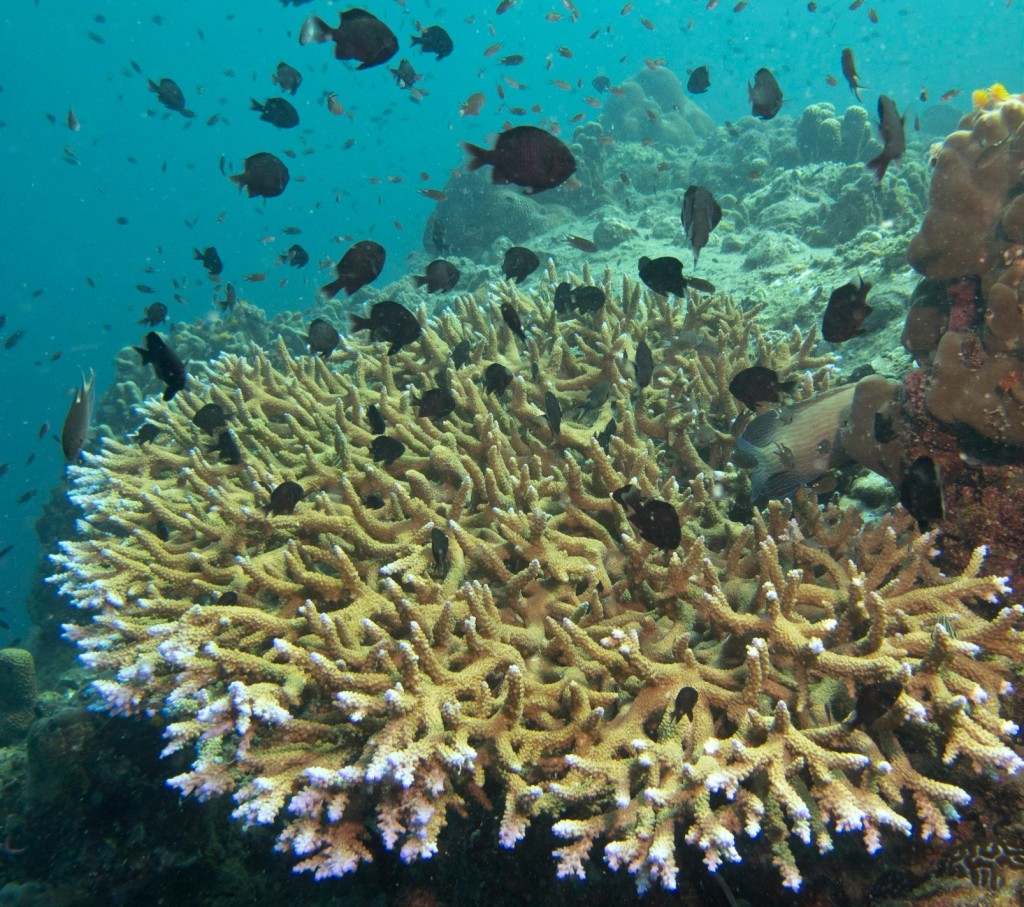
Photograph by Lucienne Shenfield – Coral in Thailand showing signs of distress due to coral bleaching.
“The ocean is at its best today.” It was hard to believe how this sentence which, on the surface, seemed so optimistic, could be so depressing.
An individual’s engagement with creation is inherently personal. For some, the idea of creation is deeply embedded in religion, art, science or politics. For me, creation is felt when I sense the existence of something more profound than my own being.
The first time I went scuba diving I was intensely fearful, unwilling to trust the breathing apparatus or my ability to remain safe underwater. In spite of this, it remains one of the most important experiences of my life. I became aware of the magnificent structures and the enormous amount of life that had been created in this space which I had, relatively speaking, once presumed empty. I couldn’t believe that something so enormous could be hidden beneath the surface, a secret preserved exclusively for those who venture deeper. I loved everything about it: the beauty, the sense of adventure and discovery, all in a weightless world where real life seemed far away and trivial.
Today climate change and marine conservation are becoming increasingly prevalent issues in scientific debate, the media, and everyday life. Those who choose to address this issue do so in a number of ways. Two common approaches are scientific research, and political activism. A great example of the latter is the “Raise the Heat” campaign, run collaboratively by the Australian Youth Climate Coalition and 350.org. This campaign was designed to encourage The Commonwealth Bank to pledge not to finance Adani’s Carmichael Coal Mine, set to cause immeasurable and irreversible damage to The Great Barrier Reef.
Ten months after I first tried scuba diving I had obtained a professional accreditation and was working as a diver, taking people diving, sometimes for the first time. Being able to introduce people to the ocean was a privilege. I saw fear transform into awe just as it had for me, and I enjoyed being a part of that process. Through diving I felt engaged and connected with life, like I was bridging a gap between naïveté and understanding. I saw creatures I never knew existed. I watched cuttlefish change colour to communicate; I learned about colourful butterfly fish who swim in pairs, and how they mate for life.
It was during this time that I had a conversation with one of the instructors at the dive center. His name was Matthieu, and although France was his country of origin it hadn’t been his home in years. The minimum age for diving is eight, but Matthieu’s father, an instructor, had ignored this limit and had taken him diving anyway. Matthieu said he couldn’t remember a time before he had been diving.
For artists, writers and others, creation involves the production of something that didn’t exist before. This perfectly encapsulated how I felt about diving. Although we were visiting the same places no two dives were ever the same, and the sites would exist brand new every day, as if reborn. I had a desire to capture this. To create memories for people who couldn’t experience it first hand. After some time working I was fortunate enough to land a job as an underwater videographer.
My conversation with Matthieu took place in the bar above the dive centre one afternoon. Our working day was over and we were relaxing. Although he was young he had been diving for longer than most other instructors at the shop, and so I had been asking him about how diving had changed over the years.
“I mean, it sucks to say, but the diving now… it’s shit.” He said casually.
This was something I was used to hearing, and it majorly irked me. People who had been diving for years frequently made this call. I knew what was coming: romantic descriptions of underwater scenes, fish everywhere and endless corals. But to me diving was perfect, and I found any notion that it might once have been better unfathomable. I didn’t like to think about everything I had missed.
Twelve months ago, when I returned from my life on the island, my hair was lighter and my skin was darker than it ever had been before. I was happy. I felt motivated to pursue my studies in psychology. I settled back into student life and would daydream about scuba diving while watching diving videos on YouTube.
It surprised me when Matthieu didn’t describe the oceans of the past. He didn’t offer elaborate accounts of abundant fish species now dwindling in numbers. Instead he said, “But you know, the ocean is at its best today.” And somehow this was even harder to hear.
I took my new job as a videographer seriously. I was determined to do a good job for my customers. I spent months watching footage shot by Nico, a former videographer at the shop who I had met briefly and idolised. Nico’s skill was flawless. He appeared to have boundless intuition when it came to marine life and its movements. Fortunately, the shop had archived many of Nico’s videos, so I was able to review hours of footage. He had worked at the shop for about five years. As I worked my way back in time I was able to see how much the diving in the area had changed.
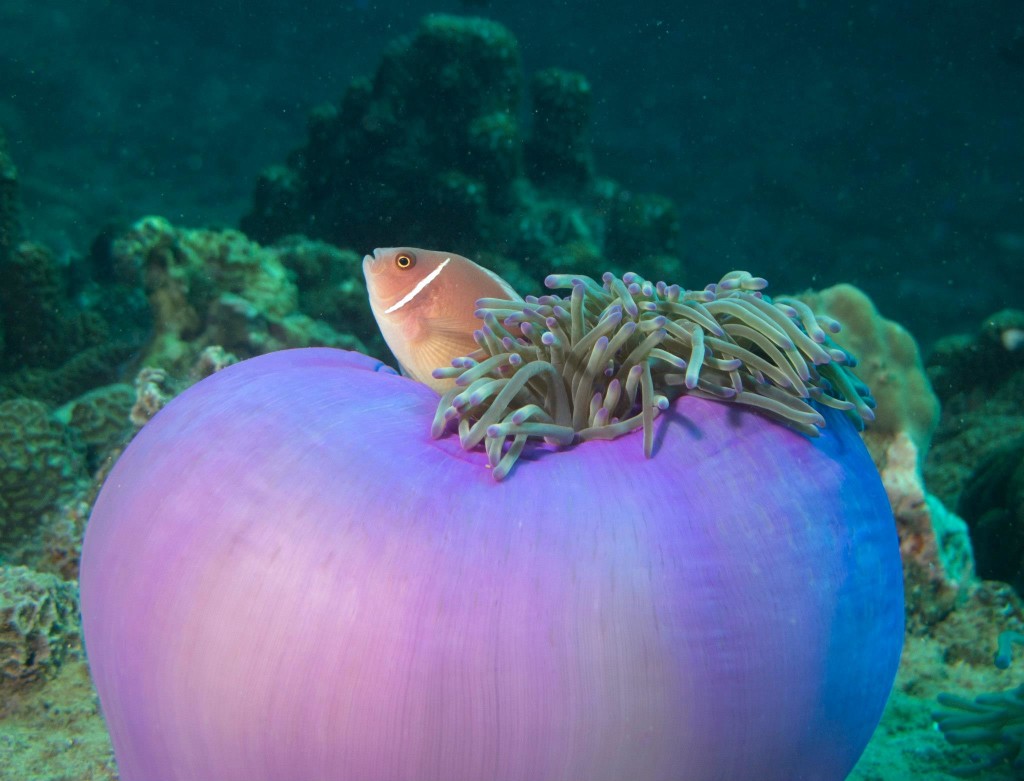
“You see, the way the world is going, the ocean will never, ever be this good again.” Matthieu explained, “The animals that we see there now? One day we will be describing them, explaining what used to be here, and why they’re all gone.” For me this eerily echoed the state of the Leopard Sharks, once a feature of the island. I had heard stories about how divers used to see five or more on every dive. I had recently gone one hundred dives without seeing a single one.* I instantly thought of the turtles I had made friends with. Suddenly they seemed vulnerable.
While on campus this year I attended an action for the Raise The Heat campaign. It happened by circumstance: right place, right time, I knew some people who were going to be there. Later that week I went with my family to another action. I supported the cause, of course, but am not typically the kind of person to get involved in political protests. I was impressed by all of the people who were there, standing in the cold on a Canberra morning. It was my first winter in 3 years. They were handing out t-shirts which some people opted to wear under MacPacs and Kathmandu jackets.
“This is why it is so important that we dive, every day,” Matthieu continued, “Because the ocean is at its best today. In your life, this is the best that it will ever be.”
One day shortly after I began filming, my boss, James, came to watch some of my footage. It was the first time he had done this and it made me tense. “You’ve got great composition” he said, and I could tell that he meant it. James ran the shop, but he didn’t dive anymore. He watched my footage for another few minutes, affording me feedback, mostly compliments.
After some time he said “I’m sorry, I can’t watch anymore. It’s just too hard to see. The corals are in such bad shape, everything’s dead. All I can see is what used to be there… Your work’s great though” he said as he walked away.
In 2004, the Boxing Day tsunami took 230,000 lives and caused massive structural damage to affected areas. Due to the gravity of this event it is understandable that these were the primary facts reported. But under water a different kind of wave had hit. With extreme force all of the debris that had been picked up by the wave now trawled through the water. Corals strong enough to withstand the wave on its way in were brittle and weak in comparison to the debris that churned through the water.
During one of my classes this semester our professor asked us “What do you think humans are best at?” My peers answered enthusiastically, dutifully noting all of the things that we, as humans, are good at: language, meta-cognition, creation, etcetera. We build huge buildings, and fill them with books full of knowledge which we understand and communicate to one and other. I raised my hand. “I disagree” I said, “I think we’re best at destruction. We destroy everything.” My professor politely agreed with me, but acknowledged that it wasn’t really the answer he was expecting or looking for.
Greg, the manager of the dive centre I worked for had been diving at the time of the tsunami. He didn’t seem to like to talk about it very much, but he described the dive, remembering the strongest current he had ever felt. He spoke about surfacing to find nothing. The boat had been carried far away and when it returned the captain described in broken English the biggest wave he had ever seen. But it wasn’t until they returned to land that the enormity of what had once seemed like a strong current really hit. The island had been decimated. At this point Greg changed the subject abruptly and began to describe the best chocolate brownie that he had ever eaten. After a few minutes of describing the brownies he concluded,
“The woman who made them was killed in the tsunami” he said, “and no one on the island can make brownies as good as hers.”
By the end of my time on the island even the biggest schools of fish seemed smaller. It was painful to realise the difference in only one year. I think all the time about my conversation with Matthieu, and how it affected me. The plan had always been to take a gap year. I planned to travel overseas, but hadn’t anticipated that I would find diving and work in the sea. One gap year became two, but I always knew that I would have to return to my studies eventually. However I hadn’t anticipated the sense of loss that I would feel, because the ocean is at its best today, and I’m not there.
Recently I learned that the Commonwealth Bank has withdrawn from their agreement to act as financial advisors for the Adani coal mine. I felt proud for having possibly contributed to this, even in a small way. Up until this point I had seen coral reefs as an entity which had been created, but which was slowly dying. By helping I felt, for the first time, that I was contributing to restoration, in essence to the re-creation, of the ocean.
We tend to see the fate of the ocean, and the whole planet, as being on a trajectory towards an inevitable, horrible fate. But the oceans are at their best today. It may not be what it once was, but it’s not gone yet, and we still have something to save.
*For more information about Leopard Sharks and conservation efforts focused on helping Leopard Sharks please see Spot The Leopard Shark Thailand’s Facebook Page.
demos journal acknowledges the Ngambri and Ngunnawal people on whose lands this journal is made and imagined. Sovereignty of these lands was never ceded. Always Was Always Will Be Aboriginal Land.
Web Design by Rio Ramintas
Build by Charlotte McLachlan
demos journal © 2026. All Rights Reserved.


