
Photo: Robert Hall
The 1960s, student activism and the Vietnam War conjure images of protest, change and radicalism. At the time, radical Australian students were referred to by politicians as ‘political bikies who pack-rape democracy’ (Billy Snedden, 1970) and have since been referred to as a ‘whole youth generation who were edgy, who directly confronted the dominant mainstream with demands for change’ (Simon Marginson, 2005). But what about Canberra? How did students at ANU protest Australia’s involvement in the Vietnam War? In the late 1960s and early 1970s, Canberra and ANU were both small and relatively newly established. ANU had a small undergraduate population and was dominated by older, part-time students, as well as the children of public servants. Canberra also lacked the union presence that contributed to demonstrations and stop work actions in Melbourne, and was full of government employees who were less likely to vocalise their dissent or to strike. Given this, it is not surprising that student protest in Canberra was smaller than in other Australian capital cities. However, there was still dissent and protest from students who used a variety of protest methods that amplified their small numbers. From the ANUSA, Woroni and The Canberra Times archives a narrative emerges of a vocal minority of Canberra students who protested the Vietnam War. We should bear in mind that the archives of many smaller, more radical groups are kept privately and so the image is weighted towards institutions whose history is publicly recorded.
ANU Students’ Association
On the whole, ANU Students’ Association (ANUSA) — the representative body for undergraduate students — kept itself removed from politics and the debate over the Vietnam War. However, with a new Student Representative Council (SRC) elected each year, ANUSA’s position was far from static. An ‘anonymous’ contributor to the 1967 Current Affairs Bulletin, who was known to be UNSW student Richard Walsh, wrote that due to its location ANU ‘might well have been expected to prove the most dynamic and involved campus in the country,’ but ‘undergraduate life is distinguished by its apathy, conservatism and indifference to national causes’ (Foster & Varghese, 2009, p212). The conservatism of ANUSA can be seen in a long running debate over whether the SRC should take a position on any political matters or hold itself independent. In May 1965, a motion for the SRC to condemn the sending of troops to Vietnam was lost as some thought the SRC was ‘not a competent body to issue dictums on student opinion’ and that the motion ‘set a dangerous precedent’ (ANU Archives: ANUA 331.15, SRC Minutes, 1965). The SRC decided instead to call a Special General Meeting to discuss the motion and later passed a motion declaring itself incompetent to decide ‘political questions in the name of the student body’ (ANUA 331.125, SRC Minutes 1965). In 1966 ANUSA conducted a survey of ANU students and found that their views generally mirrored the general population in supporting Australia’s involvement in Vietnam. 65 per cent of students, from a 20 per cent sample group, supported Australia’s military commitment to Vietnam, but only 32 per cent supported the sending of conscripts (ANUA 331.3.8.354).
The SRC was beleaguered by internal problems and infighting, even passing a motion to disband in 1971 — although this motion was later declared void (ANUA 331.5.17, President’s Report 1971). This affected their ability to carry out advocacy work as much of their focus was directed inward. During this time ANUSA campaigned for internal campus issues, including for a dentist on campus and a childcare centre (ANUA 331.1.15 15, SRC Minutes 1965). However, ANUSA also supported the establishment of the Aboriginal Tent Embassy in 1972 and campaigned for the first scholarships for Aboriginal students (Abschol) through the late 1960s, demonstrating that students were willing to engage with external, national issues as well as internal politics.
Changes in feeling toward Australia’s involvement in Vietnam in the general population were reflected within ANUSA. Towards the end of the 1960s ANUSA and ANU student activism increased. The 1969 Bulletin survey of university campuses ranked student activism from ‘frigid’ to ‘hot’. ANU was in the middle with a rating of ‘simmering steadily’ (Foster &Vaughan, 214). An example of this is the AGM of 1969 passing a motion declaring ANU a sanctuary for draft resisters, requiring ANU to provide accommodation and physical assistance to any men resisting conscription. While the motion passed at the AGM, it generated sufficient controversy for a student referendum to be called on the matter, where the motion was soundly defeated (ANUA 331. 3. 8 Minutes 1969). While ANUSA remained preoccupied with internal problems and were reluctant to speak on behalf of a diverse student population, active students gravitated to the ANU Labor Club.

ANU Labor Club and Vietnam Action Committee
There was a core of protest organisation in the ANU Labor Club. Labor students first mobilised at the Australian Labor Students Federation (ALSF) Conference, held in Canberra in May 1965. This led to one of the first student protests against the War, a sit-in on Alinga St which resulted in 15 students being arrested and fined £10 each (The Canberra Times, 1965, p4). In April 1966 the Vietnam Action Committee (VAC), with a membership of 50 students, was formed within the ANU Labor Club. Its aims were to ‘organise peaceful, educative protests’ and to ‘reprint important articles from overseas journals’ (ANUA 336, ANU Labor Club minutes, 1966). The VAC achieved its second aim with a campus newsletter, as well as publishing articles in the ANU Labor Club publication, The Crucible. Much of this organising was based in a nondescript house in Ainslie — 30 Canning Street. This house was a hub of activity for the ANU Labor Club and its many affiliate groups. For some time there were weekly Tuesday organising meetings at Canning Street and it was the contact address for many demonstration organisers.
Jack Waterford (Canberra Times, 2014) writes of the Canning Street house:
(It) housed at any one time between six and fifteen people, plus people crashing while travelling to and from Sydney or Melbourne. We had learned to silkscreen posters, and the house was the starting point for expeditions going out leafleting, postering or painting up the town – because of which, a police car was sometimes parked up the street, waiting for people to return home with incriminating materials, such as paint brushes.
Many students supported the efforts of the Labor Party in 1965 and 1966 as Arthur Calwell focused much of his campaign on Vietnam and conscription. However, after the Liberal Party won the 1966 election with an increased majority, many were demoralised and were reluctant to trust campaigns for change that used traditional tactics. This led to a splintering of groups and diversification of protest methods, with students engaging in non-compliance and action outside of traditional political structures.

Alternative Protest Groups
In the late 1960s new groups emerged on the ANU campus: the Draft Resisters Union, the Vietnam Day Moratorium Committee, the Conscientious Objectors Advisory Committee and Students for a Democratic Society (NAA, A61222). Perhaps unsurprisingly, few records from these groups are easily accessible. Much of their history lies outside of the public record. However, the limited mentions of the groups in ANUSA Minutes and Woroni articles suggest that they had limited numbers and influence on the general student population. Students groups were often aligned with the various philosophies of Maoists, Trotskyists or other splinter groups gaining traction at different points in time (Curthoys, 1992, p 91). At ANU these groups all competed for students’ time and attention. Many students were alienated by the radical and militant tactics of some groups, or were confused by the different philosophies and struggled to engage meaningfully with the protests. Another deterrent for student protest was that many actions were organised by small groups of elites with closed ranks.
On the other hand, there were protesters who said that students did not go far enough. In a letter to Woroni Terry Maher wrote that the ‘“May sit-in” and all other “peaceful protests” are INEFFECTIVE and hence futile… a positive example of an EFFECTIVE protest is the student uprising in Paris… I suggest that Australian students should learn from that a basic lesson in power politics’ (1968, p 2). Clearly, when it came to protest, students’ aims and ambitions varied greatly.
Methods of Protest
Methods of protest used by ANUSA, the ANU Labor Club and other smaller groups varied but were often designed for maximum media impact. They included teach-ins, sit ins, demonstrations, anti-war concerts, vigils and protest meetings. Many of the tactics came from other Australian campus groups, and also mimicked movements in the USA. The first ever teach-in in Australia was held at ANU, in Childers St Hall in July 1965. Around 800 people, the majority of whom were students, attended from 7pm to 2.30am (ANUSA 336, 1965). The ANU teach-in garnered significant press coverage, with The Australian reprinting the speech of ANU Professor of East Asian History CP Fitzgerald in full (Curthoys, p 91). Teach-ins were seen by students to be a ‘striking advance in a rational approach to the problems of life and international co-operation’ and an alternative to more rowdy demonstrations (Woroni, 1965, p 4). The rational aspect was appealing to students reluctant to engage in direct action. Teach-ins quickly became a tactic used by various groups, but particularly university groups with their easy access to academics. Monash and Melbourne Universities held teach-ins in the weeks following the ANU teach-in, and not long after this churches started to hold preach ins.
Another popular tactic in anti-Vietnam movements was the sit in. Some sit ins aimed to disrupt daily life to garner attention and media coverage. These were often on major roads, causing traffic delays and getting the attention of many in the community. Major sit ins took place on Alinga St in 1965 and 1971. In 1971, 190 students were arrested and it garnered significant attention from crowds of onlookers, as well as from the media (NAA, A432.2, item 302). This sit in was part of a ‘Day of Rage’ where 2000 people demonstrated in Canberra City Centre. Other sit ins occupied public space so as to voice their opposition to the powerful. There was a sit in held on Adelaide Avenue, outside The Lodge in May 1968 and another inside the Vietnamese Embassy in July 1969. Every Friday in the month leading up to protests at the American Embassy on July 4th 1969, the ANU Labor Club occupied a different government building in Canberra (NAA, A432, item 311).
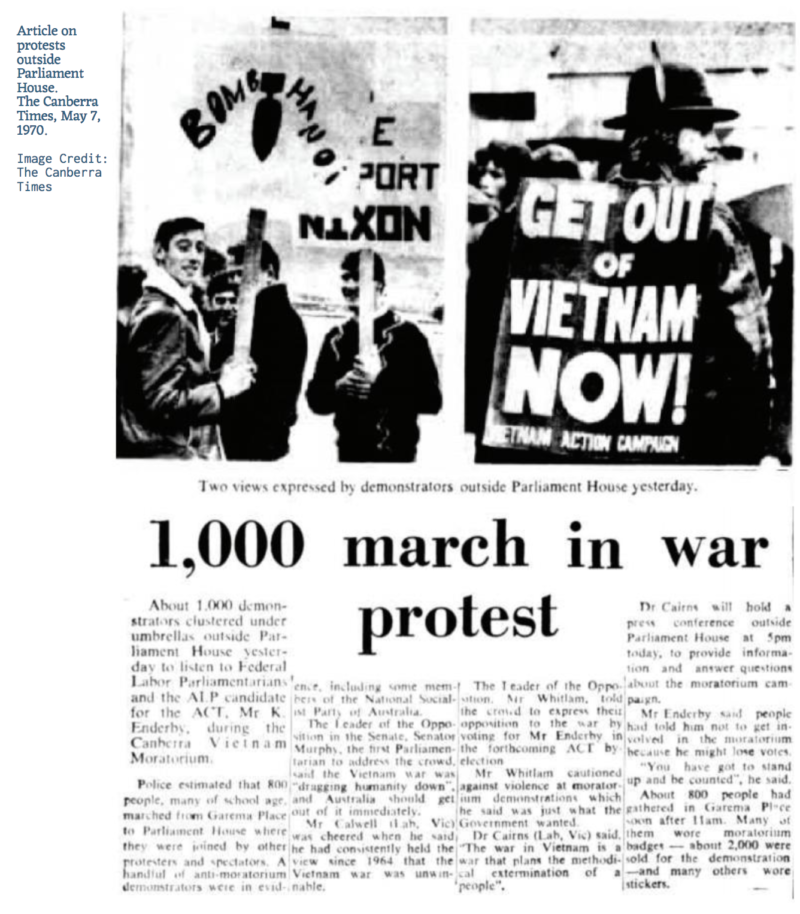
A defining image of Vietnam War protest in Australia is the streets of people taking part in the Vietnam Moratorium. The first and the biggest Moratorium march took place on May 8th 1970. An estimated 150,000 people took to the streets of major cities, with up to 80,000 people in Melbourne alone (Wood, 2013). The Canberra Moratorium was significantly smaller and was held two days prior to the national Moratorium. It attracted 800 people who marched from Garema Place to Parliament House, where other protesters met them for a teach-in on the topic of ‘Vietnam in the World Context’ (Canberra Times, 1970, p1). ANUSA asked for all lectures to be cancelled on the May Moratorium Day, so that students could attend (Canberra Times, 1970, p 5).
Action against conscription was another part of protesting the Vietnam War. Methods of protesting National Service and conscription largely involved non-compliance, including refusing to register, burning draft cards and filling in false draft cards (NAA, A432, item 319). ‘Fuck the Draft’ pamphlets were distributed with instructions on how to resist and people hosted ‘Fill in a Falsie’ parties, where people were encouraged to fill in false draft cards to clog up the systems of the Department (Woroni, 1970, p5). However, not many students participated in these actions, with the majority content to register and defer their service. In 1972, 11 students, two of them members of the SRC, wrote publically that they had refused to comply with the National Service Act (Canberra Times, 1972, p3). It was this small group of students who attracted significant media coverage.
The Vietnam War is often called the first ‘Television War’, as the nightly news was full of coverage from Vietnam. The protests against Vietnam were then the first ‘television protests’. This may go some of the way to explaining how the opposition and protests were able to occupy the media and nation’s imagination. The actions of protesters were designed to garner maximum media exposure. Shock tactics like burning the Australian or the American flag, or smearing red paint on soldiers at marches, could be done by a small number of activists and generate significant media attention. ANU Student Helen Jarvis, who was involved in the ANU Labor Club, was part of a protest outside the Lodge in 1966 where protesters were arrested for burning the Australian flag. Jarvis said: ‘Unfortunately for the authorities, when they went to charge us, they found there was no law against burning the flag. The only possible charge was the misdemeanour of “burning rubbish in a public place”. They couldn’t call the flag rubbish, so they decided not to charge us’ (Green Left Weekly, 1995). Some protesters were intent on going to jail and did not pay fines deliberately so that they would be imprisoned (The Canberra Times, 1969, p 3). This provided added publicity for a minor offence. A good example of this is the protests against President Johnson’s visit to Australia. While 500,000 people turned out to support and see him in Sydney and Melbourne, much of the media focus was on the protests. Only 300 people demonstrated at the Rex Hotel — where the President was staying — but it made international news. ANU student Megan Stoyles achieved notoriety after a photograph of her wearing a ‘Make Love Not War’ t-shirt appeared in a 1966 edition of Time Magazine (Curthoys, p 72).
Students’ motivation for protest varied, but the majority can be drawn into the categories of either Old Left or New Left. Some of the earliest protests were organised by the Old Left, including the Eureka League, the youth wing of the Communist Party of Australia. Some of the ALP groups were also from the Old Left. They supported the National Liberation Front in Vietnam through collections of money and campaigned for North Vietnamese victory, rather than an end to the conflict.
The New Left was part of a broader movement of dissent against society. They were non-communist and generally from the growing middle classes, which included many students. One Canberra student who epitomised the New Left was Stephen Padgham. Padgham, whom Jack Waterford refers to as ‘Canberra’s most prominent draft dodger’ was an ANU Law student from 1968 onwards (The Canberra Times, 2012). He went to jail twice, each time for seven days, for refusing to register for the draft. He also had two periods on the run from police. He spent two months living with his girlfriend in the then all female Ursula Hall, where staff knew of his whereabouts but kept quiet (Foster & Varghese, 214). He was finally sighted by two plain-clothes police officers on campus and was taken into custody after being plucked from Sullivan’s Creek, where he had attempted to make a getaway.
In an interview with Woroni just before he went underground he said: ‘The Draft Resistance Movement is just a small part of a revolution, a revolution to enable the fullest and freest flowering of the human personality. We are trying to escape from becoming cogs in a machine, we are endeavouring to become human. No longer can we dream or pay lip service to ideals when humanity is being crushed around us‘ (1972, p 3). Padgham’s protest against Australia’s involvement in Vietnam and against conscription tied into a broader narrative of protest against societal norms. This can be seen in student support of Aboriginal people, with students active in the Freedom Ride, the establishment of the Tent Embassy and the Abschol (Aboriginal Scholarship) program (ANUA 331.15 minutes 1972). It was also linked to protests against South African apartheid and the Springbok Tour, support for feminism and women’s liberation and nuclear disarmament. ANU student Helen Jarvis, who participated in the protests against President Johnson’s visit, chained herself to the Civic Hotel bar in 1965 and demanded service (Green Left Weekly, 1995). Jack Waterford and others from the Canning St house regularly spray-painted ‘Smash Apartheid’ on the walls of the South African Embassy (NAA, A12389. A30.9.87 1972). These actions took place outside the usual political party structure and were part of an emerging rejection of traditional political action.
Students today might ask ‘Whatever happened to student activism?’ Nostalgia and mythologising have created a picture of the late 1960s and early 1970s as the glory days of student protest and counter culture. But the conservatism of the majority of Canberra students shows that student activism was never a large part of student life. Students were hindered by varying aims, ambitions and philosophies, a disengaged and often apathetic population and an inwardly focussed Students’ Association. Canberra and ANU were never centres of protest against the Vietnam War and were overshadowed by bigger and more established capital cities. However, the actions of the small number of students involved prove that a concerted push from a few can have an impact that bears remembering.
Primary Sources
ANU Archives
Australian National University Archives, ANU: 53/4.0.0.22 parts 1-3 & C, compulsory military service, draft evasion, anti-war protests, Australian National University’s relationship with the Holt, Gorton and McMahon governments 1962-1975.
Australian National University Archives, ANU Labor Club, AU ANUA 336, minutes, correspondence, copies of ‘The Crucible Newsletter’ 1963-67.
Australian National University Archives, ANUSA, AU ANUA 331, Minutes of the Student Representative Council 1963-2006.
Australian National University Archives, Vietnam Moratorium Campaign, P56/262/1, Conference Papers, 1971.
National Archives
National Archives of Australia, A12389, ASIO Special Projects Branch documents, 1976/A30 PART 9.
National Archives of Australia, A432, Anti Vietnam and Anti Conscription Activities – general and protest movement, 1966/2116 PART 2
National Archives of Australia, A6122, Associations individual – The Vietnam war protest and anti-conscription movements in Australia, 1965/1676.
Print Media
1000 March in War Protest’, The Canberra Times, May 7th 1970, p1.
‘ANU Teach in on Vietnam’, The Canberra Times, 24th July 1965.
‘Don’t Rock the Boat’, Woroni, July 16 1969, p 2.
Draft Resisters Declare Themselves, The Canberra Times, April 29 1972, p 3.
‘Fuck the Draft’, Woroni, July 21st 1970, p 5.
‘Moratorium’, Woroni, 30th March 1972, p 11.
‘Padgham Underground’, Woroni, 27th April 1972, p3.
Snedden, Billy quoted in Political bikies raping democracy’ Sydney Morning Herald, May 1970, p 1.
‘Students fined after street sit down protest’, The Canberra Times, 27 May 1965, p4.
‘Students to try to be arrested’, Canberra Times, 24 March 1969, 3.
‘Terry’s Tale’, Woroni, June 27 1968, p. 2.
‘Teach In’, Woroni, 8th July 1965, p 4.
‘Teach in request’, Canberra Times, March 19 1970, p5.
Secondary Sources
Curthoys, A, (1992), The anti-war movements in Doyle J & Grey J (eds), Vietnam: War, Myth and Memory, Sydney, Allen and Unwin.
Foster, S & Varghese M, (2009) The Making of the ANU 1946-1996, ANU Press, available online http://press.anu.edu.au?p=31641
Hastings, G, (2003), It can’t happen here: A political history of Australian student activism, Adelaide, Students’ Association of Flinders University.
Lorimer, D, ‘The movement against the Vietnam War – its lessons for today’, Green Left Weekly, October 22, 2003. https://www.greenleft.org.au/node/28844
Margison, S in Anns R, October 2005, Those were the days, accessed 15th October 2014, http://www.monash.edu.au/pubs/monmag/issue16-2005/around-monash/around-activism.html
Moore, K, (2006), The Vietnam War and youthful protest during the 1960s – challenging the myth, in Hall, Carly & Hopkinson, Chanel (Eds.) Social Change in the 21st Century, Brisbane, Carseldine.
‘Vietnam and the Women’s Liberation Movement’, Green Left Weekly, issue 184, 26 April 1995.
Waterhouse, J, ‘Dirty Secrets: Smash the State’, The Canberra Times, 19 April 2014
Waterford, J, ‘How I lost my marbles’ The Canberra Times, 2nd Dec 2012
Wood, Kate, ‘Student Activism’ in Protest! Archives of the University of Melbourne, last modified 5th March 2013. http://www.lib.unimelb.edu.au/collections/archives/exhibitions/protest/stories/student_activism.html
demos journal acknowledges the Ngambri and Ngunnawal people on whose lands this journal is made and imagined. Sovereignty of these lands was never ceded. Always Was Always Will Be Aboriginal Land.
Web Design by Rio Ramintas
Build by Charlotte McLachlan
demos journal © 2026. All Rights Reserved.


