
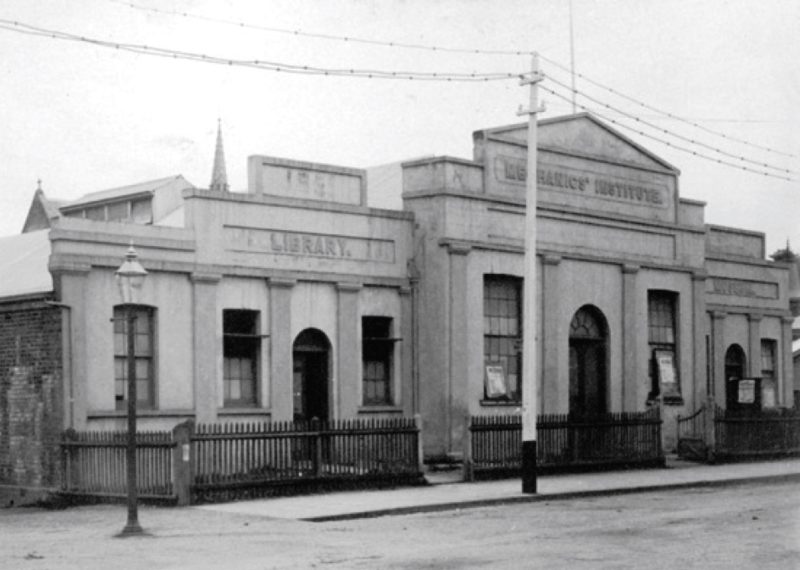
Image: Swan River Mechanics Institute, Perth in the 1980s. Image credit: National Library of Australia.
Action on higher education policy is a core aspect of activism at universities. While this work is important and necessary, something is fundamentally missing from our demands and our narratives. Education activists demand the opportunity for everyone who wishes to attend university to be able to do so, and to be able to do so for free. This demand is of fundamental importance and the fight for free university education must continue until it becomes a reality. However, not all higher education happens in universities and not everybody who wants or needs further education will attend one.
Vocational education in Australia is in a state of disarray. If our demands for higher education policy reform are to be coherent, far-reaching, and truly inclusive, we should be fighting in solidarity with TAFE and other vocational students. The quality of vocational education in Canberra has plummeted; courses are changed while students are partway through them, and training often leaves students in debt while not meeting the minimum standards for the job pathways advertised.
Around the country, the problem is significantly worse. The influx of private providers combined with course cuts to publicly funded institutes and TAFE centres over the past decade has left vocational students vulnerable to exploitation by for-profit con artists. These private ‘colleges’ often recruit students for whom the courses are blatantly unsuitable by using salespeople on commission. There have been incidents of salespeople signing intellectually disabled students up for $25,000 courses without their knowledge or consent. Some providers charge upwards of the cost of a medicine degree for a low-quality diploma which offers few skills and few prospects upon completion.
A report by the Australian National Audit office in 2015 found that some qualifications had a completion rate of just 7%. Students incurred hefty debts while providers gained large profits while delivering very little. Meanwhile, the public providers are struggling to cover the basic costs of teaching with their meagre funds, let alone spending on the necessary resources and additional support staff for students with disabilities and limited English.
Prior to coming to the ANU I completed a Certificate IV through a private vocational provider. I was lucky enough to have the cost covered by my employer at the time, as the qualification has now been rendered virtually useless. The trainers have been fined nearly seven million dollars for meeting none of the minimum standards for their courses and taking negligent shortcuts and liberties with government and student money, for profit. My story is not an uncommon one; this situation is widespread and implicitly condoned by government policies and regulatory inaction.

Needless to say, the current Liberal government, with its contemptuous rhetoric and policies towards public-funded education, is worsening the situation. The past three years have seen more cuts to TAFE funding and deep cuts to the number of courses for which students may receive government support. State governments in New South Wales and Victoria are threatening further funding cuts as well. Why then, are we not fighting for the re-regulation or re-nationalisation of TAFE and protesting for free vocational training too?
It is undeniable that not all employment, or the pursuance of all interests, requires a university degree. I remember in my final years of school, those who chose to pursue vocational training rather than university education were treated with quiet derision. Yet, the knowledge they were pursuing was immensely valuable, both in terms of self-enrichment and in terms of the skills with which they would be equipped to contribute to society. Buildings would not be built, water systems would not be plumbed and animals in veterinary offices would not be nursed if it were not for vocational training.
Where is our solidarity with vocational students, current and future? Our demands for free education ring hollow when instead of fighting for equal access to quality training, we implicitly continue the pre-existing dismissive attitudes towards TAFE and endorse the idea that university is uniquely deserving of full status as a public good.
This year, the National Union of Student (NUS) campaigned on the platform, “Make Education Free Again.” As in previous years, the message was that we must work to stop cuts to university funding, abolish tuition fees, and resist the corporatisation of the education system. This message goes hand in hand with those of campaigns to protect TAFE. Similarly to the NUS, TAFE staff and students have struggled to prevent funding cuts and similarly to the work we do at universities, protests have been held at TAFE campuses for years now, with active staff and students working tirelessly to resist the erosion of public-funded education. There is so much potential for joint action: holding days of action together, engaging in stunts together, making shared demands on government, making demands in solidarity with each other to our administrations and more.
As the ANUSA Education Officer for most of this year, I have organised protests, solidarity actions with stunts (such as ANU students interrupting Education Minister Simon Birmingham in the press gallery, making the national news), written submissions and made endless calls to crossbenchers. If I could have my time over again, the one thing I would change is trying to start making these changes. Something always feels missing, no matter how valuable and worthwhile national days of action and other protests are, when we narrow the concept of higher education just to universities. This is not to downplay the importance of university activism. Rather, in the face of the corporatisation and underfunding that sweeping across almost all public institutions, we need to advocate for systematic change that is as widespread as possible.
One of the biggest barriers to building solidarity with vocational students is the disparity in student representation between universities and vocational training institutions. While the NUS struggles to prevent the closure of university student unions around the country, many TAFE institutes have already lost them. Students at private colleges do not have any representation at all and online students are often so isolated from each other that they may not even know anybody else in their courses.
However, it would be a shame to let these differences detract from finding ways to work together. We would do well to work out how to build solidarity with vocational activists, and to share in their vision for the future. Breaking down the barriers between vocational and university students will allow us to work for higher education changes that do not leave anybody behind.
demos journal acknowledges the Ngambri and Ngunnawal people on whose lands this journal is made and imagined. Sovereignty of these lands was never ceded. Always Was Always Will Be Aboriginal Land.
Web Design by Rio Ramintas
Build by Charlotte McLachlan
demos journal © 2026. All Rights Reserved.


