
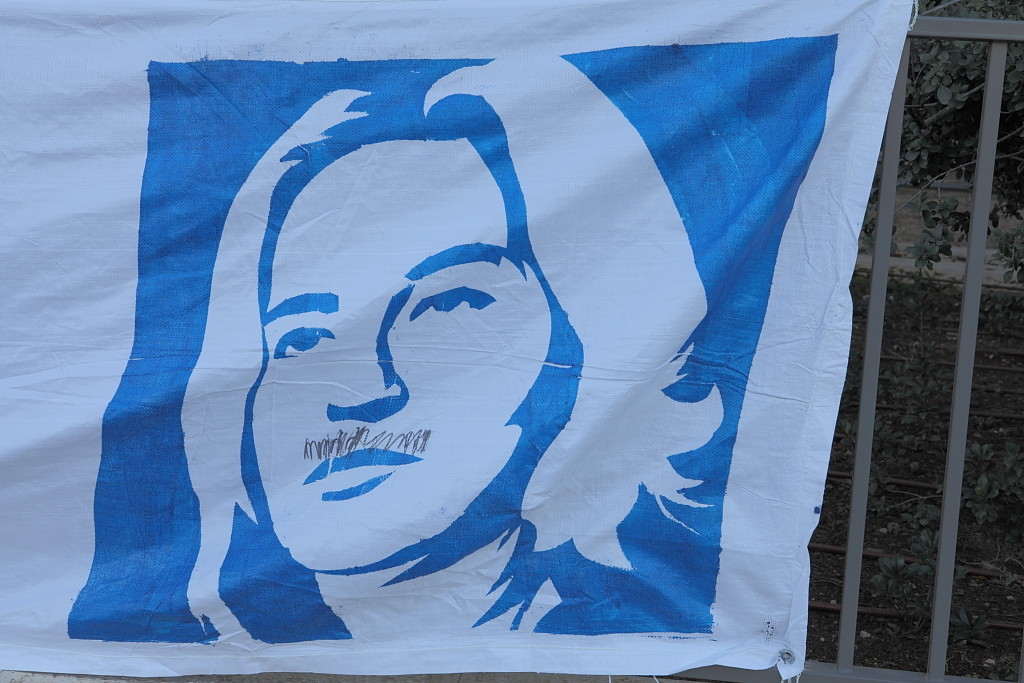
Image: A masculine touch to Tzipi Livni’s campaign poster, courtesy of some graffitista
United Nations Security Council Resolution 1325, passed in 2000, called for the mainstream involvement of women in conflict resolution and management. The Resolution intended to promote equal participation in peace processes, from which women had previously often been glaringly absent. This essay will focus on the peace-building processes of the 1990s – the decade preceding the passing of Resolution 1325 – in relation to the Israel-Palestine conflict, where there was only limited women’s representation. Drawing on scholarly discourse surrounding the role of women in peace-making and peace-keeping, this essay will trace the involvement of women in Israel-Palestine negotiations of the 1990s, considering their participation, impact and legacy.
In order to thoroughly assess the role of female negotiators and peace builders in the Palestine-Israel context, it is worthwhile to understand the importance of such involvement. Female involvement in conflict resolution and management is credited with doing more than just adding perspectives on women’s issues. Instead, it contributes a sense of pluralism to negotiations, highlighting issues such as education and healthcare. In conflict resolution talks in the struggles in Guatemala, Northern Ireland and Darfur, the presence of leading female negotiators “elevated topics of inclusion, equality, and rights.”[1] By disestablishing otherwise exclusive ‘boys clubs’ of (male) military personnel and senior political figures, peace negotiations often consider a broader range of societal needs. Engaging with women as equals to men in any peace building processes contributes different perspectives.
Neither are women peripheral to conflict and its consequences. Women and children are the primary victims of modern conflicts, rather than the predominantly male combatants.[2] Despite being excluded from decision-making, women suffer for the choices of their male counterparts. This makes it important to engage with women as credible negotiators for conflict resolution.
Some discourse makes a distinction between women participating in conflict resolution as agents of masculine-dominated governments and female negotiators actively representing women as a constituency. According to Leila Hilal, a former legal adviser to Palestinian negotiators, women can only make a significant difference as participants in peace-making if they attend as voices for women and their concerns, instead of just engaging, without gendered contributions, in male-dominated discussions.[3] This is relevant to the Israeli-Palestinian negotiations of the 1990s, and to whether the few women involved – discussed below – were autonomous political actors or merely spokespeople for masculine governments.
The peace processes of the 1990s are the most significant and most hopeful period of active negotiation between Israel and Palestine, and came in the aftermath of the “triumphantly masculine” First Intifada.[4] It is in this context that the limited female involvement in peace processes must be understood. In the first serious peace talks between the Palestine Liberation Organization (PLO) and Israel, which took place in Madrid in 1991, women were active players and highly visible.[5] Indeed, the official spokesperson of the Palestinian delegation was the academic and activist Hanan Ashrawi. She was a core adviser and a speechwriter for the delegation, and suggested afterwards that “as a woman I certainly brought my gender approach and awareness to the talks.”[6] (As a resident of East Jerusalem, she had previously been prevented from being a core negotiator by Israel.) The global media attention given to Ashrawi and her role in the Palestinian team is credited with the urgent summoning of parliamentarian Sarah Doron to join the Israeli lead negotiators, whose ranks were previously conspicuously lacking women.[7] There have as of yet been no assessments of Doron’s individual contributions as a female to the 1991 negotiations.
It was at the beginning of the 1990s that Palestinian female activists began articulating a women’s agenda to be included as part of the broader struggle for a Palestinian state. This echoed the historical engagement between women’s movements and national liberation; as early as the 1930s and 1940s, the Palestinian national struggle was adopted as a priority in the global feminist movement for liberation and emancipation. The efforts of female activists in the early 1990s culminated in a technical team on women’s issues that advised and informed Palestinian negotiators in the discussions following the Madrid Conference.[8] At this stage, it seemed as though women were to be included as key participants in the peace building process between Israel and Palestine.
However, by 1993 and the negotiations towards the Oslo Peace Accords, women had retreated from the tables of power. Some have attributed this to the fact that negotiating power was transferred to the Palestinian Authority, which lacked the representative diversity of the PLO. Hanan Ashrawi, who had led two years earlier in Madrid, suggested that women were being excluded because the decision-making was too serious and monumental to be the realm of women.[9] More generally, the Palestinian Authority governance structure solidified traditional patriarchal hierarchies, impeding women’s advancement in all fields of politics including international negotiations. The exclusion of women from core negotiating roles was equally present in the Israeli team. Sarai Aharoni of Hebrew University suggests there was a gendered division of labour, placing Israeli men as primary negotiators and women in supporting roles, including as secretaries, assistants and junior advisers.[10] Women on both sides of the conflict were, and continue to be, relegated to the domestic sphere as reproducers of the nation. They were to secure the future of the country through bearing children, whereas men would conduct the high level negotiations.[11] In both Palestine and Israel, motherhood was glorified, with feminine Palestinian heroism embodied by being Um al-Shaheed – the ‘mother of the martyr.’[12] Valerie Pouzol also suggests that the vocal nature of women’s peace groups in the early 1990s contributed to their marginalisation in the 1993 negotiations, arguing that the “tendency to deviate from nationalist loyalties” saw female-driven peace groups and their priorities sidelined from international dialogue by the male leadership and strictly nationalist priorities.[13]
In 2000, at the Camp David talks convened by President Bill Clinton, there were no female negotiators or technical advisers invited to participate. Although the talks ended with a famous handshake broadcast across the world, there was no meaningful agreement towards resolving the conflict and the Second Intifada broke out later that year.

Bill Clinton was later to state that “if we’d had women at Camp David, we’d have an agreement.”[14] While there are many reasons for the failure to achieve a lasting and credible peace between Israel and Palestine, many commentators would suggest that the lack of women’s involvement has not helped. Ronit Avni correctly observes that no freedom struggle over the last century “has succeeded without women’s leadership.”[15]
To understand the presence of women in peace-making processes of the 1990s, it is important to assess why Israeli-Palestinian formal negotiations were dominated by men. While traditional patriarchal roles associated with almost every society played a part, some reasoning was specific to the region. While naturally very different in their attitudes, both Israel and Palestine can be considered highly militarised societies, or at least societies with a high tolerance for militarisation. In societies such as these, promotions within the security sector and international relations are commonly based on military service. This has the effect of excluding women, who are less likely to reach positions of power in the military.[16] This is because in the militarised societies of both Israel and Palestine there are widely held beliefs that women do not adequately understand warfare and military affairs. These beliefs manifested themselves in exclusionary practices at high level peace negotiations in the 1990s. This is intriguing in the case of Israel, where there is compulsory military service for both men and women. Despite this, there is a perception that men are the ‘real’ soldiers, and few female members in the Israel Defense Forces (IDF) serve in combat positions.[17] Official announcements and press releases in relation to the IDF commonly refer to “soldiers and their wives,” and care packages seldom include items appropriate to women.[18] Women are marginalised across the hierarchy of power, and not just at top-level negotiations.
A further factor contributing to the lack of women in the peace negotiations between Israel and Palestine was entrenched biases, whether conscious or not, about women’s abilities and inherent natures. Hunt and Posa suggest, in Women Waging Peace: Inclusive Security, that “women are often excluded from negotiating teams because the war leaders are afraid the women will compromise and give away too much.”[19] The perceived emotional weakness of women is a precursor to their exclusion. Aharoni notes that in the context of Israel, collective societal perceptions of women’s passivity and weakness prevent them from negotiating with the imagined hyper-masculinity of Palestinian delegations.[20] Conversely, it may encourage women who do participate in negotiations to downplay their femininity and so undermine the benefits that female peacemakers bring, such as sensitivity to diverse perspectives and awareness of a variety of different needs and issues that might otherwise not be considered. Women have been excluded from high-level negotiations for so long that those who become active in this sphere encounter entrenched trends as well as potential bias.
The nature of the Israel-Palestine conflict also perpetuates the lesser role of women in official peace-making.[21] As long as tension persists between Palestine and Israel, it is easy for governments to defer debate and action on the status of women, including as political actors, in favour of the national struggle.[22] Discourse that detracts from the main objective is seen as unhelpful when international relations and politics must take precedence. Additionally, scholars like Andrea Bopp further consider the conflict itself as a cause when suggesting that defence of traditional notions of Palestinian cultural heritage (including patriarchal hierarchies) in the face of Israeli domination “has caused much opposition to any change in women’s status.”[23] Yet women must be part of the national struggle and be integrated into any successful efforts at peace. Without women as autonomous actors contributing on a variety of levels (not just as note-takers and personal assistants), no peace settlement can hope to be representative of the entire community.
Hanan Ashrawi, who received the 2003 Sydney Peace Prize in recognition of her contribution to peace efforts in the 1990s, later reflected on the role of gender in peace and conflict, suggesting that “if a woman is to succeed in politics she has to bring her gender with her. Attempting to be a watered-down version of the male politician won’t get you anywhere… She must be true to her gender.”[24] The benefits of female participation in peace-making and international politics can be undermined or lost if the ramifications of gender are dismissed. Women who did successfully engage with high-level negotiations, such as Ashrawi, did so in part because of their gender, not in spite of it.
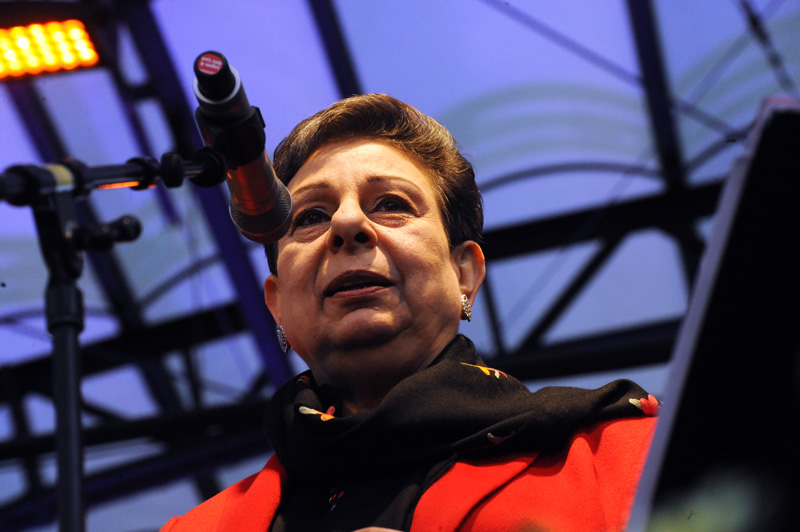
In order to accelerate potential conflict resolution between Palestine and Israel it is important to involve women as active participants in any peace building processes. Since the 1990s, laws that seek to involve more women in politics have been passed by both the Palestinian Authority and Israel. The Palestinian Authority has a gender quota on elected municipal and legislative council positions, but this has failed to “translate into gender parity in the diplomatic process or in the distribution of power.”[25] Similarly, an amendment that seeks to require the inclusion of women in Israeli negotiating committees has yet to be implemented in full.[26] Much work still needs to be done to mainstream the involvement of women in peace processes in both Israel and Palestine. Margot Wallstrom, the UN Secretary General’s Special Representative on Sexual Violence in Conflict, noted in 2011 that less than 10 per cent of all peace agreements are negotiated by women and less than 3 per cent are signed by women.[27] This is a failure of the international community, especially given that the constructive contributions of women such as Hanan Ashrawi of Palestine and Tzipi Livni of Israel have demonstrated that women can excel in operating at the highest echelons of international negotiations.
UN Security Council Resolution 1325 was intended to give women an active role in conflict resolution and peace building. Unfortunately, even after the active involvement of Palestinian and Israeli women in the early 1990s and the ratification of the resolution in 2000, challenges remain for the international community and for women seeking to have a voice in peace building. While the 1990s saw only limited female involvement in Israeli-Palestinian peace attempts, the decade provides many insights into the issues surrounding the broader participation of women in high-level negotiations. From considering the necessity of women’s involvement to the reasons why they have historically been excluded from peace processes between Israel and Palestine, it becomes clear that tangible change will require huge societal shifts. What is clear, though, is that no peace process can be holistic or representative without the presence of women’s voices and women’s issues.
[1] Elizabeth Weingarten, “Where are all the women peacekeepers?” The Week, 30 June, 2014. http://theweek.com/articles/445798/where-are-all-women-peacekeepers
[2] Galia Golan, “Women and Conflict Resolution.” Palestine-Israel Journal of Politics, Economics and Culture, Vol. 11, No. 2 (2004): 45.
[3] Weingarten, “Where are all the women peacekeepers?”
[4] Maria Holt, “Palestinian women, violence, and the peace process,” Development in Practice, Vol. 13, No. 2 (2003): 231.
[5]Alma Abdul-Hadi Jadallah, An Inclusive Peace Process for the Israeli-Palestinian Conflict. (Washington D.C.: The Institute for Inclusive Security, 2012), 5.
[6] Hanan Ashrawi in Lior Finkel, The role of women in Israeli-Palestinian Peace Negotiations. (London: The International Centre for the Study of Radicalisation and Political Violence, 2012), 15.
[7] Valerie Pouzol, “Constructing peace…but what kind of peace? Women’s activism, strategies and discourse against war (Israel-Palestine 1950-2012),” Quest: Issues in Contemporary Jewish History, Issue 5 (2013), www.quest-cdecjournal.it/focus.php?id=328
[8] ibid.
[9] “Political backlash for women after the Oslo Accords.” Equal Power Lasting Peace. Viewed online 1 August, 2015. http://www.equalpowerlastingpeace.org/2013/09/30/political-backlash-for-women-after-the-oslo-accords/
[10] Sarai Aharoni, “Gender and ‘peace-work’: an unofficial history of Israeli-Palestinian formal peace negotiations.” Politics & Gender, No. 7 (2011): 391.
[11] Nahla Abdo, “Gender and Politics Under the Palestinian Authority.” Journal of Palestine Studies, Vol. 28, No. 2 (1999): 41.
[12] Holt, “Palestinian women, violence, and the peace process,” 231.
[13] Pouzol, “Constructing peace…but what kind of peace? Women’s activism, strategies and discourse against war (Israel-Palestine 1950-2012),” www.quest-cdecjournal.it/focus.php?id=328
[14] Bill Clinton in Finkel, The role of women in Israeli-Palestinian Peace Negotiations, 21.
[15] Weingarten, “Where are all the women peacekeepers?”
[16] ibid.
[17] Elana Maryles Sztokman, “Gaza: It’s a Man War.” The Atlantic, 7 August, 2014. http://www.theatlantic.com/international/archive/2014/08/gaza-a-mans-war-israel-gender/375689/
[18] ibid.
[19] S. Hunt. and C. Posa, “Women Waging Peace: Inclusive Security.” Foreign Policy, May/June 2001: 38.
[20] Aharoni, “Gender and ‘peace-work’: an unofficial history of Israeli-Palestinian formal peace negotiations,” 399.
[21] Nabila Espanioli and Dalia Sachs, “Peace Process: Israeli and Palestinian Women,” Bridges, Vol. 2, No. 2 (1991): 119.
[22] Abdo, “Gender and Politics Under the Palestinian Authority,” 42.
[23] Andrea Bopp, “The Palestine-Israeli Pace Negotiations and Their Impact on Women,” Boston College Third World Law Journal, Vol. 16, Iss. 2 (1996): 347.
[24] “Interview with Dr. Hanan Ashrawi.” The Palestinian Initiative for the Promotion of Global Dialogue & Democracy. Viewed online 29 July, 2015. http://www.miftah.org/Display.cfm?DocId=17931&CategoryId=1
[25] Weingarten, “Where are all the women peacekeepers?”
[26] ibid.
[27] “UN lauds awarding of Nobel Peace Prize to three women’s activists.” UN News Centre. Viewed online 2 August, 2015. http://www.un.org/apps/news/story.asp?NewsID=39969&Cr=women&Cr1=#.VcCj_4tGwlJ
demos journal acknowledges the Ngambri and Ngunnawal people on whose lands this journal is made and imagined. Sovereignty of these lands was never ceded. Always Was Always Will Be Aboriginal Land.
Web Design by Rio Ramintas
Build by Charlotte McLachlan
demos journal © 2026. All Rights Reserved.


