
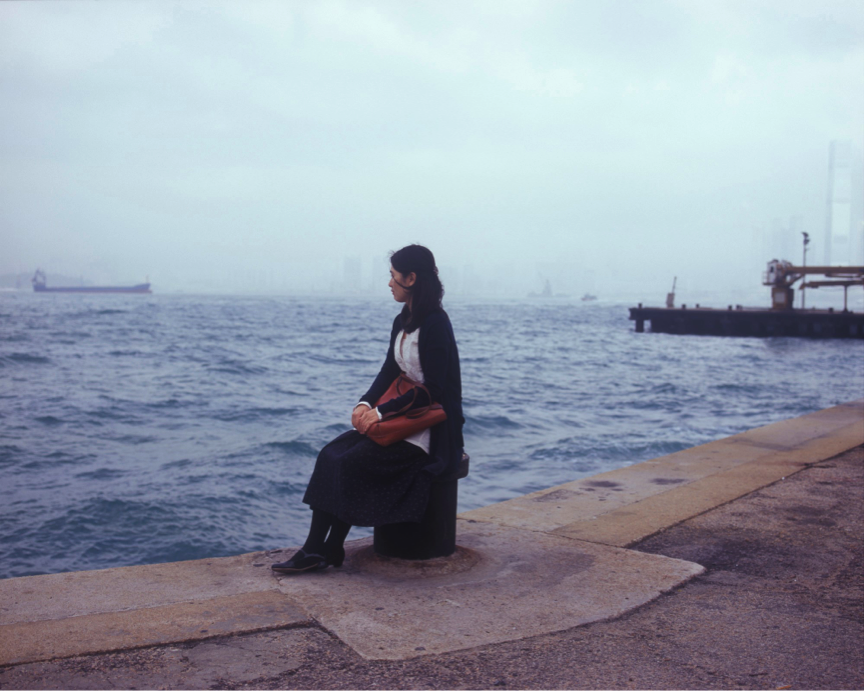
Image: Wei Leng Tay. Untitled, from the series ‘The Other Shore / 彼岸’, Hong Kong, 2014-2015
– Olivier Krischer interviewed by Annette Liu and Esther Carlin
As you enter Wei Leng Tay’s exhibition ‘The Other Shore’, you are drawn in by the darkness. The space is contained, and the dark grey walls allow the lightboxes mounted on the wall, and in frames on the ground, to glow. Recordings of interviews with the subjects play softly, and are dispersed throughout the room. This exhibition seems to ask of its audience to slow down, to look, and to seek to understand. We met with the curator of the exhibition, Olivier Krischer, to find out more about the stories behind the photos.
Esther: Can you tell us a little bit about this exhibition? What cultural context do you bring to the work in terms of your own research and background?
Olivier: The project really comes about because I had met Wei Leng when I was living in Hong Kong. I was there for about a year, working. She has worked in journalism, and in art publishing, so I knew her from that professional world. I was familiar with her past work, more on Hong Kong and South East Asia, as well as some residencies that she has done, in Japan, for example. This project came out of a conversation that we should work together on something– maybe a book, maybe an exhibition, or maybe both. And then over the 2014-15 period, she developed this project, which specifically dealt with mainland migrants in Hong Kong, which is a topic that, having been in Hong Kong, and then obviously because of the protests, seemed more and more timely. I really liked the fact that this was an issue that a lot of people could connect to, they may have seen in the media, but it seemed to offer a totally different perspective, because it was more local, it was more nuanced and specific, asking about individual people, about a community, which isn’t the way the media approaches it.
Annette: Is Wei Leng planning on showing the work elsewhere?
O: Our idea is to try and take this elsewhere and we talked about that from the beginning. In some ways, this was a project that we were interested in doing anywhere, and I pushed for it to happen here. Now we’re interested in trying to take it to the region. The work speaks perhaps more directly to audiences in places like Singapore, obviously Hong Kong – some of the work has been shown in Hong Kong – and also mainland China.
A: I just ask because I think a lot of the background story and the whole discrimination towards mainlanders– this sentiment is very present in Taiwan, where I come from, and amongst Taiwanese people.
O: Yeah that’s really interesting. Some people have asked questions like ‘where does this [sentiment] come from?’ and Wei Leng comments on the fact that in communities like Singapore and in Taiwan, as well as in Hong Kong, the idea of a kind of condescension towards the mainland, has been quite typical in popular culture since the 1980’s. There are lots of films for example where you have ‘communist backward mainlanders’ who don’t understand what the outside world is like.
These stereotypes are certainly not the truth, but skirt around it in the sense that for a lot of people in mainland China, they didn’t have these experiences and they didn’t have this market of international connections. And yet, long after this has changed materially, people’s perceptions have certainly remained the same, and if anything have hardened.
A comment Wei Leng made is that she sees this as having become politicised more recently. She doesn’t think that it’s originally really been a political issue, whereas now because of the so-called rise of China economically and politically, that has meant that this stereotype of mainlanders is also conflated with people’s attitudes towards the Chinese government.
E: Correct me if I’m wrong, but some of these individual stories of migration actually span generations though, they are not a recent phenomenon?
O: Yes, that is one of the interesting things that the project does, in that it tries to ask what these different histories of migration look like. So the way Wei Leng works is that she starts with people she knows who have mainland connections, and it’s a little bit like in Taiwan, in the background everyone always knows whose family are originally from the mainland, or whose families are local, even if things are kind of mixed now. Some people have been in Hong Kong for decades. There’s one particular person who’s from Shanghai for example originally. She sees herself as from Shanghai, despite having been in Hong Kong for decades, and she doesn’t identify as ‘local’. So self-identification comes into it a lot too.
A: Yes that’s like my dad’s parents because they migrated.
O: Whereas there are other people whose family have actually migrated when they themselves were quite young. Like one guy, his parent’s don’t speak Cantonese, which is definitely the dominant language still in Hong Kong, and is now more and more a source of local cultural politics. So he speaks Cantonese but his parents speak Hokkien from Fujian province. He thinks that he’s totally local and he hates mainlanders, and he totally identifies in that way. In the conversations that Wei Leng has had with him, she’s said ‘well, but hang on, what about your parents? They’re kind of part of this community that you’re saying you don’t associate with, or that you don’t identify with’, and he’s like ‘oh, that doesn’t matter.’
I think that’s one of the things that is actually quite nice, and really particular to something like an art project, is that it doesn’t make sense. A lot of these people’s narratives, it’s kind of messy, and that’s fine. Which is something that I think you don’t get in the media or academia. You tend to get a position, which is clear and concrete.
A: Yes, certainly. Is there a particular message Wei Leng wants people to take out of the exhibition though? Does she hope to change people’s perspectives in a particular way? Because I guess these are images, and it’s not overly evident because there are no captions, and even with the audio transcripts it’s very general. I suppose for me, it slowly moves away from the theme of boundaries and tensions and into a far more personal space.
O: Well to be honest, I want to avoid talking for her, but the way she has described it to me, is that the project began with her being interested in that political tension. Very quickly, she felt however, and this is again going from what she said so I can feel comfortable saying it, that there was only so much you can say about this issue. And in fact what people seemed to be more interested in talking about were their backgrounds and their own personal experiences, and that’s what comes out in a lot of the transcripts.
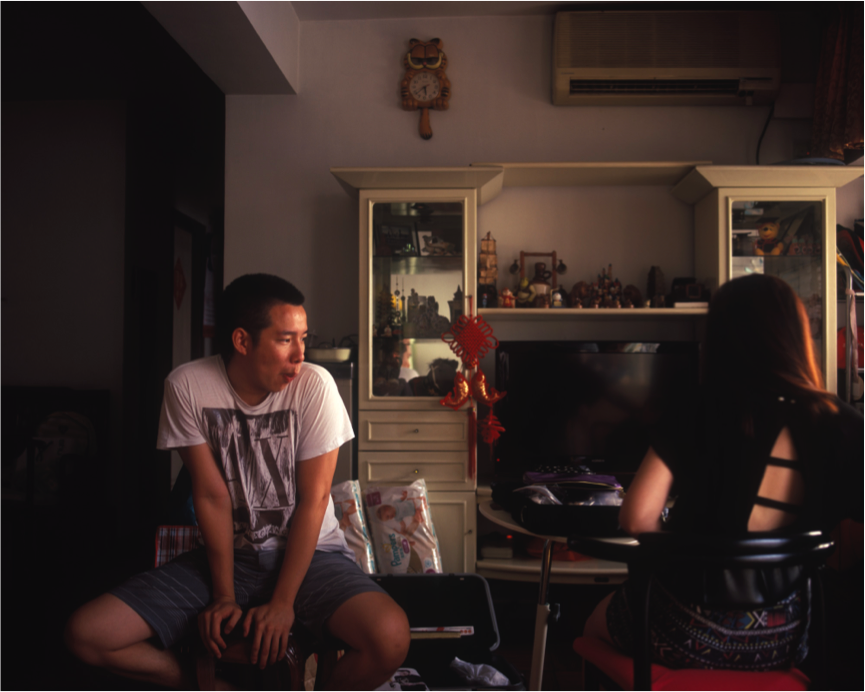
So, she hasn’t selected images because she feels like they totally symbolise this person’s experience of discrimination in Hong Kong. It’s not really about that anymore. It’s more about ‘who are these people? Why are they here? What are their backstories?’ You do get a sense from their environments, particularly because Wei Leng asks people to choose where they are going to be photographed, so they photograph in familiar places to the subject, you get a sense that there’s something about this environment, which is saying something about them. One example is an image with a guy and a girl, and he’s kind of looking at the girl, and they’re in this family style apartment, and there’s a lot on the walls and in the background which is kid’s stuff. The family has actually been going to Hong Kong, back and forth, for decades because they have a business on both sides of the internal border. So there are these longer backstories, you know, very different to tension or politics, or simple identity in terms of national identities. If everybody has a particular story, how or where do you draw the line in terms of what this border means? For some people that border is real, and it’s a part of their identity. For other people, it’s not at all– they live on both sides of the border, and their families are all over the place. And that’s something that I think which connects a lot to Wei Leng’s previous work, looking at her own family. She is Singaporean but her family is originally from Malaysia, originally from Southern China, and she also has family in Thailand, and in Hong Kong.
A: How were these transcripts chosen? Wei Leng must’ve had quite a few hours of recording How did she narrow it down to just these five? It’s interesting how diverse they all are. There are some personal stories about one’s family history to Hong Kong and then some general reflections about their own experiences as Mainlanders. When I read the latter transcripts I can’t help but feel guilty for having similar discriminating thoughts towards Mainlanders. This sentiment is rooted in Taiwanese identity and nationalism as well.O: To answer your first question, it was basically to try and show a range of the conversations and people’s perspectives, which are all very personal on different levels. I had access to more of the transcripts, partly because we were talking about making a publication in which we would like to include the full transcripts. When we started to talk about the conversations and their place in the exhibition, it was about how much we wanted to show. How can we show a range that is not too long, bearing in mind that most people, on the one hand, won’t understand and, on the other, if they do, they won’t want to stand around for half an hour? It was trying to select them in such a way that you could get sound bites and you would still feel kind of intrigued and it would kind of compliment the images. We didn’t expect that people would wait and listen to the whole transcripts.
The transcripts weren’t to try and make people feel guilty. They weren’t trying to present something from a mainland position to bring people around to their point of view. Instead it was more trying to present a range of opinions– experiences– and show the complexities of the situation– the messiness. The fact that you can agree with these people on one hand but you can also disagree. You can see how there is a certain fragility to their arguments and how sometimes they are very confident yet not really that ‘worldly’ either.
Wei Leng’s position is interesting and complicated because she’s come to know a lot of these people, and they trust and confide in her to some degree. She’s not trying to present them as right or wrong. She’s quite adamant about Hong Kong’s discrimination towards Mainlanders and yet we would also have conversations about how a Mainlander’s position is just as biased towards Hong Kong people. Within one’s own context, the tension between ‘locals’ and ‘outsiders’ is always present. I think it comes from one’s pride in their home place.
E: As someone who doesn’t understand the language, it’s interesting how the transcript informs my encounter of the work. It definitely still does add some other layer, and complexity, but I don’t know how to approach it when it’s not a linguistic kind of form?
O: One reason I was comfortable with that is because of the nature of the centre and the fact that it gave us the license to not worry about that. The Centre for China in the World is the sort of space that can and should cater to Chinese language comfortably. If this was presented in the Biennale I feel like it might be more background noise. Here, however, I was conscious of the fact that some people coming would understand. I think the intention was also just to– it’s very different when you hear people’s voices, even if you can’t understand what they’re saying, you still get this sense of different people speaking, and I think that it’s funny how that works: you can hear when somebody’s kind of confident, you can hear, you know particular types of people you still get this sense from like their quality of voice.
E: Yes, and another layer of a very personal magnitude.
O: Which again is, you hear somebody’s voice, and it’s such a personal signature. Like we were saying before, Wei Leng presents generally and so if you walk through and just see the images, I think it would be really different if you didn’t hear voices. Even if you don’t know which voices belong to which images, there’s that sense of these individual people. That’s brought closer, I hope, by hearing some of the conversations.
A: Esther, what is your experience of the exhibition? And how do you encounter the series? Because I obviously approach it quite differently, knowing the political tensions and also with Taiwan’s position between Hong Kong and China, and our history with China as well. I can relate quite personally and differently I guess.
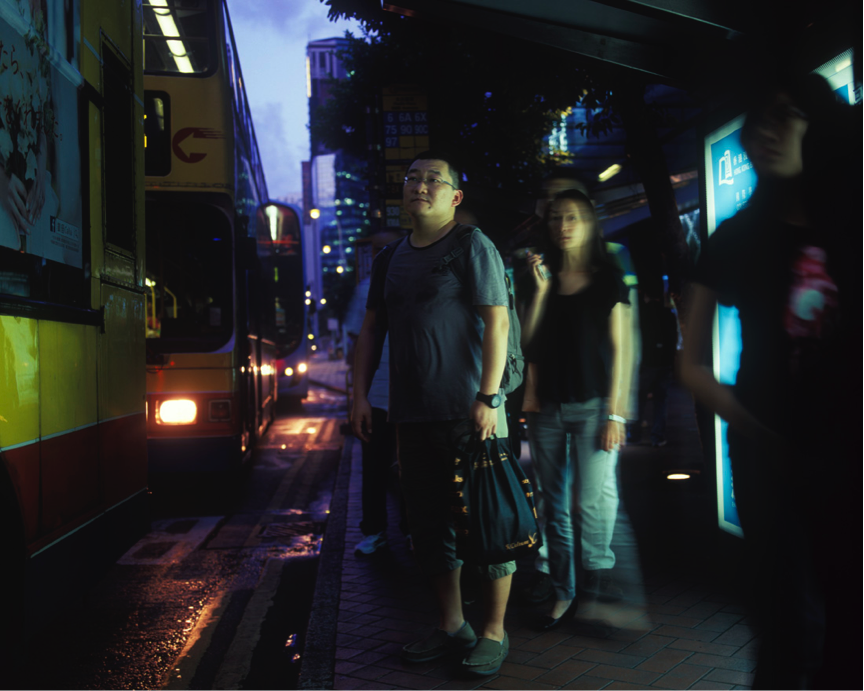
E: So strangely enough, I actually went to Hong Kong on a school trip when I was in Grade 6. This experience was very formative; I hadn’t been before and have never been back since. It was the first place I’d ever been in Asia, so I guess in terms of place, in terms of identity, I have this quite strong impression of that metropolis, and not necessarily a very rational or mature one, but more a fleeting emotional connection. Looking at the works is really interesting in that sense, I have some sort of outsider knowledge of the political goings-on through media, and people I know from that time who I am friends with on Facebook, but it was great to be inside those small spaces again, and the harbour, and the buses, all of that which I remembered distantly. I suppose I hadn’t thought about the longer term histories of overlapping and cross-migration, but those personal stories brought me back into that in a really beautiful way.
Like you were saying Olivier, art can do that, it can have that complexity. It doesn’t have to be fixed or firm, and that in this case it’s not foremost a political act, but that the politics kind of intercepts and overlays in different parts of different stories.
O: I think that’s something which is also quite particular about Wei Leng’s work, which makes it sometimes difficult to place. I don’t think it really conforms.
______________________________________________________________
Go and check out the exhibition Wei Leng Tay – The Other Shore, on until July 15, open 9am-5pm Monday-Friday and on the weekend of July 9-11, at the Australian National University Centre for China in the World.
See http://ciw.anu.edu.au/events/gallery/weilengtay/ for further details.
demos journal acknowledges the Ngambri and Ngunnawal people on whose lands this journal is made and imagined. Sovereignty of these lands was never ceded. Always Was Always Will Be Aboriginal Land.
Web Design by Rio Ramintas
Build by Charlotte McLachlan
demos journal © 2026. All Rights Reserved.


