
Beneath the shade of large arch’s awnings there is a rectangular window through which you can see out onto rubble. ‘A Bold New Campus’ is how a placard below the window describes it. These are the remains of Union Court, a place that for many students was synonymous with the ANU for a time. The sight of it makes me recall something a friend of mine said recently—that as an only child, a member of a family of precisely three, she felt a great responsibility as the sole custodian of her parents’ memories, as the only repository of all their experiences and stories. Does it make sense to speak of a custodian of memories in a place like this? Is there a repository of the past when undergraduate populations are renewed ever ythree or so years? Should someone, stepping for the first time onto this bold new campus, care what once happened in Union Court?
It is here, I believe, that community projects like Demos’ history of student activism have an indispensible role. Any official history, relying as it must upon conventional archival material, will find it difficult to grasp the meaning and character of agitation, rebellion, uprising, and insurrection. This was a consideration for Ranajit Guha, who founded the Subaltern Studies Group at the ANU in 1981 (something seldom noted in accounts of the movement’s history). In his Elementary Aspects of Peasant Insurgency in Colonial India (1983) he asks: how can one represent and reclaim a history which has left behind little, if any, documentation? How can one resist its erasure by official histories? While it would be foolish to compare student protest to anti-colonial uprising, a similar set of historiographical questions emerges in the project of writing activist histories.
It is in this spirit that I have been tasked with revisiting the ‘read-in’—a protest that has left a paper trail longer than some, but which is easily misunderstood now that enough years have passed. One problem in reading about the read-in is that the mainstream media’s sources are at once the most readily available and the the least representative of what the protest meant to the protesters. I would be naïve to think I could offer a corrective here.
My task in this brief account is not to defend the read-in or to indulge in nostalgia, but to offer a narrative that contextualises and reflects upon the atmosphere and events of the time. In this undertaking I will draw mostly on my only published reflection on the read-in from the time, an open letter ‘in admiration and solidarity’ to a fellow student protester, Hannah McCann. My hope is not for a more judicious retrospective assessment, but to provide some thoughts and ingredients that may nourish future protest. Perhaps this is a way to think of the proper stewardship of memory.
The read-in was one of many strategies employed by a broad student moment in its successful opposition to the Abbott government’s 2014 proposal to deregulate university student fees. It is fitting, then, that this protest strategy was born of contingency during another such protest.
On the afternoon of May 21, 2014, I was among the hundreds of students who gathered in Union Court and marched on the Chancelry to demonstrate against the Vice-Chancellor Ian Young’s vocal support for deregulation. Young was the then Chair of the Group of Eight universities and had published his case for deregulation prior even to the Abbott government’s announcement of the plan.
As night fell, hundreds of students surrounded the glass doors of the Chancelry, demanding an audience from Young who was believed to be inside. Next to the Chancelry doors is a statue of the Hindu goddess Saraswati, which is, the ANU website explains, depicted not according to convention as “elaborately dressed and holding a plamleaf manuscript,” but “as a modern young woman holding a book, more thoughtful and contemplative than grand.” I took this as an invitation and waded out across the pool.
It felt powerful sitting beside this goddess of knowledge, as though she herself were in unity with us, reading against Young, against Tony Abbott, against the whole parade of ill-conceived policy decisions that issued from this concrete bastion in my brief time at the ANU—the abolition of tutorials, the dismantling of the School of Music, the routine cuts, humiliations, and contempt for the humanities, the continued investments in fossil fuel companies. And I was surrounded by a crowd bigger than any before, one united by a shared discontent.
The weekend after the protest I had some conversations at the Canberra Croatian Club where some friends were running an event in solidarity with a blockade at a coalmine. What if, combining performance art, the vigil, and the energy of last week’s protest, I continued to read in that very spot for a week? Everyone’s response was the same: “I’ll join you.” At home I wrote up a mission statement that I have since lost, save for a few fragments quoted in the media: “As a performative enactment of exactly what these cuts put into jeopardy and the place in which critical thinking in itself is nurtured, I endeavour to make the simple act of reading a book something subversive.” These words were influenced by a work I was writing about at the time: Judith Butler’s Dispossession: The Performative in the Political (2013). In section 20, “The University, the Humanities, and the Book Bloc”, Butler’s interlocutor Anthena Athanasiou states:
One of the most striking modes of protest was arguably the “book bloc,” in which protesters marched wearing book shields in the streets of Rome, London, and other cities, in defense of public universities and libraries. […] An image that has been circulated among several blogs epitomizes in remarkably eloquent way, I think, the spirit of the spectre of our time: a policeman raises his baton against a protester who carries a book sign of Derrida’s Spectres of Marx. This image of an armed policeman chasing the spectres of Marx reminds us that those recurring spectres still haunt capitalism; it reminds us, above all, that sometimes we have to fight for our books, with our books.

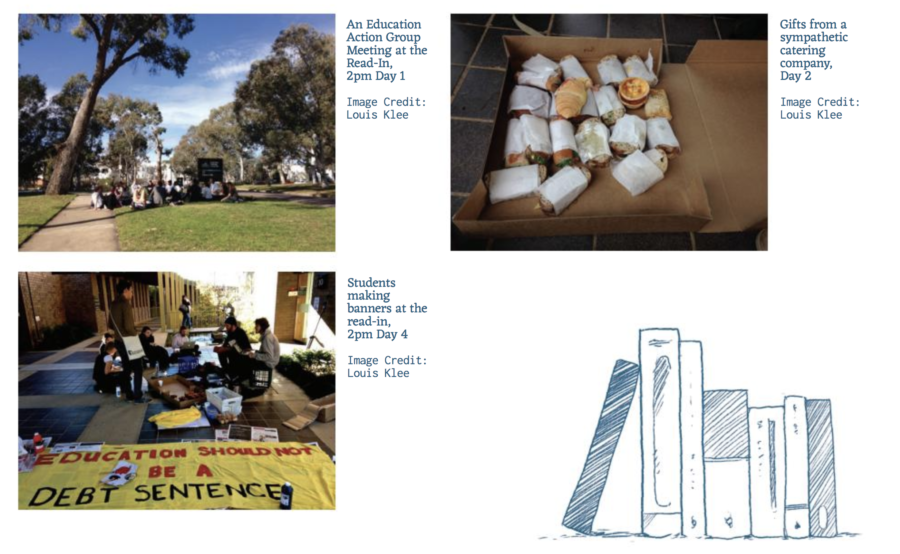
This was what I was prepared to do, and, it seemed, others too. But until the moment when I was joined by a stead flow of people on the morning of May 26—dozens, then hundreds—at the Chancelry doors, I still had no idea how the event would unfold. I was quite prepared for a scenario where I would be reading alone. The response to the read-in was electric and far exceeded anything I could have anticipated. While the media gravitated to me as a leader, I was determined to shirk that role as much as possible. The read-in was the readers. It was an experimental, non-hierarchical, and anarchic space, an assembly of diverse people united by a shared grievance. For many, it was a space not of agreement but of productive dissensus, where they could share their thoughts, quarrel, and learn from one another in a spirit of solidarity. Many people told me they had discovered a new political consciousness from their presence at the read-in. One protester, Raph Kabo, wrote in City News: “Until the read-in, I did not know how to articulate my views. Knowledge is a powerful weapon, and university administrations would do well to remember that they are meant to be its propagators, not its wardens.” This unexpected consequence was one of the read-in’s greatest strengths.
But from the first day there were also unanticipated problems. The evening before the read-in began Annabel Crabb published an article in The Sydney Morning Herald, “Students’ Soviet-era anti-budget protests outdated in our era of communication.” There she reprimanded the student protests, even going so far as to claim that students were hypocrites: “They accuse [Abbott] of extreme conservatism. But if conservatism is the stubborn refusal to evolve, then fighting a war of ideas with Soviet-era artillery strays awfully close to the mark.” For Crabb, the “era of communication” had rendered mass demonstration obsolete.
I wasn’t prepared to deal with this fatuous argument, but I had been wary of the misrepresentations that dominated the mainstream media in the preceding week. Mostly the media condemned students for violence and focused, as always, on the sensational. “A man was arrested after a flare was deployed,” begins one such article on May 21, “and protesters clashed violently with police.” Cautious of this, I noted in my statement that the read-in was “pacificist” and “humble.” But it proved naïve to try to beat the media at their own game.
The mainstream media focused ad nauseam on the question of means. Take May 6, when students hijacked an episode of Q&A. The ensuing discussion was almost entirely about whether this was a legitimate act, not what was written on their banners (more brains not war planes fund education). Tony Jones’ comments as his program went back on air are indicative of this: “We had a little musical interlude while we got democracy back on track. […] That is not what democracy is all about and those students should understand that.” Jones here purports to speak for democracy—and democracy in his meaning is an orderly public sphere where esteemed speakers and public personas are able to respond to carefully selected questions. Any question that strays too far outside of the established framework, too ‘shrill’ in tone or not easily intelligible, is inevitably answered with:
“we’ll take that as a comment.”
Ultimately, the read-in was unable to circumvent this tendency. The media’s syllogism: (i) student protests have been violent, (ii) the read-in is non-violent, (iii) therefore the read-in is against student protests. This absurdity was only reinforced by the timing of Crabb’s article. The first question from The Canberra Times: “Were you prompted to do the read-in by reading Crabb?” “I haven’t read the article.” “Well, what do you think of the idea? That students need to get more creative?” This, I said, I could agree with in principle, though I could never condone Crabb’s condescending tone. Not to be deterred, the opening of The Canberra Times somehow managed to accommodate both hyperbole and the sensational. The read-in was “an effort to re-frame student activism in Australia” led by a someone “who was a student in Quebec during the 2012 student riots.”
This would have been merely a laughable and embarrassing tabloid-style beat-up if it didn’t then have ramifications for how students—especially those from outside Canberra—perceived the read-in. In the days after May 26, other read-ins began on campuses around Australia, such as at University of Melbourne led by Ella Farby, who stated: “We’ve been getting a little bit of shit like, ‘go back to class’, so we brought class to the protest.” But there were also some students who wrote to me concerned that the read-in was a “protest against protests,” that it was “conservative,” “passive,” or “apathetic.” At first I was incredulous that anyone could come to such a conclusion—we were, after all, engaging in a form of protest. Perhaps this form of protest was idiosyncratic and unusual, but that hardly made it “anti-protest.”
Yet, by far the most compromising aspect of the read-in was the interaction with the Chancelry. At first, they ignored us, even with the television crews from Prime 7, ABC and Win queuing outside. But on Monday evening some students at the Education Action Group (EAG) meeting crossed paths with Young as he was leaving his office and persuaded him to make an appearance at the read-in the next day. This proved to be a disastrous move. As Kabo described the event: “The first of these visits was seen as a positive step towards student-administration dialogue. By their third and fourth visits, the shine had worn off. […] Each question was expertly dodged and avoided. […] They talked pure spin. And every time, their PAs would however behind them, taking more notes than us, snapping photos.” The read-in thus became a kind of ‘consultation’ opportunity for the Chancelry, a way for them to give the appearance of discussion while in fact undermining the status of the read-in as a protest.
Like Kabo, McCann was among the first to point to this problem, writing on her blog binarythis:
It quickly became apparent that the VC benefitted from the image of rational thinking man, where we all appear to figure it out together when in fact we don’t (as the CCTV they immediately installed above the read-in demonstrated). […] [W]e need to be very careful about championing rational thinking man as the figure of success, as this becomes deeply problematic once we enter the realm of rational debate with those already in power. Though reasonable discussion might sound great in theory, issues arise when a minority hold power over the majority, and it is left to the powerful to dictate discourse and discussion.
These objections point to the gravest danger in the direction the read-in took. On the one hand, discussion between students remained a powerful aspect of the read-in since regardless of our differences the collective presence of bodies in the space of the Chancelry itself constituted a protest and powerful rebuke. On the other hand, ‘discussion’ between students and Young altered the nature of the gathering, turning a protest into a mere forum. I was open-minded about the read-in, excited to see where the collective will might take us, but I must take some responsibility for its direction. It was only when it was too late that the damaging farce of discussion with the Chancelry became evident. In a mocking denouement, a member of the Chancelry even offered us a copy of one of the book bloc’s books, Spectres of Marx.
But as with then, I still have some disagreement with McCann’s broader attempt in her ‘defence of anger’ to characterise the read-in as a dominated by the rational thinking man rather than as what I think it was: a manifestation of the rightfully enraged. For the read-in, from the very beginning, did not stem from a bureaucratic, rational utopianism—a kind of Habermasian commitment to conversation free from domination—but was rooted in the very outrage McCann described. I wrote at the time:
The read-in was not an action in opposition to emotion, but an attempt to enact emotions in a novel way. […] It was for that reason that I cited the closing remarks of Butler’s book Dispossession: The Performative in the Political to describe the protest: “the collective assembling of bodies is an exercise of the popular will, and a way of asserting, in bodily form, one of the most basic presumptions of democracy, namely that political and public institutions are bound to represent the people […]. In this way, those bodies enact a message, performatively […]” even when they do simple actions, such as reading. […] [This is part of] the challenge—a task that is as difficult as it is necessary—to deconstruct the binary itself by demonstrating the subtle ways in which emotion and reason intertwine in political life. That is what I found strange and promising about attempting to make reading itself something subversive.
While I objected above to the mainstream media’s focus on the question of means as what amounted to a kind of tone policing, the question of means among students is another matter. To discuss the merits and pitfalls of strategy is essential to a successful student movement. It is to that end that I offer this first-person narrative history and, looking back, it strikes me that my only published reflections on the read-in were made in dialogue with other students, written out of serious and thoughtful engagement with those committed to the same struggle, rather than as some plead to the powers that be or public policy document or rational entreaty addressed to the Chancelry. My desire was for my presence to speak my objections to the Chancelry, while the discussion remained among students, for students. Before our discussion, the Chancelry ought rather to have felt something akin to the Europeans Jean-Paul Sartre addresses in his ‘Preface’ to Frantz Fanon’s The Wretched of the Earth:
Europeans, you must open this book and enter into it. After a few steps in the darkness you will see strangers gathered around a fire; come close, and listen, for they are talking of the destiny they will mete out to [you]. They will see you, perhaps, but they will go on talking among themselves, without even lowering their voices. This indifference strikes home […]. Their sons ignore you; a fire warms them and sheds light around them, and you have not lit it. Now, at a respectful distance, it is you who will feel furtive, nightbound and perished with cold.
It was this kind of discussion between students around a fire—a fire confrontationally inaccessible to the powers that be—that is, I hope, the lasting legacy of the read-in. Inspired by the events that transpired, Raph Kabo edited a collection of essays by the students and academics, Squarely in the Read, and I and some other members of the read-in began a group ‘ANU Activists’.
The first face-to-face meeting of ANU Activists took place on 8 October, 2014, in the Food Coop, and had the same spirited mood as the read-in. It was from this group that, late in 2014, the Demos Working Group formed. Demos Journal, launched in October 2015, was thus, in the words of its first editorial, “a project born from a space of collaboration between different activist groups”; from “an openness to the demands of our community […] celebrating and evolving with the incredible work of critique and creativity already underway.”
demos journal acknowledges the Ngambri and Ngunnawal people on whose lands this journal is made and imagined. Sovereignty of these lands was never ceded. Always Was Always Will Be Aboriginal Land.
Web Design by Rio Ramintas
Build by Charlotte McLachlan
demos journal © 2026. All Rights Reserved.


