
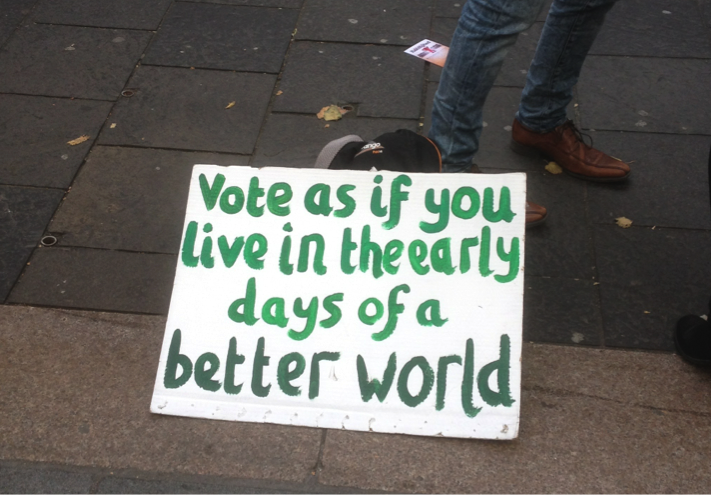
I took this photograph a week or so before the 2014 Scottish Independence Referendum. The placard, leant on a rucksack on an autumn pavement, was part of a spontaneous political demonstration in the centre of Glasgow for a Yes vote in the Indyref, as it became known. There were no Yes campaign stewards, virtually no police, just people out on the streets with songs, music, posters, placards, saying what they wanted Scotland’s future to be. It wasn’t the first or last such gathering. As the political and cultural commentator Neal Ascherson put it in his poignant, confident article soon after the result of the Referendum,
[T]his long campaign has changed Scotland irrevocably. Campaign? I have never seen one like this, in which it wasn’t politicians persuading people how to vote, but people persuading politicians. At some point in late spring, the official yes campaign lost control as spontaneous small groups set themselves up and breakfast tables, lounge bars, bus top decks and hospital canteens began to talk politics. What sort of Scotland? Why do we tolerate this or that? Now, in Denmark they do it this way…
And that sense of radical, creative possibility was all around us, in movements such as Women for Independence, Lawyers for Yes, Academics for Yes, Common Weal, Bella Caledonia, Radical Scotland:
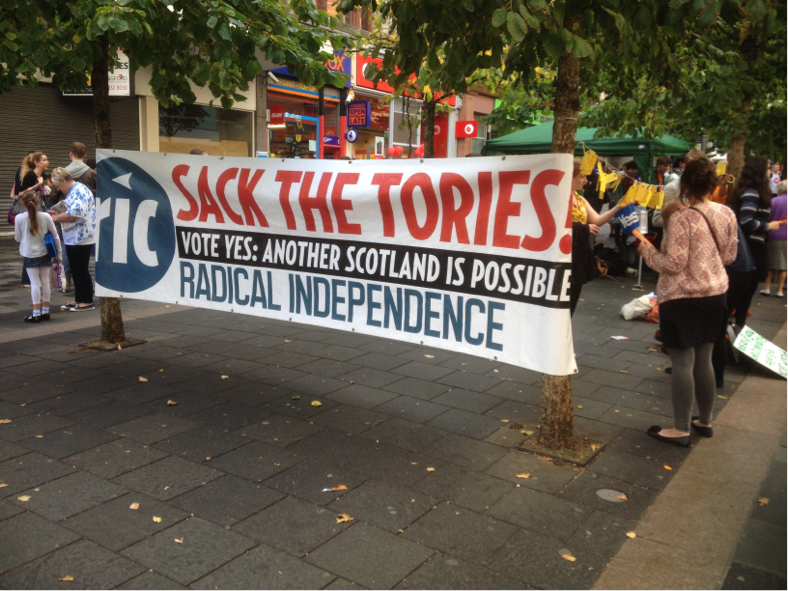
The movement for political change implicit in these images is nothing less than a call for a creative politics, and it is taking shape across Europe – in Greece, in Spain, in the election of the new Labour leader in England. Common Weal is a good example, in its own words a ‘think and do tank campaigning for social and economic equality in Scotland’, and emerging from the ferment of Indyref. Since the failure of the Yes campaign last year, at which we might have expected the movement to evaporate, that movement has only intensified in Scotland. Scottish National Party (SNP) membership has soared from around 25,000 to over 110,000.[1] At the recent UK General Election the conventional parties – Labour (for so long hegemonic in Scottish politics), the Conservatives, the Liberal Democrats – were virtually wiped out, with the SNP taking 56 of 59 seats. The same is happening in local council bye-elections, and recent polls indicate the same will happen in the Scots Parliament elections next year.
But the placard is also an allusion, in the context of Scottish literature, to the work of the novelist and artist Alasdair Gray: ‘work as if you live in the early days of a better nation’, now inscribed on the Canongate Wall of the Scots Parliament in Edinburgh. As Gray freely acknowledges, the words are loosely derived from the Canadian poet Dennis Lee’s Civil Elegies, a powerful poetic sequence written over 40 years ago, a lament for Canadian identity lost to the hegemonic culture of the USA and for Canada’s ecological degradation. For Lee, the question of how to exist in Canada was part of the larger question of how to live in the world, within an increasingly urbanized environment that erodes ecological balance, within globalized economies and multinational corporations that overwhelm cultural difference and local variation.
Gray’s inscription has a resonance for Scotland and Canada, and for all smaller nations. But in the various places in Gray’s works where the phrase occurs, he makes of it not a speech of anger and resistance (think of the words of Calgacus, to the Caledonii before the battle of Mons Graupius, facing Agricola’s legions, with the whole scene written, directed and shot by that brilliant cinematographer, Tacitus)[2] but one of creativity, hope and inspiration. It’s a microcosm of what has happened since the 1970s in Scotland, where the arts have conducted a sustained re-imagining of Scots identity in history, culture, literature, cultural commentary, linguistics, music, drama, ethnology, law, politics and much else. It is nothing less than a re-creation of the narrative of the nation – not in the sense that Scott has it in The Antiquary[3], but in the way that Edwin Morgan does in Sonnets from Scotland, or James Robertson in his novel And the Land Lay Still. Morgan’s 44th sonnet in the series of 51 can stand for all such creative explorations, archaeologies and re-imaginings, in this case constitutionality, law and politics. Here, the time travellers’ craft lands in Scotland’s future:
The Coin
We brushed the dirt off, held it to the light.
The obverse showed us Scotland, and the head
of a red deer; the antler-glint had fled
but the fine cut could still be felt. All right:
we turned it over, read easily One Pound,
but then the shock of Latin, like a gloss,
Respublica Scotorum, sent across
such ages as we guessed but never found
at the worn edge where once the date had been
and where as many fingers had gripped hard
as hopes their silent race had lost or gained.
The marshy scurf crept up to our machine,
sucked at our boots. Yet nothing seemed ill-starred.
And least of all the realm the coin contained.[4]
It might seem that there is only a tenuous connection here between law, creativity and constitutionality. But coins are more than economic value: they have symbolic power, and as Morgan says in a neat inversion, they contain realms. The first Scots coinage issued by David I in the early twelfth century signified control over money supply but it also signified identity, sovereignty and nationhood, concepts that are increasingly complex in European and global industrial and post-industrial societies, as the latest GFC revealed.
All Scots and UK coins have monarchs displayed on them. This one, Respublica, is as free of monarchs as it is free of the symbols of the present dis-United Kingdom. Its antler head echoes earlier re-interpretations of imperial iconologies. Thus the obverse of Macedonian coins of Philip II showed horses, symbols of military might, that in turn were re-interpreted by the coin designers of later Gallic peoples in forms of abstract art. This was not because of their lack of engraving skills to represent a horse but rather, as the Surrealist Georges Bataille argues, it was because the artists wanted to create imaginative art that represented their people. Similarly, the antler head stands for identity in difference, and is symbolic of a fusion of people, cultures and ecology.[5]
The coin and the poem that describes it are a snapshot of a Scotland that may be. It shows us what we can, creatively, become in history. Or to adopt another analogy, the entire poetic sequence is like the work of another modernist, Eduardo Paolozzi’s Untitled Fragmented Head (1984), where the head is composed of disparate parts. Paolozzi was inspired by a Surrealist game where each artist drew a body part, folded the paper over and circulated the paper to the next player. The paper was eventually unfolded to reveal a sort of monster or cadavre exquis made up of strange juxtaposed elements.
Morgan’s poetic sequence, Bataille’s interpretation of the creative energy of Gallic artists, the Surrealist game – do these not have their legal analogue in historical constitutionality – the constant unfolding of a constitution whose parts need to be imagined, interpreted, ceaselessly re-interpreted? Or in the emergence of constitutionality itself? At the first session of the Scottish Parliament in May 1999, Winnie Ewing declared ‘The Scottish Parliament, adjourned on the 25th day of March in the year 1707, is hereby reconvened.’ The new Scots parliament was actually constituted as a new entity and given powers by the UK Westminster Parliament.[6] But to all of us listening in the Scots nation her words spoke truth to power: our history and our identity mattered, and what had existed once, over 300 years ago, would exist again. It spoke of a resumed narrative that was in our hands to shape – no longer passive consumers of a distant politics, but active members of our renewed democracy.
If it is in the hands of people to be creative about their own social and political futures, institutions can play a vital role in helping them think about such futures and shape their thinking. This was surely part of the impulse to found the institutions we now call universities, the earliest of which began in Bologna in the late eleventh century, perhaps around 1088. Constitutionality was critical: the very first subject was Law, the course founded on the study of Justinianic law, the texts of which had been recently discovered, and which opened up radical new understandings of almost every aspect of legal relationships.
In this new gathering of scholars, entirely different from the scholastic gatherings in monasteries or cathedral schools, the students themselves ran the university, in the midst of the city. It is worth repeating this: students ran the university. Over the next century they argued for their rights with Bologna city; they set up collective bargaining and regulatory structures by which they could exist as a corporation. They were the universitas, within the city, and with rights to travel freely to and fro. They hired and fired expert scholars and teachers (who took the hint and formed their own organisation); they organised themselves into self-sustaining groups called nationes, supported each other financially and disciplined themselves and their course structures, resources, assessments.[7] As historians point out, they developed sophisticated systems to protect themselves from sharp practices – for example limiting booksellers’ profits on second-hand manuscripts.[8] The result was a res publica of learning.
Compare that to the situation today, with the Digital Rights Management contracts of corporate publishers who put paywalls around knowledge, and who charge our higher education institutions huge sums to access the knowledge created by those very institutions’ scholars. Or with the paywalls erected around higher education by successive governments in England, Australia and elsewhere.[9] Both forms of paywalls are fundamentally anti-democratic. As numerous commentators have pointed out, the anxiety created by student debt actually inhibits education, social mobility, creates further social stratification, reduces creativity and does nothing to challenge current inequities in the market for positional goods such as higher education.[10]
In England, the ruling rationale is to empower students as consumers.[11] You can read about it in the report on universities entitled Higher Education: Students at the Heart of the System – a review of the future of higher education funding in England, published in 2011 and still the guiding document for the present Conservative government. At the end of it one is left wondering, is that it, the Big Idea for the future of our universities? Students as mere consumers of courses organised by universities, and loaded with debt by government in order to pay for that consumption? Where is there space for radical creativity here, and for student power and co-partnership in learning? Nearly a millennium later, what have we learned from our beginnings at Bologna? The struggle to discover our identity in nations and what we want our future to be is a political struggle that needs to take place in our universities. It is time to re-imagine the constitutionality not just of small nations such as Scotland, but of universities too, and to re-build both along the lines of a true common weal that in place of the austerities of market economies celebrates the dynamic activism and social community of res publica.
[1] And there is an English wing to the SNP – Quinn, B. (2015). Surge in English SNP members: ‘the core message is very attractive’, The Guardian, 17.7.15.
[2] See Tacitus, Agricola, XXX.
[3] Where Scott satirises the the historical novelist’s apparent freedom, moving between fiction and history:
‘”Let me see – What think you of a real epic? – the grand old-fashioned historical poem which moved through twelve or twenty-four books – we’ll have it so – I’ll supply you with a subject – The battle between the Caledonians and Romans – The Caledoniad; or, Invasion Repelled – Let that be the title – It will suit the present taste, and you may throw in a touch of the times.”
“But the invasion of Agricola was not repelled.”
“No; but you are a poet – free of the corporation, and as little bound down to truth or probability as Virgil himself – You may defeat the Romans in spite of Tacitus.”’
[4] Morgan, E. (1984). Sonnets from Scotland, Glasgow, The Mariscat Press, 52. The coin features in the cover artwork, by Alasdair Gray.
[5] See Fenton, J. (2004) ‘Uncommon Currency’, The Guardian, 28.2.04, 24, where Fenton cites Bataille.
[6] Technically, as a number of commentators have noted, the old Scots parliament died in 1707, at the exact moment when the Earl of Seafield touched the new Union Act with the royal sceptre of Scotland. See Dalgleish, G.R. (2007). Of medals, maces and monarchy: symbols of authority (and otherwise) and the new Scottish Parliament. In Culture, Nation and the New Scottish Parliament, edited by Caroline McCracken-Flesher, , Lewisburg, Bucknell University Press, 129-40; 135.
[7] Verger, J. (1992). Patterns. In A History of the University in Europe, General Editor Walter Ruegg. Volume 1, Universities in the Middle Ages, edited by H. de Ridder-Symoens, Cambridge, Cambridge University Press, 35-65; 47-49.
[8] See, eg, de Hamel, C. (2013). The European medieval book, in The Book: A Global History, edited by Michael F. Suarez, S.J. & H.R. Wooudhuysen, Oxford, Oxford University Press, 59-79; 67-8.
[9] There are no HE fees in Scots universities for Scots students: the Scottish government has taken a stand again against the marketization of HE and supports the idea of HE as a public good. See Scottish Government (2010). Building a Smarter Future, Edinburgh, Scottish Government. As a consequence, where for example part-time student numbers are crashing in England and Wales, they remain relatively steady in Scotland.
[10] See, eg, Will Hutton for only the latest bad news on the subject:
‘[U]niversities are finding that more students want to do degrees more likely to deliver high salaries; little by little, they are being transformed from centres of rounded academic teaching and research excellence across the gamut of subjects to high-class employment agencies.’
Hutton, W. (2015). Growing student debt is entrenching unfairness for a whole generation, The Observer, 09.08.15, 34.
[11] BIS (Department for Business, Innovation and Skills) (2011). Higher Education: Students at the Heart of the System. Cm 8122. Norwich, The Stationery Office. Students are defined as consumers (6.10), and the Higher Education Funding Council for England and Wales, HEFCE, is given a role as a ‘consumer champion for students and promoter of a competitive system’ (Exec Summary, 14). Given this, the report’s sub-title is deeply, dismally wrong.
demos journal acknowledges the Ngambri and Ngunnawal people on whose lands this journal is made and imagined. Sovereignty of these lands was never ceded. Always Was Always Will Be Aboriginal Land.
Web Design by Rio Ramintas
Build by Charlotte McLachlan
demos journal © 2026. All Rights Reserved.


