
– Esther Carlin interviews Claire Louise
On a cold Tuesday around midday I met with Claire Louise, a fellow first year Visual Art student, at the ANU School of Music café. She was dressed in a layered way with a long skirt and denim jacket, and I remember the beautiful ocean green ring she wore on her left hand. We weren’t the only ones seeking warmth and nourishment at the café however, and the busyness forced us downstairs to an identical but eerily empty foyer space. We sat on a small leather couch at the back, and watched the world go by out the window, as Claire answered my questions.
So Claire, how did you come to art?
Art has been a part of my life for as long as I can remember. When I was a child I would carry around this pink little notebook and constantly draw fairies in it. When I wasn’t sitting in the corner drawing, I would go up to other kids and ask them how their drawing was going just to show them mine! At home, my parents weren’t particularly artistic, but I was lucky enough to have an aunty who loved to draw. When she noticed my drawing she sat me down and told me to draw what you see, not what you think you see. She also bought me a term of classes at Lavender Art Studios. I was eleven years old. It’s not really the sort of place where you just come for a term and then move on though. I’m still there now, and these days I don’t know if I have much of a choice in this particular form of expression. Art has been such a big part of my life for such a long time.
What does art mean to you today?
Art is an important way of processing for me. When I was eight I was diagnosed with anxiety. Anxiety affects my day-to-day life significantly. Sometimes my head feels like a very messy, clouded, cluttered place, and I find it easier to draw rather than have it all sit up there. People [counsellors and others] have told me it’s not a good outlet. I think that they believe it’s too much in your head. But I like drawing. It is my thing. Besides it is an act of externalising. Often I find if you’ve got stuff going on in your head, you can’t just sit with it. You need to physically occupy yourself or else things can spiral further out of control. For me, when everything gets too crazy, I sit and I think about what my head looks like in that moment and how I can turn it into something creative. It’s not always a conscious act though. Nor is it necessarily a literal process of drawing anxiety so to speak. Just drawing. Just the process.
Do have an example of how anxiety manifests itself in your art?
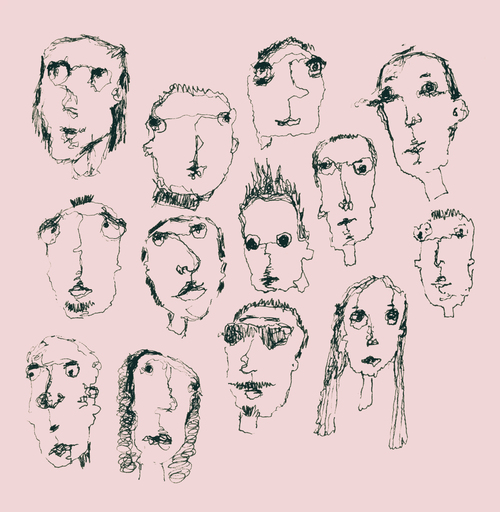
Yeah! One of my favourite drawings is one that I recently created when I was in a state of anxiety. It was during semester break, and I was in the car coming back from the coast. I really like being at Uni because it gives me a sense of direction, and without this, in the holidays, I found myself in a bad headspace. So I sat there using the movements of the car to draw these faces. I was working with black pen tracing continuous lines. It was very liberating because the style is so unrealistic. You have to get into the space of not thinking about what it is you’re drawing because if you think about it too much it starts to become really forced. That’s why I love working in the car so much. Suddenly you go around a turn and the line becomes wonky. I’m not sure if you see that anxiety in the uneven style but it is definitely interesting for me to look back at it; as one of my drawings that comes most from this space of not being able to cope mentally.
I am aware that you are Christian, how does this affect your art making processes?
The space inside my head is strongly connected to my belief in God. I grew up in a Christian house, and we always went to church. When you’re little I guess all you are doing is going along with your parents. You might have a bit of an understanding of faith but you don’t really start to take it that seriously until someone actually explains it to you. For me that someone was my nanna. She ran a holiday program at our church when I was eight. We talked about bible stories, and the question of whether or not we wanted to ask God into our hearts, which I decided I did. Then I went through a period around the age of 13 or 14 of seriously questioning what it was that I actually believed in. I think you’re always going through periods of questioning. At least for me that’s what it means to have faith. I have to try to reconcile the idea that God loves everyone and the life he has created for us is meant to be good and great, with the fact that I know God does love everyone but life is not always good and great all the time.
At Art School the culture sometimes feels about as far from that of the Christian community as you can get. I appreciate the challenges that this presents though, and faith does strongly affect my creativity. I believe that it is God that has given me this passion for creating and making art, and that one of the best ways I can honour him is through doing that. These beliefs drive the reasoning behind why I make art more than the actual physical conceptualisation of work. The world we live in may be very secular but this is always a little thought process in the back of my head; how can I best use the gifts God has given me, to glorify him?
How would you describe your experiences of the culture of art school?
In terms of Art School culture, I am aware that there are a lot of stereotypes that people attach to me being here. People love to make fun of the whole thing and ask if I sit around all day playing with crayons. Even I joke about this with people, saying that going to Art School is me putting off life decisions for another 3 years. It’s actually not though. I do genuinely want to be here, but it is very intense. Suddenly something that I did in my spare time has become full time, and I think sometimes it’s fun to joke about things that you feel are really serious. I guess it’s something that people do genuinely find hard to understand too, so maybe it is just easier to humour them sometimes.
Admittedly, you do see weird stuff at Art School. There is paint on all the floors, and life drawing in the corridors, and artworks in the middle of the trees. If you walk down to Union Court, it’s a very different feel. I definitely found arriving at Art School a huge culture shock. Suddenly you go from being known as the arty one at high school to having to get used to the fact that everyone around you is just as interesting, and just as creative, and just as talented as you think you are. At high school I spent two years basically doing the same thing. I was really comfortable in what I was learning. Now I’m constantly being challenged and pushed in new directions.
What do you see the power of art as being? Is conveying a message through your art important to you?
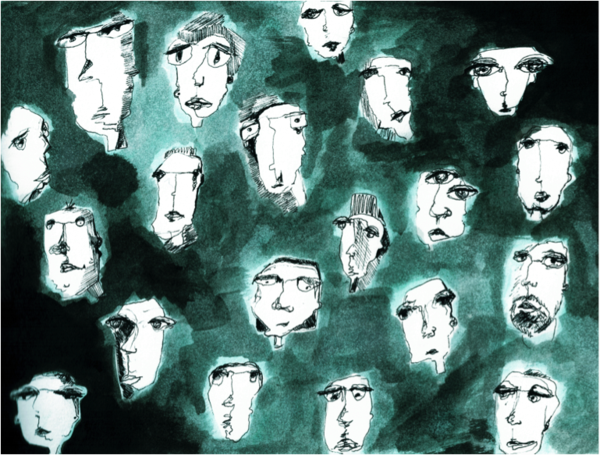
For sure. Something I brought to Art School from high school is the importance of having something to say through your art practise. My teachers always drilled that into me. I don’t like the idea of people speaking just because they can. A little while ago I was working on a zine called Arcadia. I got the idea because one of my friends asked me why I make art. At the time I was very stressed and anxious about a lot of things, and I got really frustrated that I couldn’t think of a good answer. The idea became to compile a bunch of works, which sort of represented what it is like for me to live with anxiety. Arcadia means spaces of calm, and I wanted to play with mixing artworks of calming spaces with ones that came from headspaces that weren’t calm. I had a spare page to fill and I really love playing around with pens. I drew a bunch of these faces and then scanned them into my computer. I love weird oceanic colours, so I tried to bring that into it through the background, which I did in Photoshop. The whole project got kind of messy though. I think I was running with an idea where I wasn’t really sure what I was saying. Mental illness does come into a lot of artwork, but I think sometimes it is glorified in art as a beautiful or desirable thing, which frustrates me. I want to be able to refine this idea and finish it when I do know what I want to say.
Finally, would you call yourself an artist?
I’m not sure when I get to call myself an artist, if ever. I think the art world is a very interesting place to be, but I also don’t want people outside it to think that I’m trying to pretentious by calling myself an artist. I just love making art and if that means that I can call myself an artist then great. For the time being, I’m terrified of leaving Art School. If I went out into the world right now I don’t know what I’d do. I’m hoping that by the time I graduate I’ll be so filled with all the things I’ve learnt here that that will be enough.
demos journal acknowledges the Ngambri and Ngunnawal people on whose lands this journal is made and imagined. Sovereignty of these lands was never ceded. Always Was Always Will Be Aboriginal Land.
Web Design by Rio Ramintas
Build by Charlotte McLachlan
demos journal © 2026. All Rights Reserved.


