
By Dr Sara Abdelmawgoud
Amnesty Gaza representative and member of Amnesty International’s Activism Leadership Committee
Civil society has long been the arena where ordinary people contest power, demand justice, and force institutions to shift. Theorists describe it as the ‘space between state and market,’ but in practice it is the place where unions, Non-Governmental Organisations (NGOs), student groups, faith communities and solidarity networks make their voices heard. In Australia, civil society has been central to movements against conscription during World War I, anti-Vietnam War protests, Aboriginal rights campaigns, and solidarity with anti-apartheid struggles.
Within this ecology, different organisations play complementary roles. Grassroots student groups create urgency, NGOs leverage international law and legitimacy, unions provide resources and protection, and faith-based organisations contribute moral weight. These roles often overlap and sometimes even clash, but together they build the kind of pressure that forces reluctant institutions to act.
This article examines how civil society operates as a space for change through the case of the 2024 Australian National University (ANU) Gaza Solidarity Encampment. Over 110 days, the Encampment showed how diverse actors can challenge power, sustain collective action and navigate internal tensions. Two groups played key roles: Amnesty International Australia, which framed the protests in legal, political, and human rights terms; and the Muslim community, which sustained the camp through everyday acts of solidarity.
I reflect on these roles from my perspective as a Gaza Representative and member of Amnesty International’s Activist Leadership Committee, as well as an Arab Muslim who worked closely with the Muslim community throughout the Encampment. In doing so, I explore both the contributions and the challenges these groups faced, showing how the Encampment highlighted the possibilities and limits of civil society as a space for change.
From October 2023, Palestinians suffered relentless bombings and a humanitarian catastrophe. By April 2024, the United Nations reported over 34,000 Palestinian deaths and an unfolding genocide (OCHA, 2024). Yet the Australian government remained hesitant, strong in its condemnation of Hamas’s October attacks, but reluctant to press for a ceasefire, offering only limited statements throughout 2024 and formally backing a ceasefire in January 2025 (Prime Minister of Australia, 2025).
Civil society was already sounding the alarm. In October 2023, 77 organisations, from trade unions and faith groups to human rights NGOs, including Amnesty International Australia, issued a joint statement demanding Australia ‘immediately call for a ceasefire and for an end to the targeting of civilians in Gaza’ (Amnesty International Australia, 2023).
Despite this, Australia continued its arms exports to Israel and resisted any challenge to anti-Israeli policies (Burgess 2023). Activists pointed to Australia’s role in supplying military components, with banners in Australia declaring ‘No weapons for Israel’, ‘Stop Arming Israel and ‘Recognise a Palestinian state’’.

At the same time, anger was expressed not only through statements. From October 2023 through 2024, Australia witnessed some of the largest pro-Palestine solidarity demonstrations in its history. In Sydney, Melbourne, and Canberra, tens of thousands of people marched week after week, demanding an immediate ceasefire and an end to Australia’s complicity. Led by Palestinians and supported by unions, churches, Arab, and Muslim communities and civil society groups, these protests revealed the breadth of national opposition to the government’s stance. Against this backdrop of mass mobilisation and political inaction, students carried the movement onto their campuses, continuing the universities’ longstanding role in resistance movements..
Within this political climate, ANU students turned to direct action. In late April 2024, students at ANU – following a chain of university Encampments from the US (Columbia) to Sydney (23 April) and Melbourne (25 April) – established a Gaza Solidarity camp on Kambri Lawn (29 April). The ANU encampment brought together members of the student union (ANUSA), the Students & Staff Against War network, Socialist Alternative, and unaffiliated students.
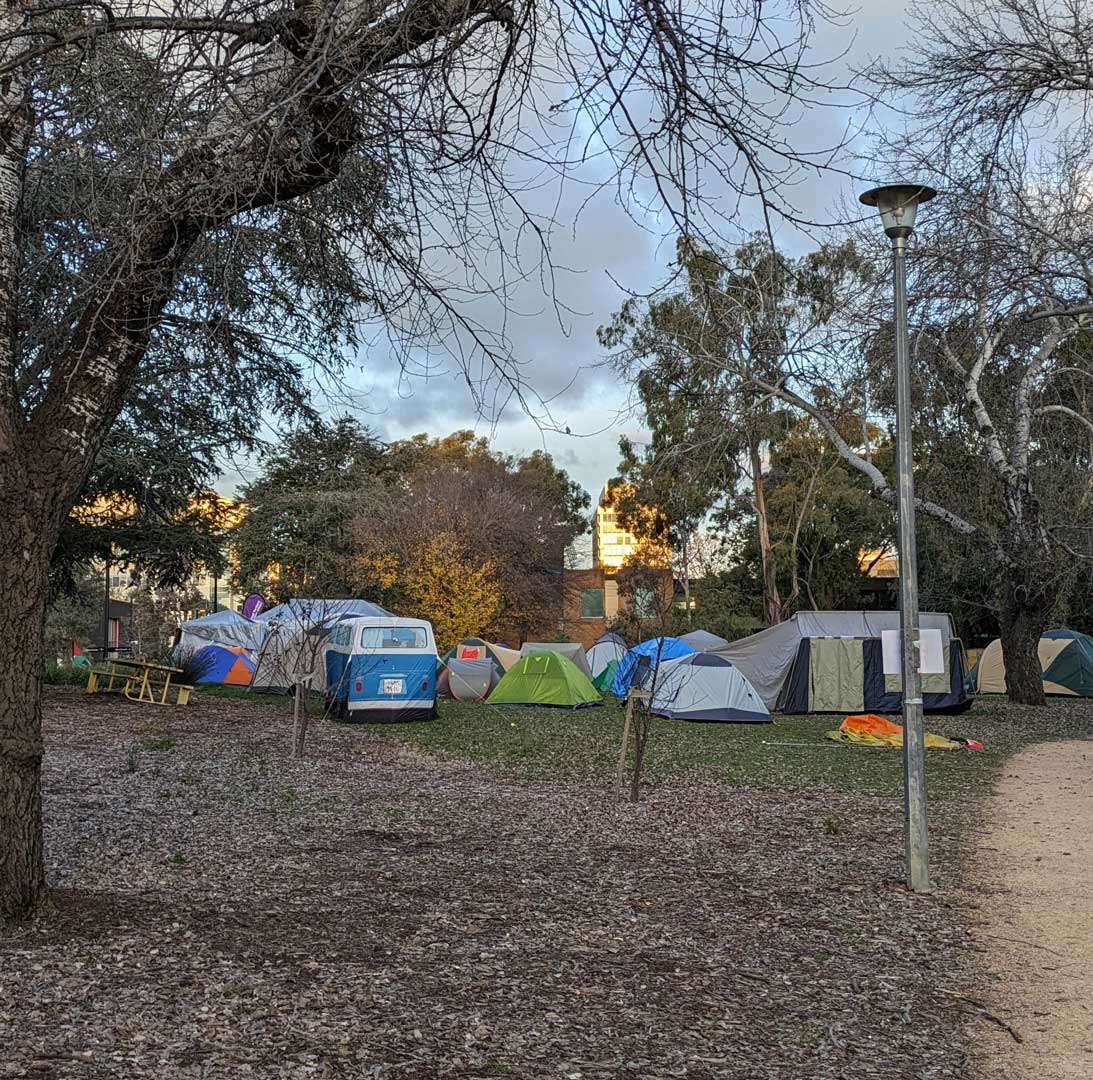
Tents quickly appeared across Kambri Lawn, decorated with banners calling for divestment and ceasefire. Signs declared the site a ‘Liberated Zone’ and carried slogans such as ‘Freedom for Palestine’ and ‘The Wall Must Fall,’ symbolically reclaiming Kambri Lawn as a space of resistance and solidarity with Gaza. Students slept overnight in tents throughout the cold Canberra winter, holding near-dally rallies that often drew large crowds at lunchtime. Over time, the camp developed routines of speeches, talks, and gatherings, while community members visited in the evenings to share hot meals. In this way, Kambri Lawn became both a political protest and a community hub of solidarity.

The protesters’ demands centred on divestment and accountability. They called on ANU to cut ties with weapons manufacturers, disclose and divest from investments linked to Gaza’s destruction, and sever academic partnerships with Israeli institutions such as the Hebrew University.
The Encampment quickly became a focal point of debate on campus. Daily rallies drew hundreds of supporters including union representatives, peace networks, faith-based and other groups. Counter-protesters, including pro-Israel students and external groups, also gathered, creating tense moments at the university’s central hub (Kambri Lawn).
To understand the encampment’s power, we must see it as part of a wider civil society coalition, each playing a different role. These roles did not always fit neatly together, but together they gave the movement strength. Social movement scholars such as McAdam, Tarrow, and Tilly define movements as ‘sustained challenges to power-holders in the name of a population living under the jurisdiction of those power-holders’ (Batliwala, 2021). Social movements typically include three elements: contention (acts of protest and disruption), collective action (people acting together), and sustained interaction with elites and institutions. They succeed when disruption, such as rallies, sit-ins, or encampments, is linked to organised advocacy that forces decision-makers to respond.
This combination of protest and institutional engagement has appeared many times in Australia’s history, from anti-conscription campaigns during World War I to the Vietnam War moratoriums and solidarity with those fighting South African apartheid. The Gaza Solidarity Encampments were the latest expression of this tradition: public, disruptive, and sustained, but also tied to formal campaigns for divestment, human rights framing and political advocacy. Students themselves established the Encampment, set its main goals, led the planning and managed its relationship with the university, ensuring that the protest remained focused and visible,while other groups played different roles in providing legal support, protection and resources
These roles were not fixed, at times they overlapped, but together they created a coalition that sustained the movement. Two actors played significant roles: Amnesty International and the Muslim community whose solidarity and practical support helped sustain the encampment over its 110 days.
Amnesty International Australia played an important role by framing the encampments as a matter of human rights and democratic freedoms. Because Palestine was designated as one of Amnesty’s crisis campaigns, it was treated as an organisational priority, drawing staff time and resources to ensure consistent national support. In particular, Amnesty focused on two main protections within the encampment: freedom of speech and the right to protest. This broad framing created the foundation for more specific advocacy in defence of these rights.
Amnesty consistently stressed that freedom of speech and the right to protest were at the heart of the Encampments. Guided by this framing, they followed two main advocacy approaches. First, together with other organisations, Amnesty wrote directly to the ANU Vice-Chancellor stressing the importance of upholding freedom of speech, academic freedom, and the right to protest in relation to the student Encampment. The letter emphasised that protest is a vital democratic outlet, warned against disproportionate restrictions, and reminded the university of its obligations under international human rights law.
At the same time, Amnesty made a public demand through its Solidarity Statement with Student Protests, affirming that freedom of expression and the right to protest were central to the encampments (AIA, 2024). They also launched a campaign urging supporters to write to university Vice-chancellors to protect student protest rights (Amnesty International Australia, 2024b). By combining direct institutional dialogue with public mobilisation, Amnesty sought to hold universities accountable both internally and externally.
‘As Israel's brutal war in Gaza grows more devastating each day, it’s no wonder so many students are moved to protest. All states must respect and ensure the right of peaceful assembly, urgently suspend arms transfers to Israel and call for a ceasefire now.’
— Amnesty International Australia, Solidarity Statement with Student Protests (2024c)
Despite this emphasis on legitimacy, the ANU Encampment faced escalating repression. Amnesty International, in collaboration with other organisations such as the Australian Democracy Network, contrasted the peaceful nature of the Encampments with alleged attempts by ANU to ban or surveil protests and students. Reports from students, educators, and independent observers indicated that ANU placed the Encampment under round-the-clock surveillance, carried out invasive ‘health and safety’ inspections, and cut off electricity. Many students were also subjected to disciplinary procedures: two were expelled and ten others faced formal inquiries, underscoring the high stakes of student activism. Amnesty also warned that universities’ use of surveillance technologies such as CCTV and Wi-Fi tracking against student protesters may breach human rights law (Amnesty International Australia, 2024a).
As part of this collaboration, the Australian Democracy Network sought to document the impact of these measures by reaching out through Amnesty’s Gaza representatives to affected ANU students. This process was not straightforward: many students were fearful of breaking confidentiality rules or facing further disciplinary action from the university. This climate of fear created a barrier to documenting incidents, even among those willing to share their experiences. Some students provided accounts, but they often hesitated, worried they could face the same repercussions as their peers who had been expelled, referred to police or subjected to formal inquiries.
Amnesty’s role went beyond defending protest rights in principle; it also provided practical support. Throughout the 110 days of the Encampment, staff and Gaza Representatives maintained regular contact with students, offering legal and media resources, and connected them with allied organisations. Early in the encampment, Amnesty recognised the challenges students faced under intense public and media scrutiny. To help them communicate their message more safely and effectively, Amnesty provided media support through its communications team. This support equipped students with strategies for engaging with journalists, managing interviews, and ensuring that their demands and perspectives were conveyed clearly to the wider public.
As tensions escalated, students came under greater surveillance and disciplinary measures. Expulsions, police referrals, and heavy monitoring created a climate of fear, and students increasingly sought legal advice to understand their rights. Amnesty facilitated this by connecting them with independent lawyers from a third-party law firm who volunteered to provide free legal support. This ensured that students had access to confidential, professional guidance at a time when they felt particularly vulnerable. For many, this was invaluable in navigating the risks of activism under such intense scrutiny.
At the height of the confrontation, when the university issued the evacuation order, Amnesty’s support became even more immediate. On that day, two of Encampment organisers contacted Amnesty’s Gaza representative, seeking support as part of the wider solidarity network. Amnesty responded by releasing a media statement and sending a formal email to the ANU administration urging the university to respect students’ rights to protest. In this letter, Amnesty reiterated that the right to peaceful protest, including freedom of expression, assembly and association, is protected under international law. It emphasised that this protection extends to civil disobedience and other forms of non-violent direct action, and that universities have a duty to respect and uphold these rights. The letter also reminded ANU that protests should not be broken up or shut down except in cases of widespread violence or credible threats of such violence, and that force should never be used against protesters, even against unlawful protests. To reinforce these principles, Amnesty drew on research into violence against student protesters in the United States and warned ANU against involving police,stressing that dissent should be met with dialogue rather than force.
Alongside this advocacy, Amnesty also provided legal observers, and the lawyers they had mobilised were present on the ANU lawns to support students during this critical moment. Beyond immediate responses, Amnesty also helped students strengthen their longer-term demands. When students analysed ANU’s Socially Responsible Investment (SRI) Policy, Amnesty connected them with the Rights Legal Group. Consultants assisted the students in reviewing the policy, strengthening their case by providing a legal and human rights perspective on investment practices. This support linked protest demands to concrete institutional commitments and gave students the tools to hold ANU accountable to its own stated principles.
By combining this practical assistance with consistent advocacy, Amnesty and its allies reframed the Encampment not as fringe disruptions but as part of Australia’s democratic heritage of dissent. In doing so, they reinforced that student protests should be understood as legitimate expressions of solidarity and conscience, grounded in both international human rights law and civic resistance.
Alongside this public-facing campaign work, Amnesty also coordinated direct support for the encampments. Amnesty managed its connection with the ANU Encampment through a structure that relied on Gaza Representatives, who acted as a bridge between student organisers and Amnesty staff. These representatives maintained direct contact with encampment organisers and provided support where possible. When requests exceeded their capacity, they relayed them to staff for follow-up. In this way, the Gaza Representatives functioned both independently and as a channel into Amnesty’s broader resources.
Behind the scenes, Gaza Representatives across Australia also met weekly with Amnesty staff in strategy and support meetings. These sessions allowed Amnesty to respond quickly to unfolding events, coordinate national messaging, and decide how best to allocate resources. Through this process, requests from the Encampment, such as the need for legal observers, media training, tailored media consultations, and legal connections, were translated into concrete forms of support. Amnesty’s work during the 110 days of the ANU encampment was not without its challenges. The pace of events shifted rapidly, often beyond the organisation’s ability to respond in real time. This pressure was compounded by the fact that Amnesty was supporting not only ANU but also other campus Encampments across Australia, straining staff and resources. Without a permanent Canberra office, Amnesty sometimes relied on partner organisations to provide local support when stretched.
The Gaza Representatives model proved invaluable as a bridge between students and Amnesty staff, yet it also revealed limitations. At times, representatives became overburdened or emotionally affected by the intensity of the work, especially given their close ties to the cause. The combination of emotional involvement, the stress of the ongoing genocide in Gaza, and the racism experienced by students and pro-Palestinians, created significant pressures on wellbeing. Amnesty reminded its representatives of the importance of self-care and taking breaks. While it sought to provide assistance to its members, the situation remained deeply stressful, and sustaining this level of engagement over 110 days was both challenging and demanding.
Despite these challenges, the structure enabled Amnesty to play an important role. Amnesty reframed the Encampment as a human rights issue rather than an illegitimate disruption. Its work illustrates one way civil society drives change: by providing legal, political, and human rights framing that connects student activism to broader democratic traditions. Yet sustaining the Encampment required more than legal defence or rights-based advocacy. It also depended on the everyday solidarity, care and presence of communities particularly from the Muslim community, whose support provided the social grounding that carried the protest through its 110 days.
Social movements are not only driven by formal advocacy or visible protest but are also rooted in everyday practices of care, solidarity and cultural meaning (Vinthagen & Johansson, 2013). Alongside NGOs and student groups, Muslim communities in Canberra played an indispensable role in sustaining the ANU Gaza Solidarity Encampment. Their contribution went beyond rallies and monetary donations, extending into the daily life of the Encampment itself.
The Muslim women, in particular, organised and prepared food that was brought to Kambri Lawn every day after the Encampment meeting, ensuring that students had the support to continue their 110 days of protest. As one of the group explained:
‘We knew the students were under enormous pressure, balancing classes, exams and assessments with the daily work of sustaining the encampment, often while travelling from off-campus housing. Providing meals was our way to ease that load and help the protest endure.’
More than forty Arab and Muslim women created a group called ANU Support – Hot Meals, which became a cornerstone of the encampment’s continuation. These meals were served in the evenings, and although most of the women were not activists or politically engaged, with some having never attended a protest before, they felt compelled to contribute in whatever way they could to sustain the students. What stood out most was their extraordinary attention to detail. Knowing that Canberra nights were bitterly cold and that the University only permitted limited use of ANU buildings, they deliberately prepared hot meals and drinks that would keep the students warm. As one participant explained:
‘We treated them as our kids. We were thinking about variety, about the ingredients, and about serving the food in a good way. We stayed to serve the meals ourselves, because we wanted to show them care.’
Their contribution was more than ideological or religious alignment, but importantly an act of solidarity and community. Differences of political stance or belief were set aside in favour of a shared commitment to support the encampment. In addition to providing meals, the women sometimes celebrated students’ birthdays, offered breakfast, and stayed for conversations, building a sense of family and belonging in the camp. Through these acts of care, the women showed their solidarity by ensuring students were supported, both practically and emotionally, so the Encampment could endure.
The effort, however, was not without challenges. Financial costs quickly mounted, especially on nights when seventy or more students needed meals. The group responded creatively: pooling resources so that two or three households could cook together, occasionally serving only vegetarian or vegan meals to stretch budgets further. Yet the overriding aim remained clear: to ensure the Encampment endured. After the relocation of the camp, both the number of students present and the number of women preparing meals declined, but the commitment to sustaining the protest, in whatever form was possible, never waned.
This everyday work of preparing hot meals was just one expression of a much broader outpouring of solidarity from the Muslim community. I vividly recall the day ANU students announced the start of the Encampment; within hours, messages spread rapidly through community networks, and donations of food, supplies, and money quickly exceeded what was needed. A number of people even offered their homes as collection points, so that others could drop off goods which were then delivered directly to Kambri Lawn. Many community members, even those who never visited the protest, sent items to support it. As the Encampment continued, more donations were collected whenever requests were made. I was one of those who collected donations and used them to buy daily necessities for the Encampment, everything from lights to keep the site visible at night, to mats and coverings to protect against the mud. The speed and scale of this response showed how deeply the community identified with the cause, and how instinctively generosity was transformed into collective action.
The support extended beyond material aid to rapid mobilisation when the students faced threats from the university. When ANU demanded that the Encampment relocate, the students called on the community to gather at Kambri Lawn in defence of their protest. Within minutes, the message spread through Muslim community networks, and many people arrived to stand with the students. The strong turnout demonstrated how deeply the community identified with the Encampment’s struggle. This swift response showed that solidarity was not only expressed through food and donations but also through physical presence at moments of crisis.
Besides this, mosques also stood as powerful symbols of this solidarity. Some imams used Friday prayers to stress the importance of the Encampments as part of a wider struggle for justice, and community leaders encouraged Muslims to donate, visit, and stand alongside the students. In this way, mosques linked everyday acts of care with a broader faith-based duty to resist injustice.
At the same time, Muslim organisations extended this involvement into civic life by providing speakers for rallies, signing joint statements with other civil society groups, and supporting petitions and email campaigns directed at the university. These everyday acts of care and solidarity were not separate from the protest but central to it. By providing food and support, the Muslim community made it possible for the Encampment to continue as a visible space of resistance. This showed how civil society works in different ways: while Amnesty focused on legal and political advocacy, Muslim communities offered practical care and presence. Together, these efforts allowed the encampment to endure and keep its momentum for more than three months.
These examples show just two of the actors who played roles in sustaining the ANU Gaza Solidarity Encampment. They were not alone, other important contributors included ANUSA, the National Tertiary Education Union (NTEU), grassroots peace networks, refugee and anti-racism groups, and faith-based and others. Ultimately, the Encampment drew on a dense web of civil society supports, from NGOs to unions to grassroots collectives, reflecting what social movement scholars describe as resource-mobilisation in a robust civil sector. These diverse actors helped sustain momentum and connect campus demands to national issues.
Every social movement faces moments that test its unity, strategy and resolve. The ANU Gaza Solidarity Encampment was no exception. Beyond its daily routines of rallies, speeches, and solidarity, students also had to navigate difficult choices about how to sustain the protest in the face of pressure from the university and external authorities. These challenges revealed both the movement’s strength and the tensions that inevitably arise when diverse groups come together to sustain a long-term campaign.
One of the main challenges came on 27 May, when university officials ordered tents removed from Kambri Lawn, citing safety concerns. After initial resistance, students voted to relocate to avoid forcible eviction, and by 28 May the camp was moved under threat of police action.
The decision to move was not taken lightly. At first, many students strongly resisted the relocation, arguing that the university’s real aim was to marginalise the Encampment by pushing it into the peripheries of the university, which would lose visibility. In the general meeting that followed, the debate became heated and protracted, involving not only students but also representatives from supporting civil society groups, who brought different perspectives. Some of these interventions helped shift the mood, and eventually a majority of students agreed to relocate.
I was present at this meeting. My own view at the time was that relocation, though painful, would be the safer option. I feared a direct clash with police and the possibility of students being suspended or harmed. But many students took the opposite view. They argued that arrest was preferable to relocation, because it would attract community and media attention to the cause and show they had done nothing illegal. From their perspective, a clash would amplify the movement rather than weaken it.
Ultimately, the students agreed to frame the move as a tactical decision rather than a surrender. Yet in hindsight, I believe this was a mistake. The relocation gave the university exactly what it wanted. In the weeks that followed, ANU gradually undermined the Encampment further by cutting off electricity during the cold Canberra winter, making it increasingly difficult for students to continue.
Scholars of social movements describe these moments as ‘strategic dilemmas’, when activists must choose between confrontation and compromise in ways that can shape the future of the movement (McAdam et al., 2001). The ANU encampment’s relocation illustrates this dilemma. By moving, students avoided a direct clash with police and preserved the camp’s longevity, but they also lost their central symbolic space on Kambri Lawn. The outcome showed both the challenges and resilience of coalition-based activism, where unity requires negotiation among diverse actors with different risk thresholds. It also revealed the influence and pressure that supporting civil society groups can sometimes place on student-led movements, shaping decisions in ways that may diverge from students’ instincts or priorities.
Another significant challenge occurred at the very beginning of the Encampment, when ABC Radio Canberra interviewed two of the student organisers. In that interview one student said: ‘I actually say that Hamas deserve[s] our unconditional support … not because I agree with their strategy … (I have) complete disagreements with that. But…’ The following day, the story ran under the headline: ‘ANU Gaza solidarity Encampment organiser says Hamas ‘deserves our unconditional support’ (ABC News, 2024). The headline was profoundly misleading, stripping away the student’s context and framing the Encampment as extremist.
Regardless of the wording, the nine minutes, during which the students outlined the Encampment’s demands and emphasised the importance of ensuring the safety of all students on campus. For much of the time, the questions were reasonable, until the interviewer suddenly raised the issue of Hamas. The students later acknowledged that such questions distracted from the Encampment’s purpose, yet they chose to respond. This interview needs to be seen in a broader context: in an media environment where mainstream media often approaches Palestine activism with suspicion, outlets such as the ABC appeared less interested in understanding the Encampment than in searching for flaws to exaggerate.
However, this was not the right platform for such a statement, particularly in a place where Hamas is a proscribed terrorist organisation and where media framings of Palestine activism are frequently hostile. The consequences were immediate: ANUSA withdrew visible support for the encampment, the students involved were expelled, and the media amplified the headline to overshadow the Encampment’s actual demands for divestment and human rights.
For the movement, this incident underscored the critical importance of media discipline and framing strategy; lessons every civil society campaign must navigate in order to prevent its message being redefined by others. Major organisations such as Amnesty have already consistently condemned violations of international law by all parties, including Hamas, the Israeli government and other armed groups.
Another challenge the Encampment faced was communication. At times, when we needed to offer support to students, it was difficult to know who the correct contact person was. Within Amnesty, as mentioned, Gaza Representatives were the first point of contact. But at the Encampment itself, particularly in the early weeks, representatives often had to reach out to several different people before receiving a response. The difficulties stemmed directly from the Encampment’s horizontal structure: rather than having a single leader, decisions were made collectively, which made the space more inclusive but also slower and harder to navigate for outsiders. Over time, this improved as relationships developed and informal systems of coordination took shape, for example, students began designating specific roles such as a media contact, which made communication more effective.
Despite these challenges, the Encampment secured tangible results. In July 2024, ANU announced it would amend its investment policy to ‘not invest in controversial weapons manufacturers and civilian small arms manufacturers’ (Petrovic, 2024). Students celebrated this as a partial victory, ‘we’re really happy with the work we’ve made for that policy to be revisited’, even as they recognised the struggle was ongoing.
However, the same period also saw tighter restrictions on student expression. In early 2025, ANU introduced a revised Poster and Banner Policy that tightly regulated how activism could be made visible on campus. Posters were confined to designated noticeboards, all materials had to carry author attribution, and non-affiliated groups were barred from posting. Signs, placards and banners could no longer be displayed freely on campus grounds or attached to offices, doors or buildings outside authorised protest areas. Student leaders condemned these measures as a direct attack on freedom of expression, launching a ‘Tear Down the Poster Policy’ campaign in response.
Viewed in full, the Encampment’s legacy is mixed. On one level, it resulted in a limited but significant adjustment to ANU’s investment policy, and heightened public awareness of weapons divestment. It exposed racism in university systems, drew attention to the gap between ANU’s stated SRI commitments and its actual investments, brought diverse groups together, and amplified the reality of human rights violations in Gaza. On the other hand, those same gains came with trade-offs: increased surveillance, tighter policies and censorship measures that will likely constrain future dissent.
These outcomes are not unusual in social movements, every step forward can trigger pushback from institutions trying to regain control. As the students themselves said, ‘the struggle will never stop’ and they will continue, though in new forms.
Across 110 winter days on Kambri Lawn, the ANU Gaza Solidarity Encampment demonstrated what civil society can do when people come together: students took the lead, NGOs gave legal and political backing, unions offered protection, and Muslim communities provided food and constant support. But it was never easy. Muslim women carried the financial and practical strain of providing meals, night after night. Amnesty gave crucial legal and political support but also struggled with limited staff, resources, and the emotional toll on its Gaza Representatives. Students themselves faced heavy pressures: surveillance, expulsions, relocation, and the challenge of making collective decisions under constant threat. Misleading media coverage added further risk, showing how quickly the story of a movement can be reshaped by others.
From these experiences, several lessons stand out. First, solidarity requires resources, financial, emotional and human, and these must be spread across the movement, so they do not fall on a few. Second, media discipline and training are essential to protect campaigns from being misrepresented and undermined. Third, student-led movements need clear systems of coordination and communication so that decisions can be made under pressure without losing inclusivity. Fourth, NGOs like Amnesty can give vital legitimacy and legal support, but their limits mean alliances with unions, faith groups and community networks are just as important. Finally, institutions will push back with surveillance and restrictions. So campaigns must prepare for these countermeasures and plan how to resist them.
The question now is how we continue the fight: how to turn a limited divestment step into broader accountability, how to protect protest rights against tightening rules, and how to carry forward the trust and solidarity built during those 110 days. The tents are gone, but the struggle for justice remains, and what we learned from the encampment will guide the path ahead.
The Encampment’s real legacy lies in how it expanded the boundaries of civil society in Australia. It showed that when people act together, whether by drafting letters, preparing food, or holding vigil, they can not only sustain protest but also make injustice visible and force institutions to respond. In that sense, the ANU Gaza Solidarity Encampment stands as a victory in itself and as a reminder of the unfinished work of solidarity.
I would like to thank Nikita White (Amnesty Campaigner) and Betty Desalegn (Amnesty Mobilising Coordinator – International) for their tireless work during the encampment, their commitment to real action on the ground, and their quick responses to our questions and concerns.
I am also grateful to Kathryn Allan (former Amnesty International Crisis Strategic Campaigner) and Jay Moran (Amnesty International Gaza Rep and ALC member) for their support throughout this period.
My thanks also go to Emeritus Professor John Minns for his invaluable insights and thoughtful discussions during the writing of this article.
Finally, my deepest thanks go to the Gaza Reps members and everyone who contributed, through time, energy or care, to sustaining the encampment across its 110 days.
ABC News. (2024, April 30). ANU Gaza solidarity encampment organiser says Hamas “deserves our unconditional support” [Audio]. ABC Radio Canberra, Canberra Drive. https://www.abc.net.au/listen/programs/canberra-drive/anu-protest/103792324
Amnesty International Australia. (2023a, October; updated December 22). Joint statement (PDF). https://www.amnesty.org.au/wp-content/uploads/2023/10/Joint-statement-updated-22_12_23.pdf
Amnesty International Australia. (2024a, July 11). Australian universities’ moves to restrict student protests may breach human rights law. https://www.amnesty.org.au/australian-universities-restrict-student-protests-may-breach-human-rights-law/
Amnesty International Australia. (2024b). Protect students’ right to protest (action page). https://www.amnesty.org.au/act-now/studentsrighttoprotest/
Amnesty International Australia. (2024c, May 14). Amnesty International Australia stands in solidarity with university student protests. https://www.amnesty.org.au/solidarity-statement-student-protests/
Batliwala, S. (2021). All about movements: Why building movements creates deeper change (Primer). CREA. https://creaworld.org/wp-content/uploads/2020/12/All-About-Movements_Web.pdf
Burgess, A. (2023, November 15). Australia criticised for 'opaque' defence exports to Israel, as warnings grow of potential to fuel Gaza war crimes. ABC News. https://www.abc.net.au/news/2023-11-15/australia-defence-weapons-exports-israel-hamas-war/103072608
McAdam, D., Tarrow, S., & Tilly, C. (2001). Dynamics of contention. Cambridge University Press. https://doi.org/10.1017/CBO9780511805431
Minister for Foreign Affairs. (2024, June 11). Australia welcomes UN Security Council ceasefire resolution [Media release]. https://www.pm.gov.au/media/middle-east-ceasefire-and-hostage-deal
Petrovic, V. (2024, August 14). ANU changes investment policy to exclude certain arms manufacturers following months of pro-Palestinian protests on campus. ABC News. https://www.abc.net.au/news/2024-08-14/anu-investment-change-arms-manufatcurers-gaza-protest/104222284
The Australian National University. (2025, February 6). Posting on ANU campus (Policy ANUP_8406859). https://policies.anu.edu.au/ppl/document/ANUP_8406859
Vinthagen, S., & Johansson, A. (2013). ‘Everyday resistance’: Exploration of a concept and its theories. Resistance Studies Magazine, (1), 1–46. https://resistance-journal.org/wp-content/uploads/2016/04/Vinthagen-Johansson-2013-Everyday-resistance-Concept-Theory.pdf
United Nations Office for the Coordination of Humanitarian Affairs (OCHA). (2024, April 22). Hostilities in the Gaza Strip and Israel: Flash update #156 [Situation report]. https://www.ochaopt.org/content/hostilities-gaza-strip-and-israel-flash-update-156
demos journal acknowledges the Ngambri and Ngunnawal people on whose lands this journal is made and imagined. Sovereignty of these lands was never ceded. Always Was Always Will Be Aboriginal Land.
Web Design by Rio Ramintas
Build by Charlotte McLachlan
demos journal © 2026. All Rights Reserved.


