
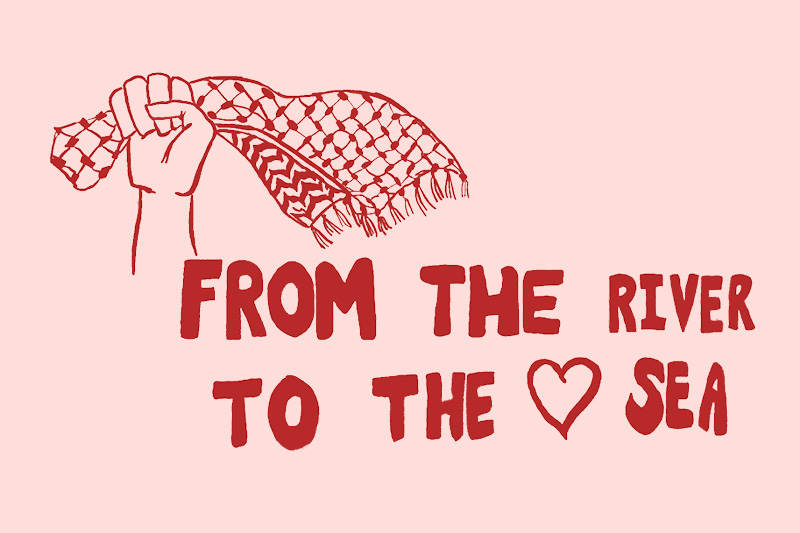
When I first read بطاقـــــــــــــــة هويـــــــــــــــة (Identity Card), a poem by Mahmoud Darwish, I immediately connected to what Darwish signified and evoked through this poem; what living under a militarised occupation means. He writes,
Write down:
I am an Arab
And my ID number is 50,000
I got eight kids
And the ninth is due after the Summer
So will you be mad?
Write down:
I am an Arab
سجل
أنا عربــــــــــــــي
ورقم بطاقتي خمســــــون ألف
واطفالي ثمانيـــــــــــــــة
وتاسعهم سيأتي بعد صيـــــف
فهل تغضـــــــــب؟
: سجل
أنا عربــــــــــــــي
I come from a similar context. I have witnessed the military occupation of lands, air, trees, bodies, and souls. I belong to a land which has been highly militarised since 1947 when the British Empire left one of its colonies in South Asia, partitioning the region into multiple parts. The newly formed nation-states in the region, emerging from colonial rule, deployed military force with impunity, engaging in spectacular forms of genocidal violence, murder, rape, and merciless killings against their own populations, who had earlier participated in the anti-colonial struggles. In doing so, these populations were freed from one colonial occupation only to find themselves subjected to another form of internal colonial-domination.
Colonialism did not end for the peoples inhabiting the fragmented remnants of the former Empire. Instead, it persisted through new forms of domination, subjugation, and control. These continuities of colonial power are evident in the experiences of those oppressed by the ruling elites who emerged after the formal departure of the colonisers. Legal instruments rooted in colonial administrative legacies have been used by these new regimes to suppress any form of dissent. Security forces use brutal forms of torture, extrajudicial detention, sexual violence and enforced disappearance. Under the guise of counterinsurgency measures using laws like the Armed Forces Special Powers Act (AFSPA) which grant them broad powers and impunity to operate without any accountability in the peripheral regions of the postcolonial state of India. AFSPA remains as a colonial relic, modelled on the 1942 Armed Forces Special Powers Ordinance used by the British Indian government to suppress the anticolonial Quit India movement.
These ruling elites who continue to rule these postcolonies have ironically transformed these states as the neo-imperial outpost. Continuing the legacies of colonial-violence inherited and actively maintained through colonial modalities of governance and networks of patronage, including deeply militarised state structures now embedded into the social organisation of everyday lives. The Indian state is one such example which has maintained a tacit support of the genocide of Palestinians in the current phase, due to proximity between the ruling class of Indian elites and Israeli government maintained through an exchange of trade, new military, and surveillance tech, such as Pegasus and Adani-Elbit joint venture. Gautam Adani, an Indian billionaire, has been widely described as having close ties to the current ruling Hindutva (Hindu nationalist) government in India. Through the Adani Group, he leads a consortium that holds a majority stake in and operates the Haifa Port in Israel, while also partnering with Israel’s Elbit Systems in the Adani-Elbit joint venture for the manufacture of weapon systems.
The Indian state’s deepening alignment with Israel reflects a broader pattern of rising authoritarian and exclusionary politics in India. This relationship can be understood in light of India’s ongoing campaign of marginalisation against its minorities, particularly Muslim population, which is marked by processes that systematically strips them from citizenship registers. This has rendered many effectively stateless within their own country, initiating what scholars and observers have described as a process of systemic violence and structural erasure, a form of slow genocide. Rather than dismantling these violent structures and systems during the postcolonial phases, the neo-imperial ruling elite has perfected them, ensuring that the decolonisation of minds, bodies, spaces, and political life never fully took place.
The identity card document evoked in Darwish’s poem is a colonial relic. It is a vestige of colonial governance regimes designed to perpetuate the subjugation and domination of populations rendered stateless, whose identities have been appropriated by these neo-colonising powers. These bureaucratic instruments serve not merely to document identity, but to enforce exclusion: they signal to the dispossessed that they do not belong to the lands they call their ‘homeland.’ Through such documents, histories are contained, reconfigured, and/or erased altogether.
In my homeland where I was born, when military personnel storm a house and demand to see identity cards, the act is not about verifying identity but humiliation. It is a performance of dominance, control, and subjugation. It conveys that recognition is not inherent, but contingent upon validation by the state. The claim to indigeneity is no longer embedded in lived presence or ancestral belonging; it is bureaucratised, locked in official registers controlled by police and military apparatuses. Through these mechanisms, colonial legacies of control and state-power are reproduced under the guise of administrative order.
Darwish poignantly captures this fracture where original inhabitants of the lands are made to prove their own existence and history through pieces of papers. His poetry resonates with the absurdity of dispossession. Reciting Darwish’s poetry to myself reminds me of the profound power of poetry; its ability to bind together fragmented and broken human experiences. In conditions of extreme suffering, pain, and loss, poetry becomes a vessel of meaning, stitching together scattered pieces of life to affirm presence, memory, and resistance.
Poetry and protest function together in similar ways. Both evoke strong emotions and construct a world of futuristic imaginaries built on labyrinths of fragmented realities and broken truths. Life tied together as fragments through metaphors of resilience and suffering, evoking a sense of collectivity and solidarity humanising our world. A world which pushes us away from each other, into a wormhole of individuality where emotions are commodified to generate profits for corporations. Both protest and poetry construct a worldview where people can assemble; sing together, shout together, read together, live together, and most importantly think together.
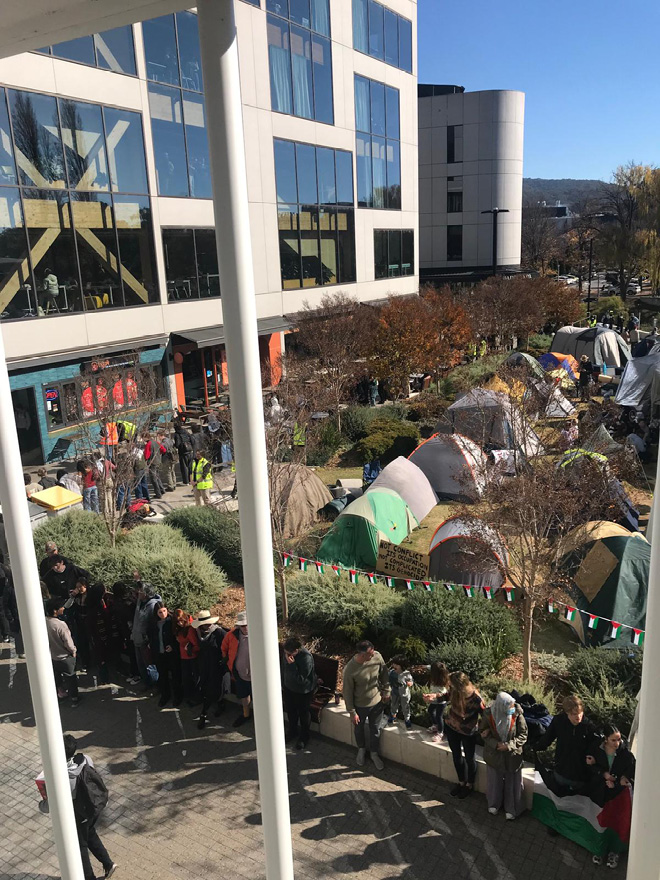
The Australian National University’s (ANU) Encampment set up in solidarity with the people of Gaza in Palestine symbolised this character personified in both poetry and protest. It symbolised refugee camps; people with no protection over their heads except the thin cover of a tent, shielding them from the harsh winters and scorching summers, and offering some assurance to protect them against high-grade military drones and missiles. These Encampments located across university campuses in the Global North attempted to recreate the displacement and disenfranchisement that people in Gaza face. These Encampments were temporarily put on the lands which once belonged to First Nations peoples here in Australia as well in the USA. Now these lands are occupied by predominantly settler-colonial universities. The lands which ANU currently occupies once belonged to the Ngunnawal and the Ngambri peoples.
The Gaza Encampment was set up in the centre of the university, ‘Kambri’. The name Kambri was apparently bestowed to the ANU by representatives of the Little Gudgenby River Tribal Council, Buru Ngunawal Aboriginal Corporation, King Brown Tribal Group, and the Ngarigu Currawong Clan. The official website of Kambri (kambri.com.au) claims that “For the traditional custodians of this land, ‘Kambri’ has been a meeting place for thousands of years.” The website remains silent on where the traditional custodians gather now, if it was their meeting place for thousands of years. Who displaced them, and who now occupies their place?
On April 29 2024, when the camp was set up as a meeting place for students showing solidarity with people of Palestine, it did not take long for the university administration to mobilise its powers to evict the Encampment. The university’s statement on the Encampment claimed that “the Encampment is currently occupying the primary emergency evacuation site for the large number of people living in, visiting and using Kambri and the surrounding area.” Isn’t it ironic to say that the Encampment is occupying, and what?
Occupation, a word rooted in historical amnesia and structural violence on which this university was founded, is used against those who were trying to reclaim the university from its colonial roots. Nevertheless, the university forced the Encampment to be vacated by calling police, ironically on Reconciliation Day, 27 May 2024. Threats by the university administration forced the camp to be relocated from Kambri Lawn to the end of the University Avenue towards the Street Theatre.
The forcible relocation with threats of police action signified how tools of colonial power operate today in micro-ways; the university’s claim was to delegitimise the Encampment as a fire-hazard to open the possibility of a violent police action if it was not relocated. A sense of control and ownership that the university momentarily lost over the occupied lands shook the foundations of an institution to spit out its violence that is usually hidden behind the calm and peaceful veneer of amnesiac structures.
For an occupier, it becomes urgent to delegitimise any claim to ownership of lands or structures by those whom they are trying to displace, remove, or replace. Even if they are students at this university who are the ‘products’ of this knowledge generation site. It is not surprising that we are witnessing how the university is trying to remove and replace the beneficiaries, both academic and non-academic staff, whose unpaid and underpaid wage labour fuels the engines of this university.
What I want to illustrate here is a discussion that reverberated across and beyond the university once the Encampment disbanded after 110 days, on 17th August 2024. A question I have also been asked by many curious friends: What did the Encampment achieve? This question continues to haunt us, especially as the atrocities in Gaza have not ceased. On the contrary, Gaza has been transformed into a spectatorship, an uncanny show of how a genocide can be committed in real time, with impunity and brutal arrogance.
However, beyond the curiosity or even the disdain with which this question is often posed lies a deeper discomfort. We are all, unfortunately, transformed into artificial beings disconnected from a sense of collective responsibility. The university trains us to think alike, to reproduce behaviours and dispositions that ultimately erodes our capacity for empathy, even towards ourselves, forcing us to doubt our own humanity. As the ironic spectacle of solidarity is stretched to its limit, we find ourselves emotionally numbed by the live images of children dying from starvation whether in Gaza, Yemen, Democratic Republic of Congo (DRC), Sudan, or anywhere else. This is how we are forced into complacency, shaped by the very institutions we respect. These institutions are built on façades of liberal humanism but are deeply entrenched in genocidal structures masked by the rhetoric of progress and enlightenment.
This is what Encampments on campuses did: they removed the blind curtains which hid these structures of violence. These protests ruptured the enforced consensus of the status quo, exposing how institutions like universities manufacture the illusion of being humane spaces, even as they remain complicit in structural violence. We are conditioned to trust their authority and demonstrate our allegiance to values meticulously engineered to convince us that these institutions uphold peace while masking the violence embedded within their very foundations.
Even when this status quo is momentarily disrupted, as the Encampments did across the Western liberal world, we witnessed how swiftly the old structures of violence reasserted themselves, unleashing repression on students, making it a public spectacle. These students became the sacrificial lambs of a crumbling liberal empire, punished for daring to expose its contradictions. An empire collapsing under the weight of its own violence, it directs that very violence onto those who resist. In its desperate bid to preserve its inhumanity, it attempts to strip away what remains of our humanity.
Thus, supporting and raising our voice for just rule of law, human rights, and civilian protections, especially for those long cast as ‘uncivilised natives’ is now framed as an act of subversion. Students and staff who participated in the pro-Palestine Encampments are no longer seen as responsible citizens; instead, they are treated as threats, suspects, and dissidents in the eyes of the very institutions that claim to uphold democratic values.
So, what did the Encampments achieve?
A tangible result in a consumerist economy where time is commodified to maximise profits is expected from all of us. To productively consume our time in order to maximise gains is a burdened expectation enforced on us. Engaging in activities considered unproductive or disruptive to these imposed routines is seen as a waste of time. Both protest and poetry unnerve the purpose of the commodification of time. However, if protest and poetry are transformed into commodities of profit, they lose their meaning, purpose, and function.
One of the biggest threats to human creativity is its commodification, by locking human creativity in the bureaucratic and corporate regimes of artificial controls. The function of human creativity is to break these militarised regimented regimes of control, thinking, and subjugation by sustaining and resisting these forms to create new avenues of creative consciousness and collective solidarity.
Poetry and protest are the culmination of this human creativity and collectivity infused in universal human values of unconditional love, care, and affective solidarity. Both protest and poetry, when embedded in values that conforms humanity to us, transform into sites of resistance producing affective solidarities which are otherwise impossible. They are not a distraction or wastage of time; they prepare us for intergenerational resistances against the structures that are designed to sustain oppressions across generations. Thus, what Encampments have achieved is beyond any tangible result; they have disrupted the routines that produce and legitimise violence and have created affective solidarities globally that have crafted a new consciousness against this genocidal violence unleashed by a highly militarised global regime.
The Encampments across the universities in the Global North have constructed alternative radical spaces where we could forge effective solidarity with a population thousands of miles away. This affective solidarity is transcribed onto the spaces and values of those who are distanced and deafened to the voices of innocent civilians being bombed day and night to starvation into a status where even the dead bodies scream of the inhumane suffering they were exposed to. Their hypocrisy has killed their humanity so much that they have instrumentalised factories of knowledge—universities—into sanitised spaces where empathy can not be generated. The lack of empathy has killed the humaneness of these institutions. The knowledge they produce reeks of a crumbling empire forgetting the fate they bestowed upon themselves during World Wars I & II.
The reason these institutions lack the capacity to generate empathy is because they sustain on constructed artificial distance not in the sense of collectivity. This collectivity would have allowed them to produce effective solidarities to build connections with diverse histories and the multiplicity of experiences of people gathering here to meet. Instead, they remain haunted by imagined threats to their privilege, seeing in the displaced and dispossessed the enemies of a “free world” built on their exclusion.
These Encampments symbolised a practice of generating unconditional love, sympathy, solidarity not only for today but also for generations to come. It marked an important transmission of memory and affective solidarities when all ways to communicate to people in Gaza were closed. As people are dying of hunger and starvation in Gaza, this is the least we can do; we can mourn together our lost humanity, of lost values of love, compassion and empathy. Whether it is Gaza or Auschwitz, it is the same diabolical performance of a failed system that has lost any touch with human values; rather it thrives on inducing suffering, horror, gloom and oppression.
The crux of the story is there are two types of people: oppressor and the oppressed. The question that we must all ask beyond the question of what did Encampments achieve: Which side have I chosen to stand with—the oppressor or the oppressed?
This is what Darwish evocatively reminded us in his last verses of the poem, to fear the hunger and anger of the oppressed:
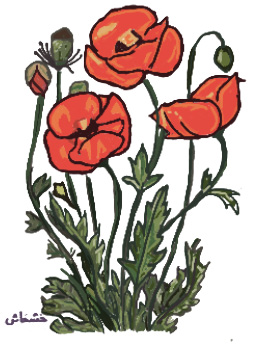
سجل
:برأس الصفحة الاولى
انا لا أكره الناس، ولا أسطو على أحد”
ولكني … اذا ما جعت،
آكل لحم مغتصبي
“حذار… حذار… من جوعي ومن غضبي
Write down
On top of the first page:
“I don’t hate people, and I don’t rob anyone
But… If I starve to death, I’m left with nothing else but
The flesh of my usurper to feed from
So beware, beware of my hunger and anger”
demos journal acknowledges the Ngambri and Ngunnawal people on whose lands this journal is made and imagined. Sovereignty of these lands was never ceded. Always Was Always Will Be Aboriginal Land.
Web Design by Rio Ramintas
Build by Charlotte McLachlan
demos journal © 2026. All Rights Reserved.


