
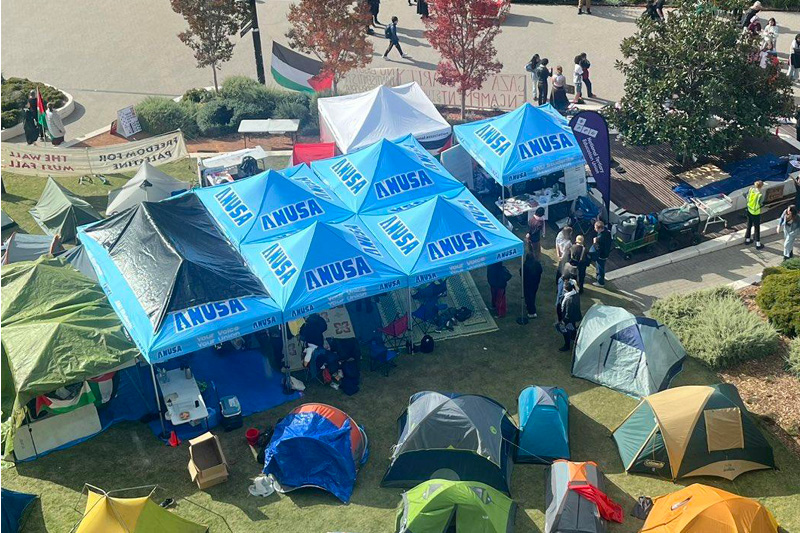
The ANU Gaza Solidarity Encampment was an independent, grassroots collective of students, staff, alumni and general ACT community members who want to center what is happening in Gaza in a local context. We are collectively fighting against colonisation and imperial structures. We focus on Indigenous liberation, both in so-called Australia and in Palestine. We have been united in the fight against ANU’s complicity in the ongoing genocide in Palestine and we will stand in solidarity with all peoples fighting colonial violence and oppression.
One of the central inspirations and a main guidance for our movement is the Aboriginal Tent Embassy. We learn from the history and struggle of First Nations People on this continent, and are guided by their ongoing fight for liberation and land back. We are very grateful for the caretakers of the Tent Embassy with whom we exchanged visits, shared meals, and danced and sang. Your support and solidarity was, and still is, invaluable to all of us.
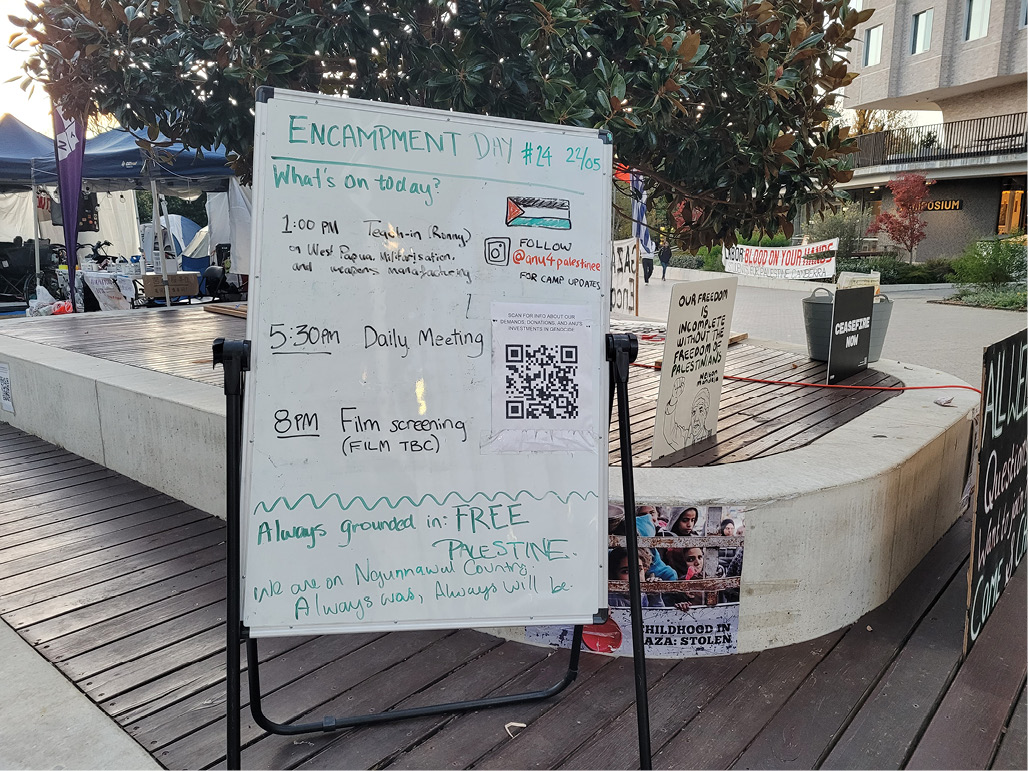
At the Encampment, we aimed to develop relationships with mob, grassroots organisations and groups organising for Indigenous sovereignty and freedom. We actively built solidarity and received support from West Papua, Fiji, Western Sahara, Oromia, Sudan and Kashmir. We seeked to learn more about each of these struggles. We ran lectures and teach-ins and met and invited people involved in these struggles to come and share a meal with us, so that we can build relationships and learn from each other.
We hosted a teach-in by Professor Mazin Qumsiyeh who was visiting from Palestine at the beginning of the Encampment and spoke about Palestine and environmental justice. Early on in the Encampment, as well, the Australia Palestine Advocacy Network showed solid support by providing advocacy training to students at camp. Allies amongst university staff also attended camp and taught us about various topics, including: ‘settler colonialism and ethnic cleansing in the British colonies’, ‘the Berkley free speech movement’, ‘the 1994 ANU chancelry occupation and No Fees campaign’, ‘protest rights, direct action, police powers and authority figures’, ‘the violence of demanding the perfect victim from Sri Lanka to Palestine’, ‘decolonial reparations as worldmaking’, and ‘the history of strikes and protests for First Nations education’. Papuan activists delivered teach-ins on the role of militarisation and weapons companies in West Papua, and on the United Liberation Movement for West Papua. Arab academics had a strong presence and talked about topics like the history of the Palestinian struggle and international solidarity from countries in the Global South. We also organised activities that explored Indigenous cultures of Palestine as a form of resistance. Arab students and community members taught the rest of the Encampment some basic Arabic, and some more complicated things like dabkeh.
At the Encampment, we were a broadbased collective including but not limited to: Palestinians, Arabs, Black, Indigenous, and other People of Colour, anti-zionist Christians, Jews, Muslims, Queers and students with disabilities. We centered groups who value community, collaboration and collective organising. Departments of the ANU Student Association, particularly the BIPOC Department, played a major role in sustaining the encampment. Activist groups on campus like Socialist Alternative and Solidarity were involved in the camp from its onset. Other Canberra-based organisations like Food Not Bombs and Communist Party of Australia also had active roles and formed part of what was ultimately a nonaligned group of pro-justice students.
The Encampment did not have any hierarchical structure, and did not have any representatives. The university management did not understand how we operated and constantly asked to meet with our “leaders” or “representatives”, a certain lack of imagination that comes with their job. The mediation team who helped us liaise with the university, was assembled at the request of the ANU Gaza Solidarity Encampment to mediate with university senior management regarding the demands of the Encampment. The mediation team comprised an independent team of concerned academic staff employed at or retired from the ANU.
We want to be very clear that Palestinian staff and students at ANU, and probably at every other university in so-called australia, never received any support from the university before, during or after the Encampment. In fact, suggestions of engagement with Palestinian students were met with responses containing racist preconditions. Palestinian staff were asked to not wear their keffiyehs and to tone down their Palestinianness. Students at ANU who have lost family members in Gaza were asked to provide death certificates to get extensions on their assignments, whilst the ANU Chancellor herself has refused to take pictures with any Palestinian graduate wearing their traditional clothing during graduation ceremonies. Whilst university management provided a physical safe space on campus for zionist students, they never extended any such support to any Palestinian student. In fact, when anti-zionist Jewish students asked for similar safe spaces they were told that, because of their political beliefs and support for the Encampment, the university cannot extend support to them.
People of many ethnicities and faiths were involved in the Encampment, including Jews, Muslims and Christians. The camp received broad support from progressive anti-zionists amongst the student body, university staff and the wider cross-section of community, activists, and civil society actors from advocacy groups to human rights law associations. Jewish students and community representatives like Jewish Council Australia stood in solidarity with Palestinians through their active involvement in the camp and their outspoken defence of protestors in media and other public forums. Muslim community was heavily involved in the Encampment’s activities and defended those students who faced horrific Islamophobia throughout the 110 days.
This piece is part of preserving the record of who was at camp, in the face of a colonial zionist lobby that will attack anyone who stands against their genocide of Palestinians. The students, staff and community who sustained the Encampment were a diverse collective of people who were either allies of Indigenous liberation movements or were there with their own lived experience of a struggle like that of Palestinians. Let the record show that this diverse collective is what shaped the ANU Gaza Solidarity Encampment, just as similar collectives characterised the many other encampments across this continent and around the world.
demos journal acknowledges the Ngambri and Ngunnawal people on whose lands this journal is made and imagined. Sovereignty of these lands was never ceded. Always Was Always Will Be Aboriginal Land.
Web Design by Rio Ramintas
Build by Charlotte McLachlan
demos journal © 2026. All Rights Reserved.


