
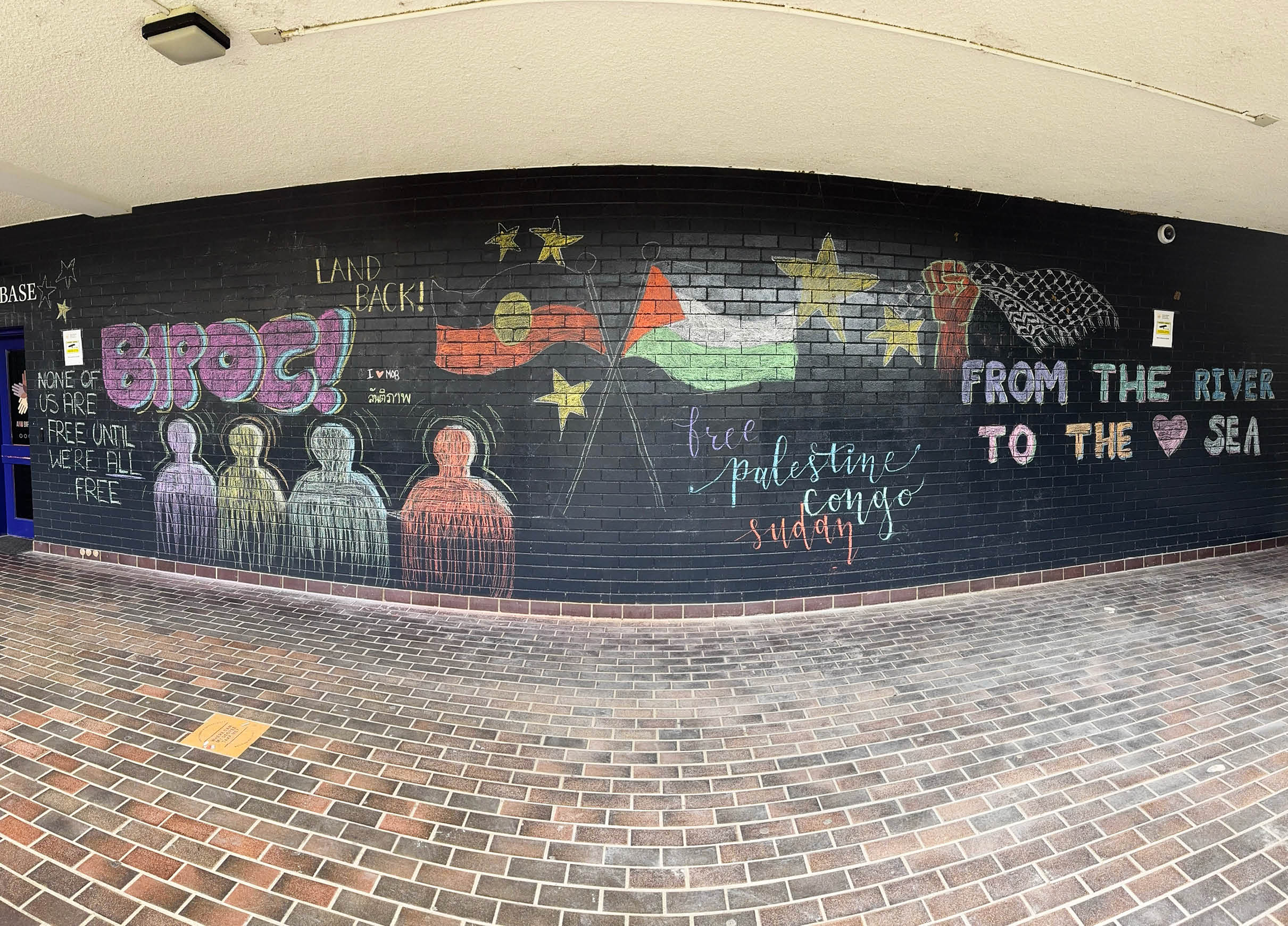
The BIPOC Base at the Australian National University stands as one of the most significant achievements of the ANUSA BIPOC Department. Established through years of relentless advocacy by BIPOC student leaders, it was envisioned as a vital safe space where Black, Indigenous, and People of Colour (BIPOC) students could exist free from the pervasive racism that continues to shape campus experiences. The base was officially launched at the start of 2024, offering not only sanctuary but also an autonomous site for political expression, cultural connection, and community care, a supplement for spaces that are often denied to marginalised students within university settings.
Yet, despite its symbolic and practical importance, the BIPOC Base has been persistently undermined by institutional inaction and, increasingly, direct antagonism from the university itself. An examination of the events surrounding the 2024 chalk mural controversy, explores the implications for student autonomy, BIPOC safety, and the limits of political expression at the ANU. The events contend that the university’s response exposes a broader pattern of silencing racialised student voices, revealing the fragility of institutional commitments to equity and inclusion when they are confronted with political dissent.
The BIPOC Base was established not merely as a common room, but as a counter-space in the truest sense, resisting the whiteness of dominant campus spaces and providing BIPOC students a rare zone of self-determination. It is a place where trauma can be spoken without translation, where cultural expression is not marginal but central, and where organising can occur without scrutiny. As a space carved out by and for racialised students, its existence asserts a right to claim belonging and safety on a campus where such things are not always guaranteed.
For years, BIPOC students at ANU have documented how racism manifests not only through interpersonal encounters but through institutional dynamics: the underrepresentation of racialised staff, Eurocentric curricula, lack of accountability in response to racial harassment, all of which has been detailed in our Racism Reports (ANU BIPOC Department 2024). In this context, the Base is more than symbolic,it is essential, affirming the legitimacy of BIPOC student experiences and offers a rare site of cultural and political empowerment.
In early 2024, the ANUSA BIPOC Department coordinated a community art initiative where students decorated the exterior of the BIPOC Base with a chalk mural expressing solidarity with the Palestinian struggle. The murals included imagery and text linking global struggles against racism and settler-colonialism, including the phrase “from the river to the sea”, a slogan interpreted by many as an expression of Palestinian liberation and one supported by the department.
Almost immediately, the mural became a target of repeated vandalism. Despite several requests for intervention, ANU Security failed to provide adequate protection or follow through on promised safeguards such as increased patrols or CCTV signage. On the 25th of September, ANUSA passed a motion in support of the mural, condemning the repeated acts of vandalism and affirming the department’s right to political expression (ANUSA SRC 2024). However, university authorities remained largely unresponsive, despite pleas from the BIPOC Officer of the time.
Matters escalated when the mural was fully erased by an individual unaffiliated with the university, a fact confirmed via email by ANU Security’s own investigation. In response, the BIPOC Department organised a restoration event, reaffirming both its political message and its right to self-expression within an autonomous space. Prior to the event, the then-BIPOC Officer met with Deputy Vice-Chancellor Grady Venville to raise concerns about student safety in light of these repeated intrusions. Rather than prioritising the welfare of BIPOC students or acknowledging the pattern of racist vandalism, the Deputy VC shifted the conversation toward the supposed inappropriateness of the mural’s political content.
Specifically, Venville objected to the phrase “from the river to the sea,” asserting that it made some students “feel unsafe.” This framing positioned pro-Palestinian advocacy as a threat to campus safety while ignoring actual threats to BIPOC students which exemplified a broader institutional pattern of conflating discomfort with harm and using this rhetoric to censor racialised political expression.
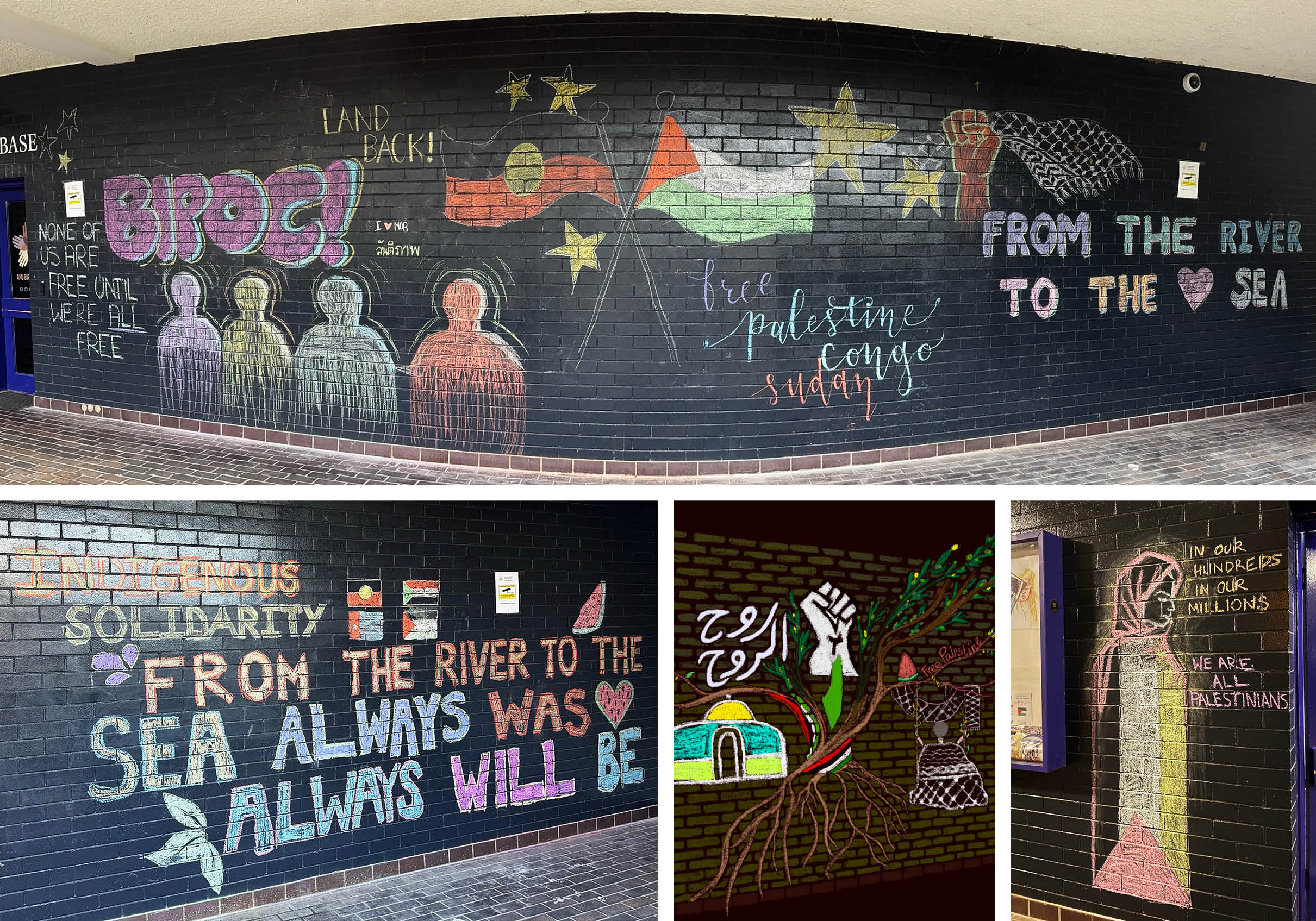
Even though the Deputy VC had made (unofficial and non-directive) objections, the department proceeded with the mural restoration, citing the university’s earlier assurance that the mural was permissible and their right to self-determination within an autonomous space. In a powerful display of community solidarity, BIPOC students and allies came together on the 10th of October to recreate the mural. This act of unity proved fruitless as within 12 hours, the mural was erased once again but this time by ANU facilities staff on behalf of the university.
Shortly thereafter, the Deputy VC issued a formal communication accusing the BIPOC Department of “breaching a university directive,” demanding payment for the “cleaning,” and threatening the department with the potential revocation of the BIPOC Base itself. Notably, there was no official written directive prohibiting the mural at the time, nor has ANU publicly committed to a stance on the phrase in question.
This sequence of events raises serious concerns about the university’s respect for student autonomy, especially within designated cultural and political spaces. It also signals a dangerous precedent where the university administration may unilaterally redefine what constitutes “appropriate” political expression and deploy punitive threats against those who resist.

Throughout the controversy, the concept of “safety” was repeatedly invoked but noticeably its application was selective in nature. While the university argued that the mural compromised the safety of students offended by its content, no such urgency was shown toward BIPOC students whose space had been repeatedly vandalised and disrespected.
This asymmetry in whose safety is prioritised is deeply revealing. It suggests that BIPOC safety is conditional: recognised only when it does not conflict with institutional interests or dominant political sensibilities. Conversely, discomfort expressed by non-racialised or pro-Israel students is treated with immediate concern, even when it involves censoring the speech of others. The invocation of “feeling unsafe” becomes a rhetorical tool, not a consistent standard, weaponised to delegitimise marginalised perspectives.
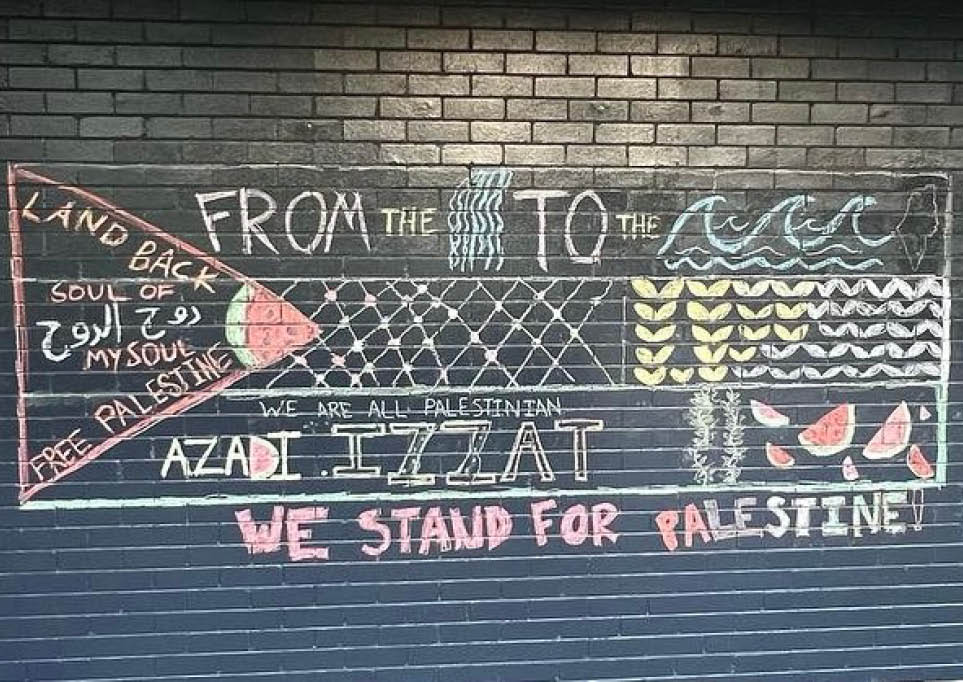
The BIPOC Department has long been a site of political organising in solidarity with oppressed peoples globally, including Indigenous peoples on this continent, Black liberation movements, and, crucially, Palestinian resistance. These solidarities are not incidental but are foundational to how BIPOC students understand and resist systemic violence in their lives.
For ANU to treat pro-Palestinian advocacy as inherently threatening, while ignoring the material harm experienced by BIPOC students, is to effectively delegitimise a core aspect of the department’s work. Moreover, it signals to Palestinian students that their political identity is incompatible with institutional recognition, further marginalising them within a campus community that claims to value diversity.
ANU has repeatedly claimed to champion equity, diversity, and inclusion but yet the response to the BIPOC Base mural incident starkly contrasts with these stated values. The aforementioned morals cannot be meaningful if they evaporate the moment marginalised students speak in ways that challenge the status quo. What unfolded in this case was not a neutral enforcement of policy, but a political decision to silence a form of speech that the university found inconvenient or controversial.
Unfortunately, such double standards are not new and have been observed across Australian universities, with racialised students, particularly those critical of settler-colonialism, capitalism, or imperialism, have found themselves censored or surveilled under the guise of neutrality. The danger lies in the institutionalisation of this pattern, where student-led political action is stifled not through direct prohibition but through bureaucratic pressure, vague threats, and manufactured outrage.
Not wanting this situation to be swept under the rug, the BIPOC Department continued the 2024 conversation regarding the mural into 2025. As the BIPOC Officer of 2025, during a Student Representative Council meeting, I moved a motion that proposed a series of actions to ensure accountability.
On the 19th of March, I was successful in obtaining enough votes in favour of passing the motion and thus enshrining the protection and support of BIPOC student’s freedom of speech and political expression in ANUSA policy.

The suppression of the BIPOC Base mural did not end with its erasure in 2024 but has continued into 2025, revealing how institutional power can shift rationales to legitimise censorship. In recent months, the Deputy Vice-Chancellor authorised the mural’s removal again, first citing claims of potential “discrimination,” then later invoking the poorly received Poster Policy and even the jurisdiction of the National Capital Authority. These shifting justifications not only expose a lack of transparency but also highlight the selective enforcement of policies, given the continued presence of other chalk murals on campus that remain untouched. Particularly concerning is the exclusionary communication process: rather than engaging directly with the BIPOC Department, the DVC initially communicated only through intermediaries, ignoring the Officer directly responsible for the Base. This disregard undermines the Department’s autonomy and accountability to its own community, leaving BIPOC students frustrated, disillusioned, and questioning the integrity of institutional commitments to diversity and inclusion.
Meetings with the DVC and ANU Security staff have produced apologies and vague promises of policy review, yet the repeated erasure of the mural (most recently during Bush Week 2025) has reinforced student perceptions that ANU deploys bureaucratic tools to stifle activism when it unsettles dominant narratives. The manipulation of “safety” and “policy compliance” to silence racialised political expression demonstrates the fragility of the freedoms supposedly afforded to marginalised students, and the ongoing precarity of spaces won through struggle.
The struggle over the BIPOC Base mural is about more than a wall or a slogan but at its core is about the right of marginalised students to exist, to organise, and to express themselves politically within a university that often treats them as conditional guests. The ANU’s response reveals the limits of institutional allyship, especially when racial justice intersects with contentious political issues. Despite these challenges, the BIPOC Department remains firm in its commitment to resistance. We will not be silenced. We will continue to organise. And we will continue to defend the spaces we fought so hard to build.
ANU BIPOC Department (2024). Publications. Australian National University Black and Indigenous People of Colour Department. <https://www.anubipocdepartment.com.au/publications>
ANUSA SRC (2024). ‘Item 5.6 BIPOC STUDENTS DESERVE TO BE SAFE & SAFE SPACES SHOULD STAY SAFE’ Agenda of ANUSA Student Representative Council meeting 25 September 2024, Zoom and Haydon Allen Building, Australian National University.
demos journal acknowledges the Ngambri and Ngunnawal people on whose lands this journal is made and imagined. Sovereignty of these lands was never ceded. Always Was Always Will Be Aboriginal Land.
Web Design by Rio Ramintas
Build by Charlotte McLachlan
demos journal © 2026. All Rights Reserved.


