

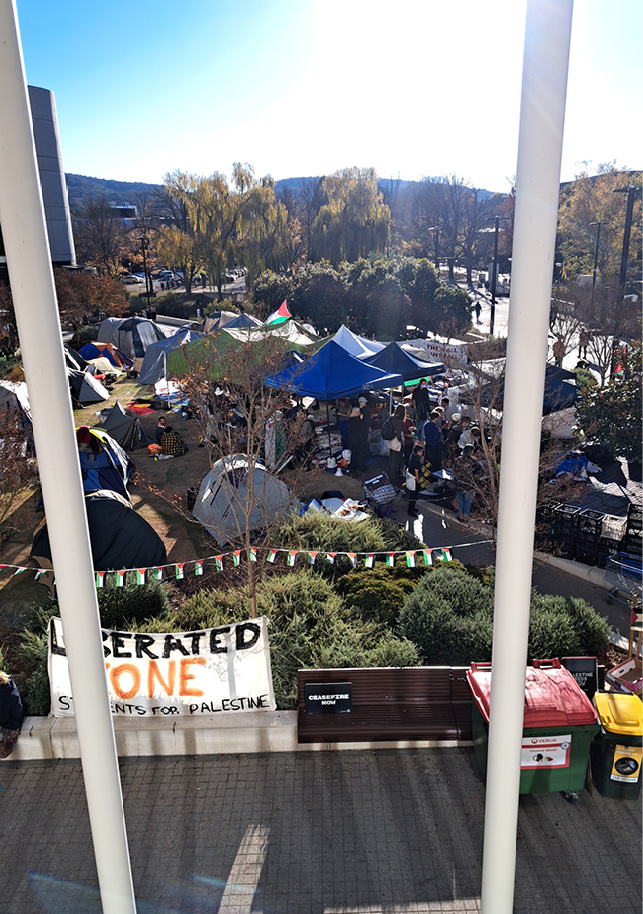
In early 2024, as other student groups in Australia and elsewhere began establishing encampments on university campuses, students at the Australian National University (ANU) established the ANU Gaza Solidarity Encampment at Kambri. The Encampment demanded accountability, disclosure of relationships; financial, educational, and research-related with the institutions and machinery of genocide in Israel, and a broader divestment from these relationships. Open letters, petitions, and protests were met with little response. As the Gaza genocide intensified, staff and students at ANU demanded a response from the University. The Encampment was central to pushing this demand, insisting that the university community reckoned with genocide and publicising an antagonism with a university management that was seemingly more concerned with avoiding controversy and carrying on business as usual.
This positioned ANU students as part of a transnational solidarity movement working towards Palestinian liberation in the face of the horrors of genocide, and prompted questions concerning what this orientation means, and what kind of community the encampment could foster, with eyes on Gaza but also on our place here at a national university on Ngunnawal Ngambri Country.
Walking past the ANU Gaza Solidarity Encampment one Wednesday morning, soon after its establishment, Ben heard someone calling his name. A small group of Jewish students, some of whom he knew, some of whom he was about to meet were gathering to organise and host a Shabbat dinner, using the space they had co-created with so many
others to mark an anti-Zionist presence on campus.
This was one of the first times Ben was welcomed into the Encampment to be in solidarity and community with the students who were developing a distinctive form of political action, one that drew on the example of Palestinian solidarity encampments and occupations on university campuses elsewhere across the world but that was shaped by the particular characteristics of the ANU and those who study here. Our experience was of an open and generative space, one marked by a commitment to Palestinian freedom, by the responsibility of living and acting on Ngunnawal and Ngambri Country, and by a dedication to the kind of inquiry that might develop critical intellectual positions conducive to the work of dismantling settler colonialism.
It became clear very quickly that students had worked to establish the Encampment as a political centre on campus with a generous and sophisticated intellectual life. We worked with them on teach-ins; two of many they organised on the eve of Nakba Day, the 15th of May, in 2024. The anthropologist Marshall Sahlins, often credited with having invented the teach-in in March of 1965, described it as articulating political activism with counterculture, perhaps activating the possibilities presented in the countercultural forms of being (Sahlins 2009, 4). How could we engage the Encampment, on a university campus in solidarity with Gaza? How could we as academics take responsibility, locating ourselves within genealogies of academic commitment in Country and in solidarity with Indigenous peoples?
Ben wanted to speak about studies of settler colonialism, an analytic concept that has become a keyword in framing the occupation of Palestine and understanding its history. The concept allows us to think comparatively and in terms of connections across colonies, to resist exceptionalising Israeli settler colonialism and understand Palestinian dispossession in a broader context. Discussing the genocide more than 75 years after the Nakba, he wanted to think with students and the community at the Encampment in terms of continuities across time as well as space.
As Patrick Wolfe famously argued, invasion is a structure, not an event (Wolfe 1994). Invasion cannot be contained to a meeting on a beach, or a moment of encounter, expulsion, or homicide; it is a relationship that endures so long as settler colonisation endures. On Ngunnawal and Ngambri Country and in Palestine, colonisation is not over; it is the past, the present, and the (immediate) future.
Ben wanted to remember these connections, so he shared stories of the early years of invasion in Dhauwurd Wurrung or Gunditjmara Country in western Victoria where in the 1840s, settler colonists waged war on clans who, in turn, fought a sustained guerilla war against the settlers who dispossessed them. He wanted to insist that even though they were outnumbered and outgunned, though they may have been unable to drive settlers out, they were not defeated. This war does not mark the end of a story of either invasion or Indigenous life. We can trace further colonial interventions that might be considered techniques of elimination, of doing away with Kooris, that have been resisted and survived by peoples who endure.
We then looked across the globe to the ‘removals’ in the 1820s–30s in the United States, removals that cleared most Native nations from the southeast in order to dismantle Native wealth and power in place and to render that land available for white settler invasion. The practice and process of expulsion travelled and can be seen in the Australian colonies and elsewhere around the empire in the following decades. In their logic and aftermath, they echo in the Nakba, revealing the deep historical resonances between settler projects of elimination and the ongoing displacement of Palestinians.
We ended the teach-in by remembering that while it is important to focus on the catastrophes of 1948, we needed to think more broadly, to consider the ongoing process of expulsion that began before that year and continue today, to think of the wide range of technologies of expulsion or transfer that have been deployed, to connect moments across time and understand them in relation. Discussion continued for some time; the Encampment at this point was rising, and students were concerned to think through their practice of solidarity and consider their position in relation to Gaza, to Indigenous peoples here and elsewhere, and to the University.
Beth had attended Ben’s teach-in, and recognised that the emphasis he made on the ongoing processes and structures of settler colonialism offered a way for the Encampment to think about how they might position themselves in relation to both that past and present.
When she gave a teach-in at the Encampment a couple of months later, a day or two after the university cut the power from the camp, she had this in mind: what kind of histories can help us see the continuity of settler colonialism right now? It was the middle of winter and pressures on the Encampment were growing. The cumulative effects of expulsions, police interference, attacks by politicians and biased media reporting were increasingly felt.
Ben had contextualised what was happening in Palestine through discussion of settler colonialism in Australia and the United States. Beth hoped to link the encampment with the longer history of protest and settler colonialism in Australia. That history includes First Nations protests aiming for greater rights, access, and freedoms, enacted through strikes, walk-offs, and camps to powerful effect. She also shared stories of settler protests that have used the same methods, but that instead aimed to take away rights, remove access, and exclude First Nations people from public institutions and spaces.
Beth wanted to convey the duplicity of settler colonialism to supply historical context for the contemporary response to the ANU encampment. She chose to discuss strikes and protests over government schooling as an example. School strikes took place across all jurisdictions, from the 1880s to the 1960s, as settler communities used them to force governments to act on their demands.
The group at the teach-in discussed how the contemporary responses to protests, such as the Encampment, might be understood in relation to this history. We thought about what kinds of protests are permitted and legitimised, and which are derided and demonised. Australian governments’ enduring fixation on school attendance lends power to school strikes as transgressive expressions of youth activism and political power. Some people had participated in the 2018 school strikes for climate and recalled their generally positive social reception. We contrasted this with skipping school for other organised demonstrations, Trans rights was one example given, and the ways that school and university student-led protests for Palestine have been attacked by politicians and media.
To end, we discussed some of the responses to the November 2023 school strike for Palestine. The Guardian reported that ‘Melbourne school students defy the education minister and strike in support of Palestine’ (Ore 2023). It cited the federal Education Minister, Jason Clare’s declaration that ‘school students should be at school during school hours.’ We positioned this kind of response, and that to the ANU Gaza Solidarity Encampment, alongside the reception of the historical settler strikes we’d started with. The pattern is clear: when protest emerges from the margins, it is met with discipline; when it emanates from power, it is met with dialogue.
The takeaways? As ongoing reporting on protests for Palestine show, settler colonial systems don’t tolerate protests that expose them. This is one way in which protests, and encampments, have such force: they are visceral, visible episodes where settler colonial relationships and antagonisms can be laid bare and contested.
These discussions, we think, aimed to help students to historicise their work, to face down those who would push them aside, and to provide intellectual leadership across the university, facing rather than evading responsibilities.Teach-ins can help us understand, contextualise, and operationalise oppositional politics. Here, the students at the Encampment helped us imagine the university otherwise. Not as a bland site of knowledge transfer or for writing to task and being graded, but a more open space of creative dissent, where we can imagine futures of freedom and orient ourselves towards practices of collective action.
Sahlins, M. (2009). The Teach-Ins: Anti-War Protest in the Old Stoned Age. Anthropology Today 25(1), pp. 3–5.
Ore, A. (2023) ‘Melbourne school students defy education minister and strike in support of Palestine,’ Guardian, 23 November 2023, <https://www.theguardian.com/australia-news/2023/nov/23/melbourne-high-school-strike-palestine-cbd>
Wolfe, P. (1994). Nation and MiscegeNation: Discursive Continuity in the Post-Mabo Era. Social Analysis 36, pp. 93-152.
demos journal acknowledges the Ngambri and Ngunnawal people on whose lands this journal is made and imagined. Sovereignty of these lands was never ceded. Always Was Always Will Be Aboriginal Land.
Web Design by Rio Ramintas
Build by Charlotte McLachlan
demos journal © 2026. All Rights Reserved.


