
Reprinted with permission from the publisher (24 May 2024).
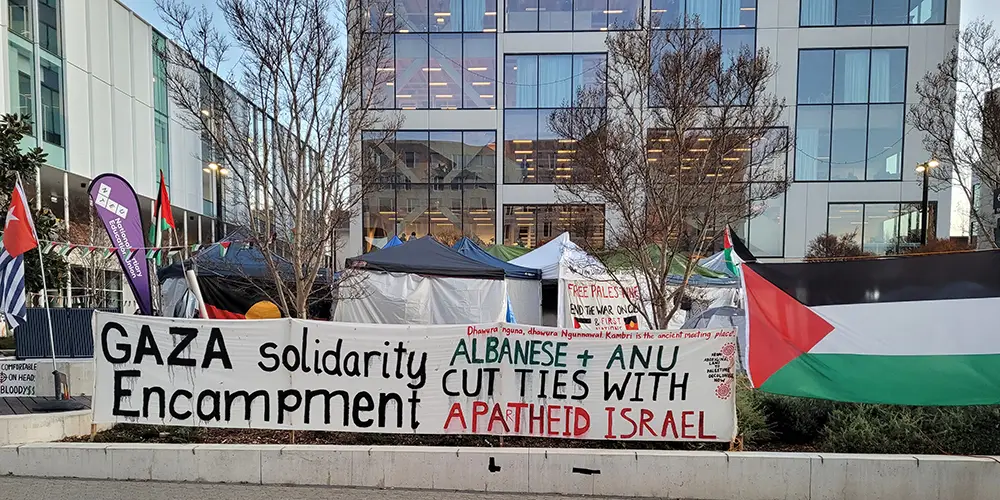
Earlier this week, the ANU Gaza Solidarity Encampment participants invited me, as an NTEU representative, to spend a night in the encampment. I was honoured to accept, and last night endured Canberra’s chilly overnight temperatures to stand (and sleep) in solidarity with university students and their rights to peacefully protest, and to exercise their academic freedom and freedom of speech.
NTEU has been a longstanding supporter of the Palestinian people. Our highest decision-making body, National Council, resolved in 2022 to reconfirm our support for Palestinian self-determination, as well as our opposition to apartheid. That motion also called on NTEU to encourage members to participate in active solidarity with Palestinians. We’ve been proud to have had a large NTEU banner displayed at the encampment from its establishment.
NTEU has previously condemned the 7 October attacks, condemned Hamas, and called for the release of hostages. Our position on those issues has not changed. We have also clearly called for a ceasefire, and reiterated our position that resolution of this issue necessarily requires an end to the occupation of Palestine, recognition of Palestine as a sovereign state, and an end to illegal settlements. Since 7 October, more than 35,000 people in Gaza have been killed in response to the attack. In addition, the Israeli military has destroyed churches, mosques, hospitals, schools, and universities – there are no universities left in Gaza. More recently, on 10 May 2024, and in line with statements by the Australian Council of Trade Unions (ACTU) and Education International (EI), NTEU has released a statement which reiterated our strong support of the right to peacefully protest and exercise both academic freedom and freedom of speech on university campuses. In addition, NTEU called on universities to critically review, disclose, and divest from research and commercial partnerships with firms and entities directly involved in military support for the war on Gaza – a demand clearly in line with the demands of the encampment (and other encampments across the country).
The ANU Gaza Solidarity Encampment was established on 29 April 2024, following the example of students at universities in Australia and overseas. The Canberra community has embraced the encampment. In recent weeks, weekly public protests have marched from their regular location in Garema Place in Canberra to Kambri, the heart of the ANU and site of the encampment. In other weeks, the protests have been wholly in Kambri.
By contrast, the encampment has not been popular with ANU Senior Management. ANU’s new Vice Chancellor, Professor Genevieve Bell, invited the ‘leadership’ of the encampment to meet on Monday 13 May. The encampment, however, does not have leadership in the traditional sense. It operates with a flat democratic structure and meets daily to decide on issues as a collective. On Monday 13 May, nobody from the encampment attended.
Then on Tuesday 14 May, 7 students were directed to attend a meeting with the Deputy Vice Chancellor, Professor Grady Venville, under threat of disciplinary action under the ANU Student Code of Conduct if they did not attend. Myself and another NTEU member from the ANU were asked by those students, at short notice, to attend in a support capacity. We agreed.
At that meeting, the students were further threatened with disciplinary action if they did not comply with a direction to collect their belongings and vacate the encampment by Friday 17 May. Professor Venville cited a number of concerns, including complaints from students, damage to the lawn, and the smell of the camp. Students asked whether Professor Venville could identify any breaches of the ANU Student Code of Conduct, and her response was “I don’t need to tell you.” Students also pointed to ANU’s policy on Academic Freedom and Freedom of Speech. Students pressed Professor Venville for an explanation as to why those 7 students had been ‘selected’. Professor Venville disclosed that ANU has had its Security staff surveilling the encampment and compiling lists of participants (indeed, I have avoided including the photos of encampment participants to avoid further ANU targeting of students). Then, Professor Venville pushed a pad and paper across the desk and invited the students to divulge the names of other encampment participants, presumably so that they could be given the same treatment. Unsurprisingly, the students did not divulge names.
In response, the Encampment – supported by NTEU members from the ANU – held a rally attended by hundreds on 16 May to save the ANU Gaza Solidarity Encampment.
At the time of writing, the ANU Gaza Solidarity Encampment still stands.

In 2018, the Coalition Government initiated a review into academic freedom and freedom of speech on university campuses. At the time of the review, ANU’s Chancellor, Julie Bishop, was a member of that Government. Throughout 2018 conservative commentators, including the Institute of Public Affairs, lamented a free speech crisis on Australian university campuses. Indeed, the ANU is also home to Professor George Brandis – the former Liberal Attorney-General and free speech warrior, who famously declared that “People have a right to be bigots.” Professor Brandis has, however, been conspicuously silent on the right of encampment students to protest. In fact, his commentary on Gaza has been to accuse “pro-Hamas hate marchers” of promoting genocide.
The academic freedom and freedom of speech review came to be known as the French Review after its author, the Hon Robert French AC, former Chief Justice of the High Court of Australia. The French Review subsequently became the basis for university policies across the country, including at the ANU. ANU’s Academic Freedom and Freedom of Speech policy applies to both staff and students (indeed, staff have won stronger protections still through enterprise bargaining).
The policy protects the lawful speech of students. While there are some restrictions, the oft-cited responsibility of universities to ensure the wellbeing of students is clearly defined. Both the model code arising from the French Review, and the ANU policy on which it is based, clearly state that the duty to foster the wellbeing of staff and students does not extend to a duty to protect any person from feeling offended, shocked or insulted by the lawful speech of another.
The demands of the camp – that ANU should disclose and divest from companies supporting the Israeli military – are clearly uncomfortable for ANU Senior Management. No doubt, they are also being lobbied by pro-Israel supporters. In an attempt to disband the encampment, they have also relied on more spurious claims – such as the apparent smell of the camp (it’s fine, trust me), and the duty to foster the wellbeing of the lawn.
Importantly, the policy seeks to ensure that no person is subjected to threatening or intimidating behaviour as a result of their lawful exercise of freedom of speech. As the support person in the meeting of the ANU 7, and as an NTEU representative concerned that this treatment of students could eventually lead to similar treatment of staff if unchallenged, it is my opinion that the approach of ANU to these students – including threats of disciplinary action on two separate occasions for exercising a right to a legitimate and peaceful form of protest – constitute threatening and intimidating behaviour on the part of ANU Senior Management toward these students. It is worth emphasising that the encampment is an entirely legitimate form of protest, especially in a city which is home to the Aboriginal Tent Embassy, which has been a form of encampment - albeit for very different reasons - for more than 50 years.
Another policy ANU Senior Management should consider, however, is their Socially Responsible Investment policy. It is difficult to reconcile a policy which aims to prevent investments which cause social harm, and to promote investments with social benefit, with a substantial investment portfolio including companies directly linked to Israeli military activities in Gaza.
I was made to feel incredibly welcome in the encampment. I arrived a little after 5pm, after finishing up for the day in our NTEU ACT office. This was in time for the daily 5.30pm meeting – a fine example of collective democracy in action. The meetings have a rotating Chair, and volunteers to take minutes on ensure speakers stick to time. They adopt a progressive speaking list and ensure that all voices get a chance to be heard. Speakers don’t always agree, but encampment participants have managed to agree on a format for resolving differences and reflect on how to ensure the process remains accessible, democratic and participatory into the future.
After the meeting I got the opportunity to have informal conversations with a lot of the encampment participants. I was struck by their diversity – not just in the sense of gender, culture or religion, but also their political diversity and the diversity of disciplines in which they study (both HASS and STEM were well represented!). Some encampment participants stay regularly, others do not. They seem well connected by technology in ways that previous generations of activists would only have dreamed. Social media gives encampment participants real-time information on what is happening in encampments around the world, and connections to other encampments in Australia. On this particular night, encampment participants at the ANU are buoyed by the University of Melbourne’s recent announcement that it will fully disclose ties to weapons manufacturers (though by the morning there is concern that the University of Melbourne is walking back this commitment).
Soon, dinner arrives – and it is quite the spread. There is no cooking in the encampment, and food is cooked offsite and supplied by supportive members of the community. The community members who drop off the food congratulate the students on what they’re doing. Students thank them for the food, but they won’t hear of it – instead thanking the students and wishing they could do more to help.
From roughly 8pm it’s movie time – participants intently watch a documentary on the Freedom Flotilla, projected onto a white tent wall. The film has been presented and introduced by a veteran Freedom Flotilla activist, and encampment participants eagerly engage in a Q&A session following the film screening.
Encampment participants duck in and out of the main marquee (which is about 8 marquees arranged to form one big shelter - a sort of central meeting hall) variously to study in the nearby Chifley Library, or to head off to bed in their tents. Some have volunteered for ‘night watch’ and will be awake in shifts to oversee the encampment throughout the night. Others continue to watch movies in the makeshift movie theatre.
It is not clear at this stage whether ANU Senior Management is willing to engage meaningfully with the ANU Gaza Solidarity Encampment, or to take seriously the encampments demands to disclose and divest from links to the Israeli military in the context of the crisis in Gaza.
It is also not clear at this stage whether ANU will pursue disciplinary action against students – academics have offered to mediate on the students’ behalf and suggested that delaying or rescinding threats of disciplinary action would be a good first step. Thus far, ANU have not engaged with this offer.
What is clear, however, is that the encampment enjoys solid support from students, staff, and the broader community. There is a widespread belief that universities should exist for social and public good, and that the university should have no business investing in the weapons business. More than that, many who do not necessarily feel as deeply about disclosure and divestment are nevertheless concerned by what is perceived to be a heavy-handed approach to ANU students exercising their democratic right to protest. There is a very conscious reflection from student participants, and from university academic and professional staff – many of whom were once student activists themselves – that the history of student protest in Australia has been important on other issues. From the freedom rides of university students in the 1960s, to anti-Vietnam War protest, to anti-apartheid protests, and anti-war protests in relation to more recent conflicts like the Iraq War, Australia has had a long history of student protest and we would be doing our nation a disservice if we were to allow universities to destroy this fundamental democratic right.
As long as the ANU Gaza Solidarity Encampment stands, the NTEU will stand with it.
If you would like to write to the ANU Vice Chancellor to express your support for the ANU Gaza Solidarity Encampment, or to encourage the ANU to disclose and divest, you can do so by emailing
vc@anu.edu.au.
And of course, if you’re working at the ANU – or any other university – and you are not yet a member of the NTEU, you can join at www.nteu.au/join.
Clohesy, L. (2024). ‘A night in the ANU Gaza Solidarity Encampment’, NTEU ACT Division, 24 May. Available at: https://www.nteu.au/News_Articles/Local_News/ANUencampment.aspx (Accessed: 30 October 2025).
demos journal acknowledges the Ngambri and Ngunnawal people on whose lands this journal is made and imagined. Sovereignty of these lands was never ceded. Always Was Always Will Be Aboriginal Land.
Web Design by Rio Ramintas
Build by Charlotte McLachlan
demos journal © 2026. All Rights Reserved.


