
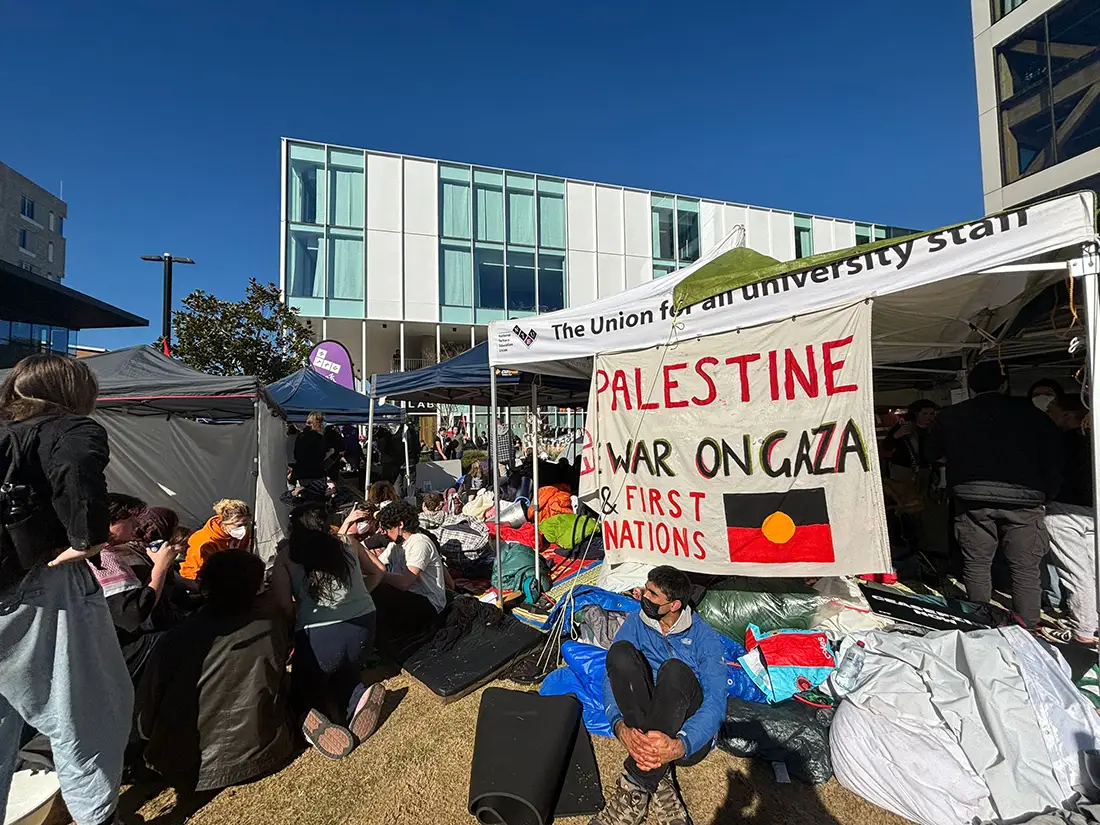
Like most crucial moments in my life, I don’t notice them until after they’ve passed. It was May 8th 2024, and it was the ANUSA AGM (ANU’s Student Union annual general meeting). Normally these meetings are uneventful; to be honest, I hadn’t even heard of the AGMs until May 2024, despite being surrounded by union involved people for years. But this meeting was different, it mattered. Not just to me but to all of us. For a week leading up to the meeting, a group of us had been preparing to defend the Encampment’s rights to exist. I don’t think any of us could’ve ever predicted the events that unfolded that night. I don’t remember everything from that day, but I do remember key moments. I remember working the 12-4 shift at my workplace because one of my colleagues wanted extra time to prep before the meeting, and in typical me fashion, I forgot that I too might need this time to also prepare.
Before the encampment, I had long felt out of place at the university; reluctant to share my Judaism or even to talk about it openly. However, being a part of the Encampment and specifically becoming close with the Palestinian students and staff changed that. I felt accepted and realised the narrative that I was fed my entire life was false. I also realised that while my own discomfort was real, it was incomparable to the struggles of the Palestinians themselves.
Unconsciously, the night of the AGM forged something central to who I am and to the kind of activist I want to be. I hate public speaking but I knew that it was important for me to speak up. Even though I didn’t go to Jewish day school, I grew up immersed in the Jewish community in Naarm (Melbourne). I had a Bat Mitzvah, I went to shul (occasionally), I celebrated Passover, Hanukkah, Rosh Hashanah, and Yom Kippur. I even went to a Jewish kindergarten. I believe every Jewish encampment member’s identity was valid, contrary to rhetoric of the Australasian Union of Jewish Students (AUJS).
I don’t remember much from the AGM beyond my speech and listening to others. But one vivid memory I have is holding a close Jewish friend’s hand right before AUJS’s motion, knowing
they would soon conflate anti-Zionism with Antisemitism. I remember reacting to the comments but not actually processing them. Even though the remarks weren’t directed at me, they cut deep because I had openly claimed both my Judaism and my anti-Zionism in the same room. Despite all my efforts to explain that not all Jews agree, and that AUJS doesn’t represent all Jews, we the Jews of the Encampment were dismissed as ‘fringe Jews’.
That label stuck with me more than I realised at the time. It was meant to delegitimise us as outsiders to the Jewish community but for me it rang true in another way. It was intended to show that maybe there are some Jews who support the Encampment, but they are not a part of the Jewish community. Thus, their opinions and thoughts should not be taken seriously as those who oppose the Encampment or those who are pro-Israel. After taking time to process this comment and speaking with my Jewish friends I began reclaiming the label, at one point even adding ‘fringe Jew’ to my Instagram bio, out of defiance. In every sector of my life, I felt fringe. Growing up, I always felt like an outsider as the only Jew at school and yet never fully at ease in Jewish spaces either. But then being in Jewish spaces, Shul, Shabbat dinners, Seder, and Bat Mitzvah classes, I always felt lesser than and uneducated. Compared to my brother, I always felt less knowledgeable, less immersed. Even now, despite learning more and reconnecting, I often feel like I exist at the margins.
So when AUJS called us ‘fringe Jews,’ I initially took it as a confirmation of something I always felt, even though it was meant as an insult. I decided not to let the term define me, but to own it: my Jewishness is part of me, but not all of me, and it fuels, rather than weakens, my activism. So, looking back, and if anyone from AUJS at ANU (specifically the person who said it) is reading this, I want to thank you for calling me a ‘fringe Jew’. I suppose you never thought that calling me a ‘fringe Jew’ would radicalise me like it did and led to me becoming even more committed and staunch in my activism.
demos journal acknowledges the Ngambri and Ngunnawal people on whose lands this journal is made and imagined. Sovereignty of these lands was never ceded. Always Was Always Will Be Aboriginal Land.
Web Design by Rio Ramintas
Build by Charlotte McLachlan
demos journal © 2026. All Rights Reserved.


