
Genocide in Gaza is the moral and political issue of our day, from which the leaders of many governments and other institutions around the world have abdicated moral and political responsibility. This is due to vested interests and because of a political strategy to erase all red lines before the Israeli state crosses them, by turning critics of its violence, regardless of who or where they are, into enemies.
University staff and students have been among the principal targets of this strategy. Nevertheless, many students in Australia and abroad last year took the bold step of occupying their campuses to demand of their governments and of their universities’ management that they cease being complicit in genocide, and instead do everything that they can to stop it.
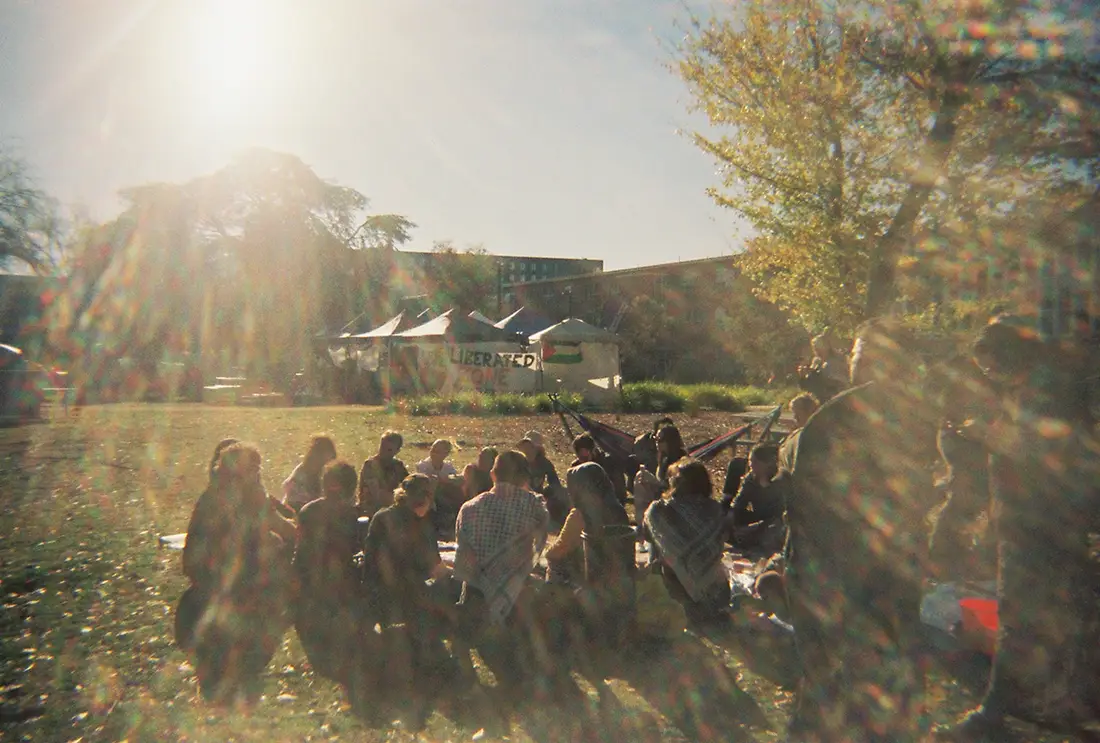
By the end of April, students at the Australian National University had joined in, demanding, in particular, that the University divest from weapons manufacturers complicit in Israel’s illegal occupation and genocide in Palestine. When they pitched their tents on the Kambri lawn, in the centre of the campus, they might have guessed that they would be there for a while. They might have expected to be accused of breaching university rules. But they did not know that theirs would be the longest-running Gaza Solidarity Encampment in Australia. Nor did they know that ours would be the only university in the country whose management would call police onto campus to threaten them with arrest.
How did things get to that? This is a question that we have more than once asked ourselves. There were other options. We know there were, because we offered them. On request of the Encampment, in May a group of academics, including ourselves, formed a team that for over three months urged the Vice-Chancellor and others in the University Executive to meet with camp participants. We put ourselves forward
as mediators.
We did not succeed at what we set out to do. University managers and executives throughout remained insensitive to the Encampment’s requests to talk. They appeared to be perplexed by its members’ insistence that because the Encampment was not organised hierarchically it had no leaders to send
as representatives. They seemed, moreover, unable to grasp why mediators were needed.
Yet, our efforts were not in vain. We learned many practical lessons. We documented how the corporatised university surveils its students and staff, polices dissenters, and refuses dialogue. We caught sight of an administration that, while expressing support for intellectual freedom and political engagement, was active against both. And we met colleagues who privately commended the Encampment but who would not speak out lest they attract criticism and jeopardise their ongoing employment in our increasingly precarious workforce.
All this was instructive. But the best lessons we learned were from the camp participants themselves. These lessons were the best because they were the lessons that nurtured hope among us
for our universities, for democracy, and for humanity.
Whereas Chancellery on paper and online calls itself ‘the University,’ we learned that participants in the university’s Gaza Solidarity Encampment epitomised the university as a forum for participatory democracy, deliberation and critique; a site in which not only to express ideals but to test them. From the Encampment’s verge, we glimpsed a wellspring of knowledge about the history and conduct of political struggle. There we felt, in participants’ concern for one another, an understanding of civic virtue. And there we heard thoughtful, respectful debate among equals.
To be sure, the Encampment brought with it some disagreements – any fight worth fighting politically, any moral burden worth bearing together, has its share of these. From where we stood, none of the things that divided its members were those that defined it. What defined it was the common humanity, shared sense of political purpose and commitment to participatory democracy.
Thoughtful, astute and emotionally engaged students can be intimidating. Might this be the reason that nobody from on high dared to meet the Encampment where it sat upon the grass? Did they worry that they were not prepared for the moment? That they would not be up to the task? Were they anxious that, just like us, they might glimpse the values of the university alive there, and not inside the deadened panel walls of Chancellery? Did this confuse them? Fill them with dread? Were they afraid of what they would learn about themselves?
We don’t know if these are the right questions to ask, let alone what the answers might be. In the end, the questions are speculative, and the answers don’t much matter. The fact is that nobody came. It remains for they who could have come but did not, despite being repeatedly invited, to ask themselves why not. Why call the cops on our students rather than talk to them? What was gained from that? What was lost?
Speaking for ourselves, we are glad that we took the opportunity to see, hear and learn from the Encampment. We are grateful to our students, and the few staff among them, for the moral courage and political awareness that they showed when history called. By taking a principled stance, they demonstrated the enduring need to assemble and speak out against injustice; to put bodies on the line when something big is at stake. By giving ear to history’s call, the encamped students embodied an imperative that has since brought hundreds of thousands to the Sydney Harbour Bridge, to city streets and town parks around Australia, and to the world.
It is not only we happy few in the mediation team who learned lessons from the Encampment, then. Its lessons, and those of its counterparts, have been heeded by multitudes. We are among them. We are proud of our students that they were the vanguard. For this, we applaud them. In solidarity with them,
we call out:
Stop the genocide now!
Free Palestine!
demos journal acknowledges the Ngambri and Ngunnawal people on whose lands this journal is made and imagined. Sovereignty of these lands was never ceded. Always Was Always Will Be Aboriginal Land.
Web Design by Rio Ramintas
Build by Charlotte McLachlan
demos journal © 2026. All Rights Reserved.


