
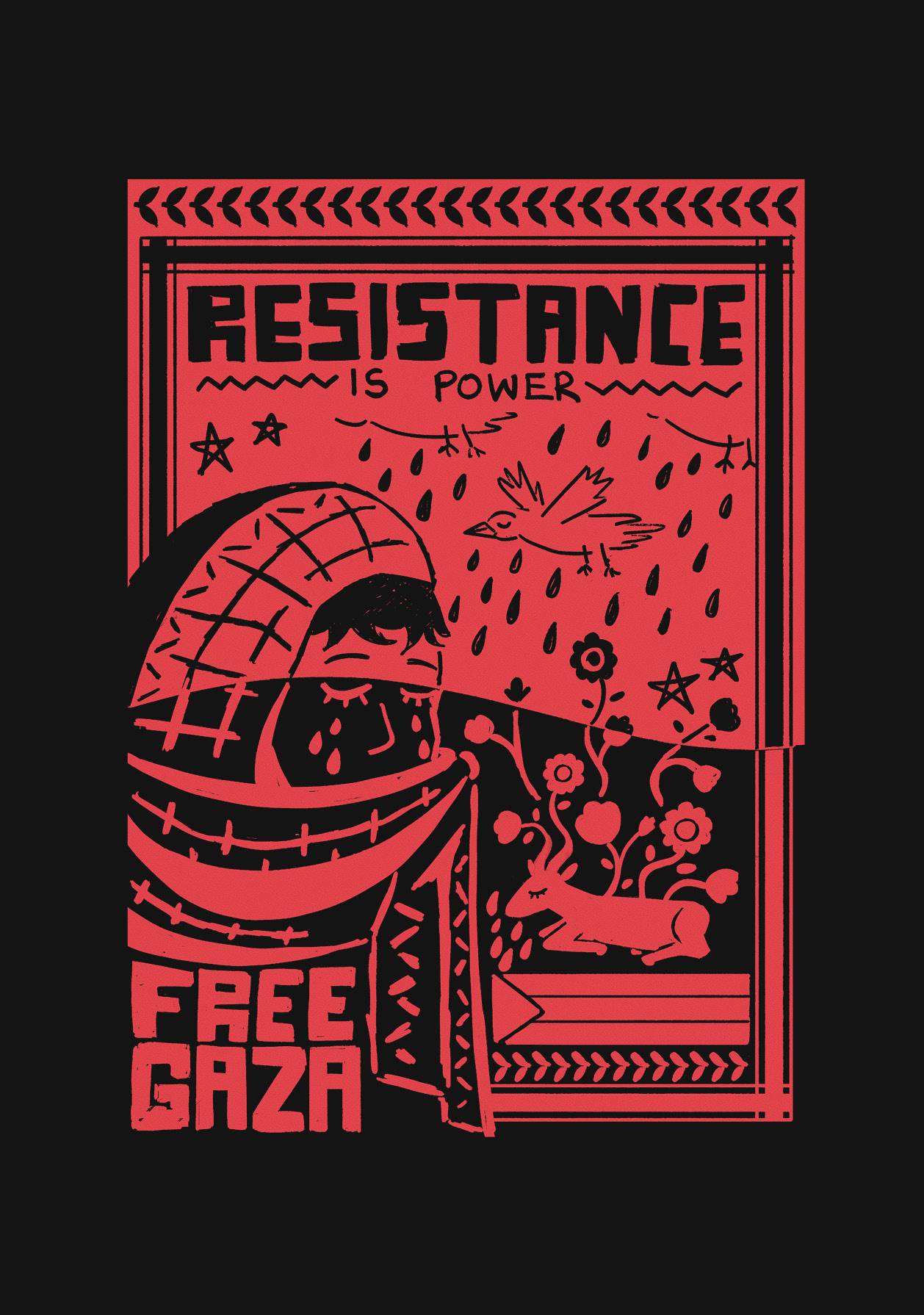
The following is an interview conducted in October 2025 with a Senior Academic at ANU, and their reflections on the ANU Gaza Solidarity Encampment.
Battikh: I want to first get your thoughts about bthe Encampment, and why was it important?
Senior Academic: Thank you for the interview. I think it’s important to maintain some sort of historical record from different perspectives. In December of 2023 we became fully aware that committing genocide was the intention as it was clearly stated by Israeli politicians in many languages, English, Arabic and Hebrew, that the intention of the war was to wipe out the Palestinian people in both Gaza and the West Bank. Of course, we were all shocked and were hoping at the time that the world-wide community would stop this clearly intended course of events.
However, by April of 2024 it became apparent that the West was not going to stop the genocide and not only were they not going to stop the genocide but the West was intending to help in the commission of the genocide. It was around April 2024 that the Columbia University students rose against the genocide, this was a consequence of students seeing what was happening on the ground in Gaza, but also that students became aware that Western governments, in particular the Biden Administration at the time, was aiding and encouraging the commission of genocide. The Australian Government was turning a blind eye and insisting that Israel has a right to ‘defend itself’ while it was attempting to ethnically cleanse Gaza.
When the students rose up you started seeing events that we have not seen in many decades. I was initially surprised that the students took up the call for the sake of peace. They did as much as they can do to influence the government at the National University and other universities in Australia to attempt to mitigate, at the very least, their own involvement in the Gaza genocide.
B: So why was it important that the encampment took place at the Australian National University?
SA: It was important that it took place at every university, including of course at the Australian National University. It has always been the role of students to stand up to authority. Had the students not stood up it would have meant that universities had failed in the task they had been given to educate young adults in standing up to authority and that authority may well be the current government. It was absolutely incumbent on students to stand up.
Every year Australia commemorates the ANZACs and Gaza is always centrally featured in the ANZACs, in fact, there’s poetry about it. So it’s not like it’s some distant place. It is a place that Australia occupied, they entered with colonial powers. Australia initiated the colonial enterprise in Gaza and in Palestine.
B: The University management thought that the students were just being antisemetic, and that the whole Encampment was antisemetic, and treated them as people who were doing something illegal and unethical. So what was your observation as a staff member to this interaction? Because we saw that the University called the police and turn the security staff on its students.
SA: I was not aware of how awful the actions were that occurred to the Encampment. I was not aware of who was at the Encampant but it was certainly my understanding that there were some pressures from lobby groups who described any display of Palestinian identity as anti-israel. I was aware that there was a massive pro genocide push.
That was the narrative, and anyone who did not support that narrative was viewed as a criminal. As for internally within the University, I was not aware that there were at the time Arabic, Muslim and Palestinian students. My initial impression was that the Encampment was entirely Left-wing white students. To my surprise there was a small core of Muslim and Palestinian students, this surprised me as by being at the Encampment this group took a huge risk involving themselves.
At one point during the Encampment one of the very senior Deputy Vice Chancellors contacted a couple of us, I don’t know how or why she thought we would be interested in providing informal support to the students at the Encampment. I decided that as long as it wasn’t too public I would help where I could because I was worried about the wellbeing of the students, in particular the Palestinian students as they are facing the trauma of their families murder in Gaza. I went to a meeting with students and staff sometime in August. At that meeting, it became quite apparent that the University had not provided any support to victims of the genocide and to families of victims of the genocide. The university had not made any effort to provide any support and in fact, the University saw it as a security issue.
Of course I saw the devastation of people who had lost 20 members of their family. People who had been told not to wear their traditional Palestinian garments. People who had been told not to worry about a place so far away.
B: From our understanding the Vice Chancellor and senior management never met with Palestinian students and staff on campus. Can you tell us more about that and why you think that happened?
SA: I think that the University reverted to Western colonial perspective, whereby brown people do not have a say in any resistance movement and that brown people should be quiet and sit at the sidelines. It was purely and simply, I don’t think there was a political agenda here, it was purely and simply a reversion to how colonialism works and how apartheid works, you’re not allowed to protest, you’re not allowed to show your face or be visible. You must work from the background and your presence is a security threat.
B: Can I please ask you to reflect on the significance of the ANU Encampment for you as a person, but also for the wider community.
SA: I found it quite devastating frankly as I was placed in a position where I was initially asked to provide support, I went to provide support, and I saw people that are hugely damaged from neglect. I thought this was just a fact-finding mission, but there was a huge amount of neglect and a huge need for support, so it was quite devastating.
My perception at the time was that the University seems to have felt compelled to be part of the local suppression of anyone associated with Gaza and to participate in their own way, in the genocide by suppressing their own Palestinian students. Israelis are killing the children but we make life hard for the Palestinian students and staff, which I see as just a show of solidarity for the killing of the children in Gaza.
However in its own way the Encampment was successful as it brought daily attention of the genocide to the University population and people could not ignore it in their classes and existence on the University campus. The greatest victory that arose from the Encampment, was forcing the government to recognise once and for all, a Palestinian state, they were dragged by their noses into the United Nations and had to stand up and recognise the Palestinian state. I believe that is the greatest achievement of these Encampments across Universities. They recognised the Palestinian state once and for all. A huge achievement, because suddenly, that’s a Palestinian flag that’s recognised by Australia and this is the greatest defeat of colonialism.
My final comment is that I saw a devastated students and staff and it made me feel that a little bit of Gaza was imported into ANU, and I saw a little bit of apartheid imported into ANU through the methods used against the Encampment. Once I saw that, it became apparent to me, and it was a revelation to me, how systemic the structures of colonialism are, it’s a global phenomena.
demos journal acknowledges the Ngambri and Ngunnawal people on whose lands this journal is made and imagined. Sovereignty of these lands was never ceded. Always Was Always Will Be Aboriginal Land.
Web Design by Rio Ramintas
Build by Charlotte McLachlan
demos journal © 2026. All Rights Reserved.


