
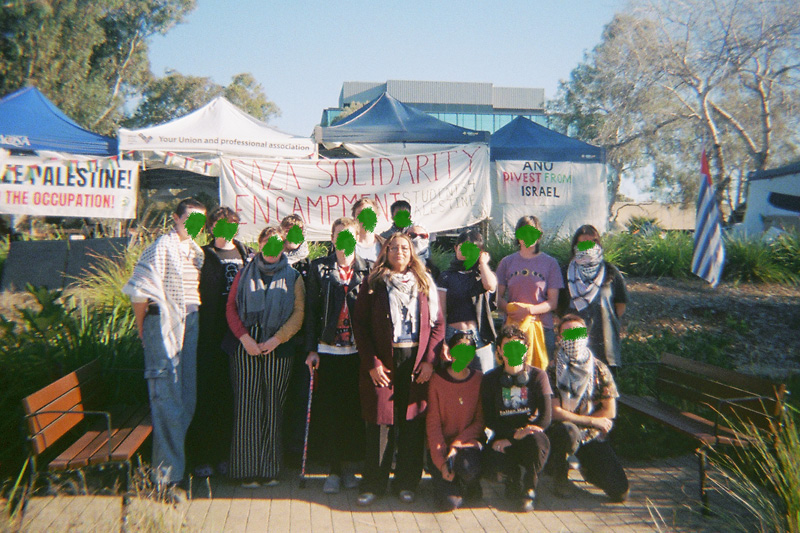
On the 29th of April 2024, a series of color-clashing, rag-tag and misfitted tents popped up on ANU’s Kambri Green; a small field of grass located in the university’s central hub. I was among them. There was no permit secured and no long-term plan. On the first day we had no idea how long we would be there; our only aim was to stay as long as possible and compel the university to fulfil our demands (Gore & Lusted, 2024): cessation of university links to Israel, and divestment from the assortment of weapons companies ANU had a stake in. The composition of the camp ranged from unionists, socialist organisations, the student union ANUSA, and several unaffiliated individuals with a stake in halting the Palestinian genocide. Managing logistics, communication, and labour-sharing consumed nearly all our energy, as temporary encampment developed into a living system of resistance. A friend at the start asked me: ‘Why do this? Why sit out there, what’s going to change?’. I had no answer but that there were few else willing to bleed.
I mostly settled myself with logistical and occasional media work (to this day, half my Google Drive is meeting minutes) and cordially, ‘hanging around’. The tents were not particularly glorious living spaces, but at least there was no rent. A pantry formed, made up of ‘temporarily borrowed’ milk crates looped together with zip ties; after a particularly rainy night we encased them in plastic trash bags to keep the rain from ruining the food, needless to say, aesthetics was not a prime concern. Strings of Palestinian flags hung between gazebos, fluttering against the wind. Somebody salvaged a hammock that soon became the camp’s most contested luxury. Hand-painted banners were hung, as were various decolonial solidarity flags, draped from gazebo roof-skeletons. Somebody found some mats to lay on the tarps we used as floors, quickly becoming covered in mud-streaks and discoloured globs of paint.
Winter developed quickly. It rained and poured and froze and there was no number of clothes or heat-packs that could stave off the cold. Nighttime was spent poking out small pools of rainwater which formed in the roof of the gazebos, turning the campsite into a mess of mud and torn grass. I went out in the early morning and could feel ice form on my nose, harsh crystals, chapped lips, listening to the eerie silence of a campsite lain with fog. Once I fell asleep in a camp chair and very well may have frozen to death if I hadn’t been fortunate enough to wake up. Amidst the cold, a constant flow of hot-water bottles were stuffed inside shirts and lain inside thermals to try and keep warm. It is difficult to describe the cold, one could ignore it as well as ignoring the sun. If you went out before dawn the entire world was coated in ice crystals and glittered under campus lights, if you went out after dawn, you could watch the dew yield under morning sun.
The community support in this period was significant. A group of Palestinian women dedicated themselves to feeding us every night, an act of unimaginable dedication vital to the Encampment’s long-term survival. Maqluba, fragrant and rich, became a symbol of care amid catastrophe. Dinners from them were superb and could only improve by being unnecessary. When we ate we listened to the progress of Israeli military operations and the total death toll of the day. To this day the conservative number of deaths between 2023 and 2025 numbers 70,000 Palestinians, not including ‘preventable disease, malnutrition and other consequences of the [genocide]’, significant as Israel utilises starvation as a weapon of war (Batrawy, 2024; Haq et al., 2025).
At first, opposition was fierce. An outpouring of support for Israel’s ‘right to defend itself’ and very little for Palestine’s (Haque, 2025). I had a few extended exchanges with Zionists, after calling it a genocide, one argued back that ‘Palestinian was not an ethnicity’, rendered speechless after I asked him to define ‘ethnicity’ and asked him what criteria would include Israelis but not Palestinians. This was a surprise to him, apparently. Similar arguments were deployed in the student union’s Annual General Meeting, which numbered around 700 students as the Zionist and Encampment factions debated the student union’s moral stance (Woroni Editor, 2024). As the genocide went on, increasing numbers of students supported us, with Israel constantly bombing aid workers and civilians (80% of Palestinians killed since 2023 were civilians) they did not do themselves any favours (Action on Armed Violence, 2024). The fact is even a brief acquainting with the conflict’s history should reveal that Israel is a settler-colonial state and has always been one, and one cannot effectively conceptualise it except as modern apartheid. What else can I say about the Encampment? The Encampment became more than protest, it was an experiment in solidarity, a microcosm of what resistance, care, and courage could look like in community.
In the world there will always be people who task themselves not with justice but with leisure, who turn up their nose at history and sneer at the notion of change. There will always be those for whom struggle is not a matter of effort but imagination; there will always be those whose response to blood in the streets is looking to the sky. Following the path of least resistance makes struggle look ridiculous, why take the hard path? It is untrodden, you will face extreme resistance, and at the end of it there is no promise of success or reward. But I am not the first to tread this long path to Palestinian liberation and neither am I alone. I walk a path carved by people who believed too, that justice was a matter of principle, freedom a matter of effort, and goodness our natural condition, so wherever I walk is in footprints, a path lined with dreams of bloodless dawns and silent skies. I do not know when the path will end. I do not know when Palestine will be liberated. But like those olive trees which grow defiantly amidst Gaza’s debris, the promise of light is irresistible, because for dreamers, dawn always awaits.
Free, free Palestine.
Cover image: Greens senator Mehreen Faruqi visiting the Encampment
Action on Armed Violence. (2024, October 28). Civilian casualties in Gaza: Israel’s claims don’t add up – at least 74 % of the dead are civilians. AOAV. https://aoav.org.uk/2024/casualties-in-gaza-israels-claims-of-50-combatant-deaths-dont-add-up-at-least-74-of-the-dead-are-civilians/
Batrawy, A. (2024, May 15). Why U.N. revised the numbers of women and children killed in Gaza. NPR. https://www.npr.org/2024/05/15/1251265727/un-gaza-death-toll-women-children
Gore, C., & Lusted, P. (2024, May 16). Australian National University officially orders seven students to vacate on-campus Gaza solidarity encampment. ABC News. https://www.abc.net.au/news/2024-05-16/act-palestine-anu-gaza-encampment-members-ordered-to-vacate/103858184
Haq, S. N., Wilson, R., Warnes, S., Robinson, L., & Pettersson, H. (2025, October 2). How Israeli actions caused famine in Gaza, visualized. CNN. https://edition.cnn.com/2025/10/02/middleeast/gaza-famine-causes-vis-intl
Haque, A. (2025, June 9). Can Israel still claim self-defence to justify its Gaza war? The Conversation. https://theconversation.com/can-israel-still-claim-self-defence-to-justify-its-gaza-war-257822
Woroni Editor. (2024, May 13). Two weeks of Kambri’s encampment. Woroni. https://www.woroni.com.au/news/two-weeks-of-kambris-encampment/
demos journal acknowledges the Ngambri and Ngunnawal people on whose lands this journal is made and imagined. Sovereignty of these lands was never ceded. Always Was Always Will Be Aboriginal Land.
Web Design by Rio Ramintas
Build by Charlotte McLachlan
demos journal © 2026. All Rights Reserved.


