

Sarah is an active member of the Palestinian community in Canberra. She has supported and helped students at the encampment enormously. This reflection is composed of excerpts of an interview where she reflects on the ANU Gaza Solidarity Encampment.
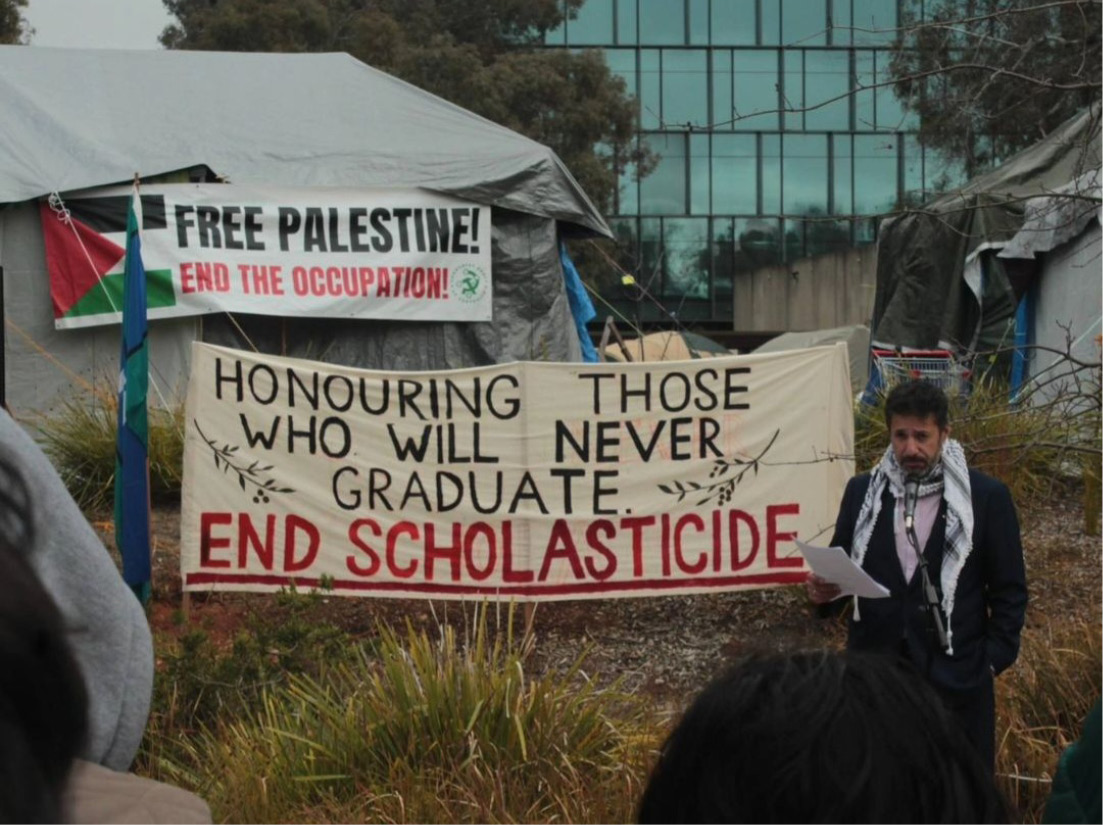
The ANU Gaza Solidarity Encampment, for me, was hope. It was seeing all of those students risking everything, risking their studies, their future, sleeping in tents in Canberra’s freezing cold winter, for us Palestinian in Canberra, it meant a lot.
It was a tough year for all of us, Palestinians. And just seeing those kids gave me hope. As a Palestinian community we felt isolated, we were often attacked and demonised. But those students at the Encampment truly cared and embraced us. They fought for us. They appreciated our food and wanted to learn more about our culture and history, they looked up to us and wanted to be guided by us in the movement. The students at the encampment actually changed the dynamics of the whole community, the community came together through that Encampment. In the Palestinian community in Canberra, we needed that space, we needed the space to grieve together, to meet regularly and support each other, and the Encampment provided us with that space.
I remember very clearly, I think it was on the 16th of April, it was minus 2 or 3 degrees in Canberra, and I remember... I sent one of my closest friends a message thinking how will these guys sleep in such cold weather? I think most of the mum’s in the Palestinian community were just really worried about those kids. So we gathered ourselves and we went to get blankets, water bottles and whatever will warm the students. I remember, one particular, very cold Canberra morning, when I woke up, it was freezing cold and dry and there was frost everywhere. So before work, I just went straight to the Encampment to check on the students. They were just covered with those blankets and I vividly remember how much I cried and thinking how did they do that? I remember texting everybody in Palestine in the West Bank, my friends and family in Palestine, that there are people who care, who are sleeping in tents at night in Canberra because they care about us, just for Palestine, it was
so touching.
The least our community could have done for the Encampment was to cook for the students and staff. It is our way to show gratitude as a Palestinian community, we wanted to support them and to show them how grateful we were. So we created a roster on a WhatsApp group encouraging all of the women in the community to participate in cooking for everyone in the Encampment. I think a lot of the women in the community were feeling helpless in the face of the genocide. The Encampment empowered all of us to do something, to give back. It was really important for the community. It was so empowering for us to cook Palestinian food and be proud of our culture. This felt like the only thing we can do in an impossible time of grief. It was absolutely amazing cooking together and watching staff and students enjoy our food. We also had a kind of informal competition! Who can cook each dish better? And who’s going to get a lot of compliments from the students? I think we all loved it. The best part was when the students came back with compliments, saying, ‘thank you’, ‘that was so good’. These moments empowered the whole community, which was really great. In Palestinian culture, this is how we love. We cook. We feed and we come together for a big meal around the table. We wanted to show the Encampment community who Palestinian people are and more about our culture, and it was such a wonderful opportunity.
I also felt a strong sense of community during the big gatherings at the Encampment, especially events like the rallies, but also when we had big Maqlooba cooking events at Kambri. These moments brought together supporters, students, and passers-by, and for us Palestinians, it was healing. Sharing our food and culture, seeing women compete over their best dishes, and simply being together was absolutely amazing. Even those who hadn’t participated before wanted to join in, and the music and dancing made it a truly healing experience for everyone involved.
When the police and security came to remove the Encampment, on Reconciliation day, I was deeply affected. I remember crying and quickly reaching out to the community for support. Despite the racism and hostility we faced, the Encampment became our symbol of strength. The way everyone came together to defend and protect it showed the power and unity of our community, and it was one of the most moving experiences I’ve ever had.
I learned so much from the students at the Encampment. Their willingness to risk everything for people they didn’t know, who maybe didn’t share their background or beliefs, was inspiring. It taught me about the true meaning of humanity and solidarity. Now, I feel compelled to support other causes, something I wouldn’t have done before witnessing their selflessness and courage.
I also believe that the encampment changed the dynamics of our weekly rallies in Canberra. It empowered both the students and the wider community to participate more actively, and it created new connections and energy within the movement. People who had previously felt helpless before the Encampment started to find a way to contribute, and the engagement on social media and at rallies increased dramatically. I truly felt we were making history together.
I have a deep sense of gratitude for the students and the time we spent at the Encampment. While it was sad when the camp closed, I wasn’t disappointed, mostly I wanted the students to rest, we did not expect them to last that long. The relationships we built and the experiences we shared left a lasting impact on me, and I miss those days and the energy they brought to our lives.
demos journal acknowledges the Ngambri and Ngunnawal people on whose lands this journal is made and imagined. Sovereignty of these lands was never ceded. Always Was Always Will Be Aboriginal Land.
Web Design by Rio Ramintas
Build by Charlotte McLachlan
demos journal © 2026. All Rights Reserved.


